

Introduction
Labor costs now account for up to 70% of total business expenses — and with salaries at their highest in over two decades, small and mid-sized businesses can't afford to staff the way they used to. For many, remote work was initially an emergency response — something adopted out of necessity during the pandemic. But the data tells a different story now.
Remote work's most measurable impact shows up on the employer's side of the ledger: in cost structures, workforce output, and the ability to scale without being tied to physical space. This isn't a workplace perk story. It's an operational strategy story.
This article breaks down 10 specific, employer-focused benefits of remote work — from hard cost savings and expanded talent access to stronger retention and productivity gains — grounded in research findings and practical business outcomes.
Key Takeaways
- US employers save an average of $11,000 per year for each half-time remote worker, per Global Workplace Analytics
- Stanford research found a 13% productivity gain among remote workers in a controlled experiment
- Hybrid work reduces employee quit rates by one-third without harming performance, per a 2024 Nature study
- 87% of workers choose flexible arrangements when offered — businesses without it face a shrinking talent pipeline
- For SMBs, offshore remote staffing can reduce labor costs by up to 60–70% compared to equivalent domestic hires
What Remote Work Really Means for Employers
Remote work, from a business operations standpoint, is a staffing model where employees perform their work outside a centralized office — either domestically or across borders — using digital tools and communication platforms.
It applies broadly: administrative functions, customer service, marketing, IT, finance, legal support, healthcare scheduling, and more. The misconception is that it only works for tech companies or large enterprises. In practice, any role where output can be measured independently of physical presence is a candidate for remote execution.
Remote work is a business strategy — not just a perk. When structured deliberately, it gives employers direct control over three things that drive growth: labor costs, talent access, and workforce scalability.
The Core Benefits: Where Remote Work Drives the Most Business Value
Benefit 1: Significant Cost Savings on Labor and Overhead
The most direct financial impact of remote work is cost reduction. Running a physical office means absorbing commercial rent, utilities, equipment, supplies, and facilities management — a significant share of any operating budget, particularly for SMBs where every fixed cost competes with growth investment.
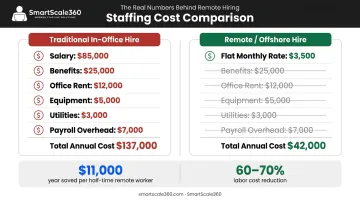
According to Global Workplace Analytics, a typical US employer can save $11,000 per year for each employee who telecommutes half-time. Savings come from multiple sources: productivity gains, reduced real estate costs, lower absenteeism, and decreased turnover.
The numbers compound further when businesses hire offshore or out-of-market remote staff. SmartScale360, which connects SMBs with college-educated, English-speaking offshore professionals, reports that clients typically see up to 60–70% reduction in labor costs compared to equivalent domestic in-house hires — with benefits, office space, equipment, and payroll overhead eliminated entirely under a flat monthly rate.
KPIs this impacts:
- Labor cost as a percentage of revenue
- Total operating expenses
- Monthly overhead spend
- Cost per hire
This advantage matters most for growing businesses where labor represents the majority of operating costs and where reducing overhead is the fastest path to improved profitability — without cutting revenue-generating functions or reducing team morale.
Benefit 2: Higher Employee Productivity
Remote work's productivity benefits were once debated. At this point, the research has largely settled the question.
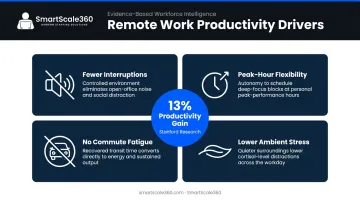
A landmark Stanford study conducted a 9-month randomized experiment at Ctrip and found a 13% performance increase among home workers: 9 percentage points came from more minutes worked per shift due to fewer breaks and sick days, and 4 points from more calls completed per minute. When the program was rolled out company-wide, productivity gains nearly doubled to 22%.
A separate HBS/USPTO study found that full work-from-anywhere policies produced a 4.4% increase in output with no increase in rework errors.
Several conditions drive these gains:
- Fewer workplace interruptions — open offices are productivity drains that remote workers avoid entirely
- Peak-hour flexibility — employees can schedule deep work during their most productive hours
- Reduced commute fatigue — eliminating a 45-minute commute in each direction has real cognitive value
- Lower ambient stress — remote workers consistently report lower chronic stress levels
KPIs this impacts: Output per employee, task completion rates, project delivery times, billable hours
The gains are most pronounced in roles involving focused, independent work — administrative support, data analysis, research, customer service, and scheduling — where office-floor noise and interruptions create the most drag.
Benefit 3: Access to a Wider, Global Talent Pool
Office-based hiring is geographically constrained. The best available candidate is whoever lives within commuting distance or is willing to relocate — a small fraction of the actual talent market.
Remote work removes that constraint entirely. McKinsey's 2022 American Opportunity Survey found that 87% of workers took flexible work arrangements when offered. Gallup data shows fewer than 10% of remote-capable employees prefer fully on-site work. Employers who can't offer flexibility are competing for a shrinking pool of candidates.
For SMBs, the global talent dimension opens a meaningful strategic advantage. SmartScale360 exists specifically to solve this problem — giving small businesses access to the same offshore talent markets large corporations have used for years, without the complexity of independent international recruiting. Their candidates are college-educated, pre-screened for English proficiency, and matched to specific role requirements before a client makes any hiring decision.
KPIs this impacts: Time-to-fill, candidate quality scores, diversity metrics, cost per hire
This matters most for businesses in smaller geographic markets, industries with competitive local hiring, and companies that need to scale quickly without proportional increases in labor cost.
Benefit 4: Lower Employee Turnover and Stronger Retention
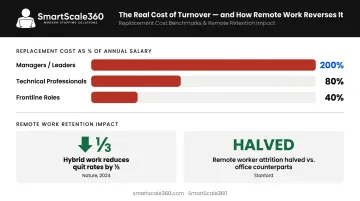
Turnover is one of the most expensive and least discussed operational costs in business. Gallup estimates replacement costs at around 200% of salary for managers and leaders, 80% for technical professionals, and 40% for frontline roles — and notes that 42% of employee turnover is preventable.
Remote work is one of the most effective retention levers available. A 2024 randomized control trial published in Nature found that hybrid work arrangements reduced quit rates by one-third without harming performance or promotion rates. The Stanford/Ctrip experiment found remote worker attrition was halved compared to office counterparts.
Remote work reduces the daily friction — commuting, rigid schedules, limited personal flexibility — that quietly erodes job satisfaction over time. It also allows businesses to retain employees who relocate, take on caregiving responsibilities, or experience life changes that would otherwise force them to leave.
KPIs this impacts: Annual turnover rate, cost-per-replacement, employee satisfaction scores, average employee tenure
For roles that are costly and slow to backfill — experienced customer service staff, operations coordinators, scheduling specialists — improved retention has direct, measurable financial value.
Six More Benefits That Strengthen the Business Case
Beyond the four core benefits, remote work delivers real operational and strategic advantages — ones that matter most to businesses managing lean teams and tight budgets.
Benefits 5 & 6: Fewer Absences and a Healthier Workforce
Remote employees tend to take fewer unplanned sick days — not because they're inherently healthier, but because the barrier to "showing up" is lower. Switching on a laptop at home is manageable with a mild illness; commuting into an office is not.
The Stanford/Ctrip research found that fewer breaks and sick days accounted for a meaningful share of the 13% productivity gain among home workers. A 2025 scoping review published in PMC found that most telework research indicates flexibility contributes to reduced absenteeism, primarily through schedule adaptability.
Eliminating the daily commute also removes one of the most underestimated chronic stressors in the modern workforce. The downstream effects are real:
- Improved sleep quality without early-morning transit demands
- Reduced physical and mental fatigue across the workweek
- More consistent presence and engagement from staff day-to-day
Benefits 7 & 8: A Scalable Workforce and Greater Business Continuity
Physical office capacity is a hard ceiling on growth. Every new hire requires a desk, equipment, and space, creating lag between business demand and team expansion.
Remote work removes that ceiling. Businesses can add or reduce headcount without renegotiating leases or purchasing furniture. SmartScale360's model makes this concrete: clients can scale staffing up or down month-to-month, with no setup fees and no contracts, adjusting packages as business needs shift. A homecare client who started with one scheduling coordinator brought three on board after a single round of candidate interviews — rapid team expansion with no overhead reconfiguration required.
That same flexibility creates a second advantage: continuity when disruptions hit. Organizations with existing remote infrastructure are significantly more resilient when disruptions hit. A 2021 analysis of 50 major companies found that remote working and digital connectivity were central to COVID-19 business continuity planning — with companies like Amazon implementing over 150 process updates to maintain remote operations. Businesses already operating in a distributed model kept running. Those without remote infrastructure scrambled to catch up.
Benefits 9 & 10: Sustainability Gains and Extended Business Coverage
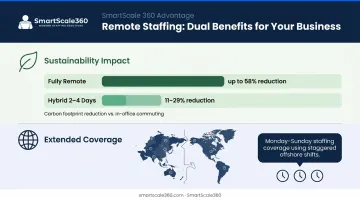
On sustainability: Research published in PNAS found that fully remote work can reduce an employee's work-related carbon footprint by up to 58%, while hybrid arrangements of 2–4 remote days per week yield 11–29% reductions. For businesses with sustainability commitments or clients who care about environmental impact, this is a measurable, reportable advantage.
On extended coverage: Distributed teams working across time zones — or offshore staff operating outside standard US business hours — allow businesses to extend operational coverage without the cost of traditional shift scheduling. SmartScale360's offshore staff work fully customized schedules: evenings, weekends, overnights, or staggered shifts as needed. A homecare franchise client runs staffing coordinator coverage Monday through Sunday using three offshore staff members on overlapping shifts — a 24/7 operational model that would be cost-prohibitive with domestic hires alone.
What Happens When Businesses Overlook Remote Work Strategies
Businesses that resist flexible staffing models increasingly face disadvantages in three specific areas:
- Talent pipeline: Gallup data shows fewer than 10% of remote-capable employees prefer fully on-site work. Non-remote employers are eliminated early in the job search, competing harder for a smaller local candidate set.
- Cost structure: Without remote options, businesses keep absorbing fixed overhead — rent, equipment, utilities — that remote-first competitors have already cut or eliminated, building a structural cost gap that widens as time goes on.
- Scalability: Businesses tethered to physical office capacity face harder limits on growth, slower hiring cycles, and greater exposure to operational disruption when flexibility isn't built into the model.
These gaps show up directly in recruiting metrics, operating margins, and how quickly a business can act on opportunity.
How to Get the Most Value from Remote Work
Businesses seeing the strongest ROI from remote work treat it as a deliberate operational strategy — not an ad hoc accommodation. That means defining which roles are suited to remote execution, setting output-based performance expectations, and using the right tools to maintain communication and accountability.
The model works best when applied consistently and reviewed regularly. Periodically assess whether your remote staff structure is delivering expected cost, performance, and retention outcomes — and adjust hiring, onboarding, or management practices accordingly.
For SMBs and entrepreneurs looking to scale remote staffing without the complexity of independent international recruiting, SmartScale360 offers a structured path to offshore staffing. Key advantages include:
- No setup fee and no long-term contract
- Three-step onboarding: consultation, candidate matching, and ongoing support
- Dedicated offshore professionals integrated into your workflow quickly
Frequently Asked Questions
What are the benefits of remote work for employers?
The primary employer-side benefits are reduced overhead costs, higher employee productivity, access to a broader talent pool, and improved retention. Each of these compounds over time when remote roles are paired with clear output expectations.
How much can businesses save by switching to remote or offshore staffing?
Global Workplace Analytics estimates US employers save approximately $11,000 per year per half-time telecommuter across real estate, productivity, and turnover-related costs. Offshore staffing compounds this further — businesses partnering with SmartScale360 typically see up to 60–70% reduction in labor costs compared to equivalent domestic in-house hires, with benefits and overhead eliminated entirely.
Does remote work actually improve employee productivity?
Yes. The Stanford/Ctrip randomized experiment found a 13% productivity increase among home workers, and the HBS/USPTO work-from-anywhere study found a 4.4% output gain. Both findings point to the same causes: fewer interruptions, reduced commute fatigue, and working during peak personal productivity hours.
How does remote work help with hiring and retaining top talent?
Remote work expands the candidate pool beyond geographic limits and makes job offers more competitive — critical in markets where most qualified candidates expect flexibility. On retention, the 2024 Nature trial found hybrid arrangements reduced quit rates by one-third, and Gallup data shows 42% of employee turnover is preventable, much of it tied to workplace friction that remote work eliminates.
What types of businesses benefit most from remote work arrangements?
Businesses with knowledge-based, administrative, or digitally-deliverable roles benefit most — including professional services, homecare administration, real estate, marketing, financial services, law, and IT. Any role where output quality can be measured independently of physical presence is a strong candidate for remote execution.
How can small businesses start building a remote or offshore team?
Start by identifying roles where output is measurable and physical presence isn't required. Then work with an established offshore staffing partner — SmartScale360 offers a free consultation, pre-screened candidates matched to your specific role requirements, and a no-contract model that lets you scale up or down without risk.