

Introduction
Most physicians graduate medical school with years of clinical training and zero hours of marketing instruction. That gap shows. Many practices deliver excellent care but remain nearly invisible to patients actively searching for providers online.
The numbers tell the story: according to Tebra's 2023 Patient Perspectives report, 77% of patients look for doctors online often or sometimes. If your practice isn't showing up where those searches happen, you're losing patients to competitors who are.
This guide covers the full spectrum of healthcare marketing—building a digital foundation, earning and managing patient reviews, creating content that builds trust, community outreach tactics, and staying HIPAA-compliant while doing all of it. Whether you're running a solo family practice or a multi-physician specialty group, you'll find strategies here that fit your bandwidth and budget.
Key Takeaways
- Healthcare marketing combines digital and offline strategies to attract, engage, and retain patients
- Your website, Google Business Profile, and online reviews are non-negotiable starting points
- Content marketing and social media build trust before a patient ever books an appointment
- Every patient-facing marketing activity must account for HIPAA requirements
- Consistent execution, not just a solid plan, separates growing practices from stagnant ones
What Healthcare Marketing Actually Means
Healthcare marketing spans far more than paid advertising. It encompasses public relations, community involvement, market research, patient communication, content creation, and reputation management—with advertising as just one component of a much larger system.
Physicians who understand this tend to approach growth strategically, building systems rather than reacting to slow months.
The 7 P's of Medical Practice Marketing
A useful framework for building a complete marketing plan is the healthcare marketing mix:
| P | What It Covers |
|---|---|
| Product | Your services, specialties, and clinical expertise |
| Price | Fee transparency, insurance acceptance, and perceived value |
| Place | Physical location, parking, telehealth access |
| Promotion | How you communicate and reach prospective patients |
| People | Front-desk demeanor, provider bedside manner, staff culture |
| Process | Appointment booking ease, wait times, follow-up systems |
| Physical Evidence | Office environment, website design, online presence |
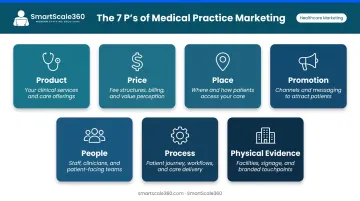
Each P affects patient acquisition and retention. A practice can run excellent ad campaigns (Promotion) but lose patients at the front desk (People) or through a clunky booking experience (Process).
Marketing also works best as a continuous investment rather than a reactive campaign. Practices that stay consistently visible—through monthly newsletters, seasonal health content, or community events—tend to retain patients and attract referrals year-round, rather than scrambling when volume dips.
Building Your Digital Foundation
Your Website: The First Impression You Control
A professional, mobile-optimized website is the single most important marketing asset a practice owns. It's where potential patients form their first impression—often before they've read a single review or called your office.
A high-performing healthcare website must include:
- Clear service descriptions explaining what conditions you treat and who you serve
- Provider bios that establish credentials and give patients a sense of who they'll meet
- Easy online appointment booking — not just a phone number
- Contact details and hours visible without scrolling
- Fast load times—Google research shows bounce probability rises 32% when mobile load time goes from 1 to 3 seconds and 123% from 1 to 10 seconds
Speed and clarity aren't optional — they're the baseline patients now expect before they ever call.
Local SEO and Your Google Business Profile
Local SEO makes your website discoverable by optimizing page titles, meta descriptions, and on-page content with location-specific keywords — so when someone searches "family doctor near me," your practice appears.
Your Google Business Profile is equally critical. A complete, accurate profile improves your visibility in local search results and Google Maps. Fill it out fully:
- Business hours and holiday hours
- All services offered
- High-quality photos of your office and staff
- Appointment booking link
- Current contact information
Google states that local results are based on relevance, distance, and prominence—and complete, accurate business information directly improves your ranking eligibility.
Online Directories and PPC Advertising
Beyond Google, patients search on Healthgrades, Vitals, Yelp, RateMDs, and WebMD. Claim your listings on each and ensure your name, address, and phone number are consistent across all of them. Inconsistent information damages local SEO and confuses patients.
For practices that need visibility faster than organic SEO can deliver, pay-per-click (PPC) advertising fills the gap. Google Ads campaigns for healthcare average around $5.00–$5.64 per click according to WordStream's 2025 benchmarks—making targeting critical. Focus on high-intent, specific terms like "pediatric urgent care near me" rather than broad phrases like "doctor." Each ad campaign should direct to a dedicated landing page, not your homepage, and ROI should be tracked monthly.
Email Marketing
Once you've brought patients through the door, email keeps them engaged between visits. Healthcare performs well here — Constant Contact reports a 30.68% average open rate for Health and Wellness Services in 2026, well above most industries.
What to send:
- Seasonal health reminders — flu shots, back-to-school physicals, annual wellness visits
- Post-visit follow-ups that reinforce care instructions or next steps
- Educational tips relevant to your patient population
- Practice news or new provider announcements
Segment your list by patient type when possible. A reminder about pediatric vaccinations shouldn't go to your geriatric patients.
Patient Reviews, Referrals, and Reputation Management
Why Reviews Are a Direct Acquisition Channel
Online reviews function as digital word-of-mouth—and in healthcare, they carry significant weight. According to Software Advice, 90% of patients use online reviews to evaluate physicians, and 71% use reviews as their first step in the provider selection process. Notably, 43% of patients would go out of network for a provider with better reviews.
Both quantity and recency matter. A practice with 12 reviews from three years ago looks less credible than one with 40 reviews from the past six months.
How to Collect Reviews Consistently
The most common reason practices have too few reviews isn't patient dissatisfaction—it's that they never ask. Build the request into your workflow:
- Ask immediately after a positive visit, while the experience is fresh
- Send a follow-up text or email with a direct link to your Google Business Profile review page
- Train front-desk staff to make a brief, natural ask during checkout: "If you have a moment, we'd love a Google review—it really helps other patients find us."
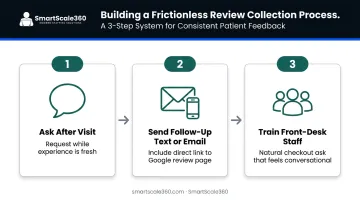
The process must be frictionless. If patients have to search for where to leave a review, most won't.
Responding to Reviews and Managing Reputation
66% of patients say it's important for providers to respond publicly to reviews. That means responding to every review—positive and negative—is part of your marketing strategy.
For negative reviews, keep every response professional and HIPAA-safe:
- Acknowledge the concern without confirming or denying the person is a patient
- Express your commitment to patient satisfaction
- Invite them to contact your office directly to resolve the issue
Monitor Google, Healthgrades, Yelp, and Vitals regularly. Left unchecked, a single platform can quietly build a damaging reputation you're unaware of.
Building a Referral Pipeline
Reviews and reputation management drive inbound discovery — referrals turn satisfied patients and trusted colleagues into a consistent growth channel. Physician referrals and patient referrals require different approaches:
To build patient referrals:
- Send referral reminder cards and thank-you notes when a patient refers someone
- Use periodic social media prompts to keep your practice top of mind
To build physician referrals:
- Attend local medical society meetings and CME events
- Be specific about your specialty and ideal patient profile when introducing yourself
- Establish clear communication protocols with complementary providers — a primary care physician who trusts you will send patients consistently for years
Content Marketing, Social Media, and Email
Blog Content That Builds Authority
Publishing educational content positions your practice as a trusted resource, not just a service provider. Blog posts that answer common patient questions improve search rankings and drive organic website traffic over time.
Effective post types for medical practices:
- Condition explainers in plain language
- Seasonal health tips ("When to Get Your Child a Sports Physical")
- FAQ-style posts ("What to Expect During Your First Visit")
- Provider perspective pieces on topics in your specialty
Write for patients, not for peers. Avoid clinical jargon and focus on the questions your front desk fields every week.
Social Media Strategy
Consistency matters more than volume. Being reliably present on one or two platforms outperforms sporadic posting across every channel.
Choose platforms based on your patient demographics:
- Facebook for older demographics and community groups
- Instagram for younger audiences and visual content
- LinkedIn for physician networking and professional credibility
Practical content ideas:
- Behind-the-scenes staff introductions
- Health awareness posts tied to national observance days (Heart Health Month, Breast Cancer Awareness Month)
- Short video introductions to providers
- Patient success stories (with written consent)
A content calendar keeps posting consistent without requiring daily decision-making from clinical staff.
Video and Community Events
Short videos—provider introductions, procedure explanations, FAQ responses—reduce patient anxiety and build trust faster than text. A single long-form webinar can be repurposed into multiple assets:
- Short social clips for Instagram or Facebook
- A blog summary post for SEO
- An email campaign to your existing patient list
In-office workshops and community webinars reach patients in the consideration phase. They also build local goodwill and give you content to repurpose long after the event ends.
Offline Strategies and Community Presence
Digital marketing gets most of the attention, but offline strategies remain among the most cost-effective options for local practices.
Community involvement options that build authentic name recognition:
- Sponsoring local athletic events or health fairs
- Volunteering at free clinics or school wellness programs
- Joining local business associations
Those community touchpoints also open doors to physician networking — the referral relationships that sustain practice growth for years. Specialty conferences, local medical society meetings, and CME events are the right rooms to be in. Be clear about your specialization and patient capacity so referral partners know exactly who to send and why.
Retention is also where the math gets compelling. MGMA estimates acquiring a new patient is 6 to 7 times more expensive than keeping an existing one. Small gestures go a long way here:
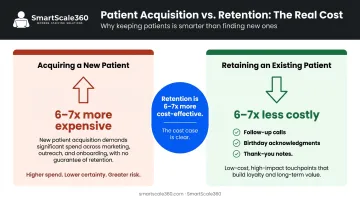
- Personalized follow-up calls after procedures
- Birthday acknowledgments
- Handwritten thank-you notes for referrals
These touchpoints show patients your practice values the relationship, not just the visit.
Staying Compliant and Executing Consistently
HIPAA Marketing Rules Every Practice Must Understand
HIPAA draws a clear line between permitted patient communications and regulated marketing activities. According to HHS guidance, HIPAA defines marketing as a communication about a product or service that encourages recipients to purchase or use it.
What this means practically:
- No authorization needed: appointment reminders, care coordination messages, prescription refill reminders, and specialist referral communications fall outside HIPAA's marketing definition
- Written authorization required: promotional emails, patient testimonials, personalized outreach using patient data, and advertising materials that include patient details all require explicit consent
- Any vendor with access to PHI must sign a Business Associate Agreement (BAA) before engaging
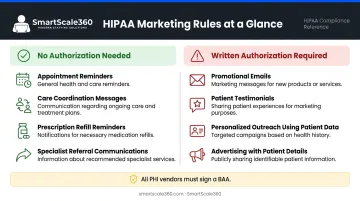
When using patient success stories or testimonials, written authorization is required before using any identifying information—name, image, or details that could identify the individual.
Beyond HIPAA, the FTC requires that all health-related advertising claims be truthful, non-misleading, and supported by adequate evidence. If your practice promotes specific treatments (particularly regenerative medicine or prescription drugs), FDA guidelines also apply.
Getting compliance right is one challenge. Executing your marketing consistently once the guardrails are in place is another.
Execution: Where Most Practices Fall Short
The best marketing strategy fails without consistent execution. For time-constrained physicians, it's exactly where things break down. Scheduling posts, sending review requests, managing email campaigns, monitoring analytics — these tasks get pushed aside when clinical demands take over.
One practical solution is delegating these administrative marketing functions to dedicated remote staff. SmartScale360 provides college-educated, English-speaking virtual staff who can handle:
- Social media scheduling and community management
- Patient email campaign management
- Review monitoring across Google, Healthgrades, and other platforms
- Appointment-related outreach and follow-up communications
- Content calendar management and basic content creation
Their staffing model assigns a single staff member exclusively to your practice, so that person builds genuine familiarity with your brand, communication style, and scheduling protocols. Compared to equivalent in-house hires, practices typically see up to 60–70% in labor cost savings, with no setup fees or long-term contracts required.
For practices evaluating this option, SmartScale360 recommends starting with a free consultation to assess specific needs before committing to any package.
Frequently Asked Questions
What is the 3-3-3 rule in marketing?
The 3-3-3 rule is a simplified planning heuristic suggesting marketers focus on 3 core messages, 3 target audiences, and 3 primary channels. For a medical practice with limited bandwidth, this deliberate focus prevents spreading effort too thin across too many platforms at once.
What are the key P's of medical practice marketing?
The 7 P's are Product (your services), Price (transparency and value), Place (location and telehealth access), Promotion (outreach and communication), People (staff experience), Process (appointment ease), and Physical Evidence (office environment and online presence).
How much should a medical practice budget for marketing?
According to Tebra's 2025 survey data, 62% of practices spend 1–5% of gross revenue on marketing. The right number depends on your growth goals, patient acquisition costs by channel, and how competitive your local market is.
How do HIPAA regulations affect patient testimonials in marketing?
Using a patient's name, image, or any identifiable details in marketing materials requires explicit written authorization. When responding to online reviews, practices must avoid confirming or disclosing protected health information—even in a positive response to a complimentary review.
How long does it take to see results from medical practice marketing?
PPC advertising can drive traffic within days of campaign launch. SEO and content marketing, however, typically take 3–6 months to show measurable results—Google's own guidance notes SEO changes can require 4 months to a year before benefits appear. Set realistic expectations and track metrics channel by channel.
What is the most cost-effective marketing strategy for a small medical practice?
Claiming and fully optimizing your Google Business Profile—combined with a consistent process for collecting patient reviews—improves local search visibility and builds patient trust at minimal cost. Both steps are free to implement and should come before any investment in paid advertising or content production.