According to Forrester, social media is now the second most meaningful source of information for B2B buyers, behind only generative AI search. Gartner lists it among the top five digital channels by buyer engagement. And 89% of B2B marketers use LinkedIn for lead generation, with 62% saying it actually produces leads.
The problem isn't the channel. It's the execution.
This guide walks through a practical framework for building a B2B social media strategy that generates real results — covering goal-setting, platform selection, content planning, key performance variables, and the mistakes that quietly kill most programs before they gain traction.
TL;DR
- B2B social media marketing targets business decision-makers through platforms like LinkedIn, YouTube, and Facebook — not individual consumers
- A working strategy requires SMART goals, audience research, the right platform mix, and a consistent content calendar
- Results hinge on posting frequency, content format, brand voice consistency, and regular analytics review
- LinkedIn leads for B2B marketer value, but buyers also use Facebook, YouTube, and Instagram throughout the purchase journey
- Consistency and authenticity outperform production budgets; delegating execution to dedicated staff is what drives sustained growth
What Is B2B Social Media Marketing and Why Does It Work?
B2B social media marketing is the strategic use of platforms like LinkedIn, YouTube, Facebook, and Instagram to reach business decision-makers, generate leads, and build professional relationships over time. Unlike B2C marketing aimed at individual shoppers, B2B social targets purchasing influencers and buying committees : the people evaluating solutions for their organizations.
It works because decision-makers research solutions the same way anyone else does — independently, online, long before they contact a vendor. Demand Gen Report data shows that B2B buyers are nearly 70% through their purchasing journey before engaging a seller, and 80% of the time, the buyer initiates first contact. Your content needs to be doing the heavy lifting before a sales conversation ever starts.
The buying process itself adds complexity. Forrester reported average B2B buying groups of 13 people in 2024. You're not convincing one person; you're building credibility with a committee. Social media is one of the few channels where you can reach multiple stakeholders simultaneously, over time, without a direct sales interaction.
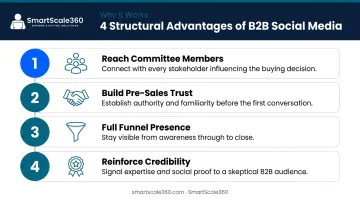
That gives social a distinct structural advantage in B2B. Specifically, it can:
- Reach different buying committee members with role-relevant content
- Build familiarity and trust before a sales rep ever makes contact
- Stay present across the full buyer journey, not just at the top of the funnel
- Reinforce credibility through consistent, expert-level publishing
For B2B, this means social content has to inform and build trust at every stage — not just announce products to audiences who aren't ready to buy.
How to Build Your B2B Social Media Strategy Step by Step
Most B2B social strategies stall not because the steps are hard, but because execution breaks down after the first few weeks. Work through each step below and treat it as a repeating system, not a one-time setup.
Step 1: Set SMART Goals Tied to Business Outcomes
SMART goals in social media mean: Specific, Measurable, Attainable, Relevant, and Time-Bound.
A vague goal like "grow brand awareness" gives you nothing to work toward. A SMART version looks like this: "Increase LinkedIn post engagement rate from 1.2% to 3% within 90 days by publishing four posts per week focused on industry insights."
The goal type shapes every downstream decision — what you post, how often, and what metrics you track. Common B2B social goals include:
- Brand awareness — reach and impressions among target accounts
- Thought leadership — shares, saves, and follower growth from decision-makers
- Lead generation — gated content clicks, form fills from social traffic
- Website traffic — click-through rate from posts to key landing pages
- Pipeline influence — social touchpoints logged against CRM opportunities
- Customer retention — engagement from existing accounts and customers
Pick one or two primary goals before building anything else.
Step 2: Define Your Audience and Select the Right Platforms
Platform selection should follow audience research, not assumption.
CMI's 2025 B2B research found 85% of B2B marketers say LinkedIn delivers the best value — and 68% increased their LinkedIn use over the prior year. But Forrester's buyer-side data tells a more nuanced story: buyers cite Facebook, Instagram, and YouTube as meaningful in their purchase journeys alongside LinkedIn.
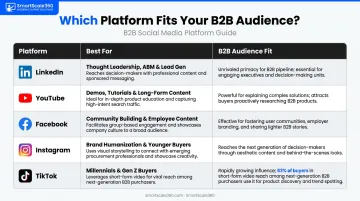
Here's a practical breakdown by platform:
| Platform | Best for B2B |
|---|---|
| Thought leadership, ABM, professional networking, lead gen | |
| YouTube | Product demos, tutorials, long-form educational content |
| Community building, employee content, local/franchise audiences | |
| Brand humanization, reaching younger buyers and influencers | |
| TikTok | Younger B2B buyers — Millennials and Gen Z now make up 63% of surveyed buyers |
Start with one or two platforms where your specific buyers spend time. Spreading thin across five channels at once produces mediocre results on all of them.
Step 3: Build a Content Calendar and Diversify Your Content Mix
A 90-day content calendar is the right planning horizon. It's long enough to build momentum and test what resonates, short enough to stay flexible.
Why consistency matters: Algorithms on every major platform reward regular publishing. Sporadic posting actively suppresses reach. You're essentially starting from zero every time you go quiet.
The content mix that performs well in B2B:
- Original industry insights and data-driven takes
- Short-form video (under 60 seconds performs well across LinkedIn, Instagram, and TikTok)
- Customer success stories and real-world outcomes
- Employee spotlights and behind-the-scenes content
- Timely commentary on industry news or trends
- Repurposed long-form content
Repurposing is how smaller teams maintain output without proportionally increasing workload. A single webinar can become five short video clips, three LinkedIn posts, a carousel, and a follow-up article. Existing blog posts, whitepapers, and case studies are all fair game.
CMI reports that 58% of B2B marketers identify video as the most effective content type, and 96% create thought leadership content — with 76% rating LinkedIn as the most effective channel for it.
Step 4: Publish, Engage, and Measure Performance
Publishing alone isn't a strategy. Once your content calendar is running, the next layer is active participation: responding to comments, asking follow-up questions, and engaging target accounts' content proactively. That's what separates brands that build pipeline from those that just post into the void.
Metrics worth tracking (beyond vanity numbers):
- Engagement rate per post
- Click-through rate to gated content
- Lead volume from social sources, tracked by UTM parameters or CRM source fields
- Share of voice versus competitors
- Pipeline influence tracked through CRM integration
Establish a review cadence — weekly for quick optimizations, monthly for trend analysis. What topics drove the most engagement? Which formats underperformed? Use that data to adjust the next cycle.
What You Need Before You Launch Your Strategy
Preparation determines results. Launching without the right inputs leads to inconsistency and wasted effort.
Platform and Tool Requirements
Three categories of tools are needed for effective execution:
- Scheduling and management tool — for planning, drafting, and publishing consistently (Buffer, Hootsuite, Sprout Social, or similar)
- Social listening tool — for tracking brand mentions, competitor activity, and relevant conversations
- Analytics dashboard — connecting social performance to business outcomes, ideally with CRM integration
Content and Resource Readiness
Before launching, audit what already exists:
- Blog posts that can be broken into LinkedIn posts or short videos
- Case studies and client testimonials for social proof content
- Founder or leadership insights for thought leadership posts
- Whitepapers or reports that can be teased with data pulls
This prevents the most common launch failure: going live with a strategy but no content pipeline.
For most SMBs, consistent execution is harder than strategy. A founder or senior marketer juggling ten priorities will eventually deprioritize social media — and that's a resource problem, not a discipline one.
SmartScale360 addresses this directly with dedicated offshore social media coordinators who handle scheduling, content repurposing, community engagement, and reporting on an ongoing basis. At a flat monthly rate with no long-term contracts, it's a practical alternative to the overhead of an in-house hire.
Key Variables That Determine Your B2B Social Media Results
Two companies can follow the same strategic steps and get very different outcomes based on how they manage these variables.
Posting Frequency and Consistency
Platform algorithms reward consistency over volume. Hootsuite's industry benchmark data shows the highest LinkedIn engagement rates for financial services at 2 posts per week (3.44% engagement rate) and education at 2-3 posts per week (2.95%). Buffer reports that moving from 1 post per week to 2-5 per week on LinkedIn is associated with 5x more clicks per post.
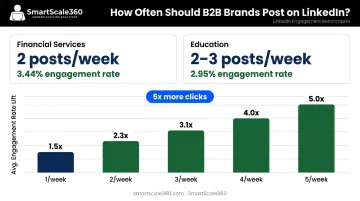
Sustainable, regular posting over months outperforms a burst of daily content followed by silence. Set a cadence your team or dedicated VA can maintain indefinitely.
Content Format and Authenticity
Format matters as much as topic. Short-form video consistently performs well across TikTok, Instagram Reels, YouTube Shorts, and LinkedIn. Most B2B marketers assume the content needs to be corporate and polished. It doesn't.
Decision-makers are still people scrolling a feed. They respond to personality, direct opinions, and honest perspectives — not press releases dressed up as posts. A 45-second clip of a founder sharing a genuine take on an industry problem will outperform a beautifully designed infographic that says nothing memorable.
Brand Voice Consistency
A defined brand voice builds familiarity over time. It should feel human and conversational, not like it was written by committee. The voice needs to stay consistent across platforms, content types, and whoever is posting.
That consistency is one reason a single dedicated person managing your social presence outperforms a rotating team of contributors.
Analytics and Iteration
Social media offers something rare in marketing: daily feedback loops. You can see within 24 hours whether a post format is resonating. Put that data to work with a simple weekly rhythm:
- Review engagement patterns and identify your top three posts
- Feed those insights directly into the next week's content plan
- Cut any format that hasn't gained traction after 30 days
- Reallocate that effort toward what's already working
Common Mistakes B2B Companies Make on Social Media
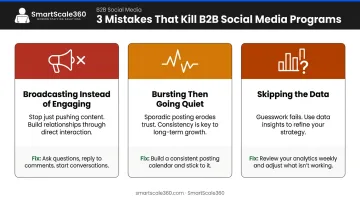
Most B2B companies stumble on the same three mistakes. Avoiding them doesn't require a big team or a big budget — it requires recognizing the patterns early.
- Broadcasting instead of engaging. Only posting product announcements and sales content is the fastest way to lose decision-makers. An account that offers nothing but promotions gets unfollowed or ignored. Value, education, and authentic engagement have to come first.
- Bursting then going quiet. Launching with energy, posting daily for three weeks, then going silent for a month is one of the most common patterns — and one of the most damaging. Algorithms deprioritize inconsistent accounts, and audiences read silence as unreliability. The fix isn't more willpower; it's assigning execution to someone dedicated to the channel.
- Skipping the data. Not reviewing performance means continuing to invest time in formats and topics that don't connect, while missing the signals showing what actually works. The brands that grow on social iterate continuously based on what the numbers tell them, not gut feel.
Conclusion
B2B social media marketing comes down to one thing: showing up consistently with content that actually means something to your audience. The brands that pull ahead aren't necessarily the ones with the biggest budgets — they're the ones who treat social media as an ongoing conversation rather than a broadcast channel.
The missing ingredient for most SMBs isn't insight — it's execution capacity. A clear strategy means little without dedicated time and resources to carry it out week after week. For businesses that want to compete without enterprise-level marketing budgets, building a lean team that includes dedicated offshore social media talent is a practical path to maintaining the consistency that drives long-term results.
That's where SmartScale360 comes in. Their dedicated offshore Digital Marketing Virtual Assistants handle the day-to-day execution — content scheduling, community engagement, content repurposing — at up to 60-70% less than the cost of an equivalent in-house hire. If you're ready to build a B2B social media presence that actually runs, book a free consultation at SmartScale360.com or call 802-345-9548.
Frequently Asked Questions
What is B2B social media marketing?
B2B social media marketing is the strategic use of platforms like LinkedIn, YouTube, and Facebook to promote products and services to other businesses — specifically targeting decision-makers and purchasing influencers rather than individual consumers. The goal is to build relationships, generate leads, and influence buying decisions over a longer sales cycle.
Does social media marketing work for B2B?
Yes. 89% of B2B marketers use LinkedIn for lead generation, and 62% say it produces leads effectively. CMI also reports that 42% of B2B marketers cite organic social as a top-performing distribution channel for B2B demand generation.
What is the 30-30-30 rule for social media?
The 30-30-30 rule is an informal content-mix guideline dividing your calendar into roughly equal portions: brand content, curated third-party content, and educational or engaging content. Treat it as a starting framework, not a fixed formula — your audience data will refine the mix over time.
Which social media platform is best for B2B marketing?
LinkedIn is the leading platform by B2B marketer value, with 85% of marketers saying it delivers the best results. That said, Forrester's buyer data shows Facebook, Instagram, and YouTube all play meaningful roles in how buyers research purchases — so the right platform ultimately depends on where your specific buyers spend time.
How often should a B2B company post on social media?
Consistency matters more than volume. For LinkedIn, posting 2-5 times per week is associated with stronger engagement, and LinkedIn itself reports that weekly posting produces a 2x lift in content engagement. Set a cadence your team can sustain, then hold it without gaps.
How do you measure B2B social media ROI?
Track lead volume from social sources, click-through rates on gated content, and pipeline influence via CRM integration — not just likes and follower counts. Engagement rate and share of voice against competitors complete the picture.