Introduction
Most small businesses treat social media like a bulletin board—post an update, hope someone notices, repeat. The result? Followers who never become customers.
The businesses generating revenue from social media aren't posting more. They're posting smarter—with deliberate systems that capture intent, qualify prospects, and move people toward a buying decision.
Meta reports that 59% of people discover new products and brands through Meta technologies, with 53% using those same platforms to evaluate options before purchasing. For most SMBs, that's a pipeline opportunity sitting completely untapped.
This guide covers everything you need to build a social media lead generation engine:
- What social media lead generation actually means
- How to pick the right platform for your business
- Which tactics consistently produce qualified leads
- How to convert and nurture what you capture
- How to measure what's working
Key Takeaways
- Social media lead generation requires deliberate systems—not just consistent posting
- Choose 1–2 platforms based on where your target audience actually spends time
- Native lead forms, lead magnets, and retargeting are the most effective tactics
- Speed-to-lead dramatically affects whether inquiries convert to customers
- Track leads captured and cost per lead—not follower counts or impressions
What Is Social Media Lead Generation and Why Does It Matter
Social media lead generation is the deliberate process of attracting potential customers through social platforms, engaging them with relevant content, and capturing their contact information or purchase intent—then guiding them through a sales funnel toward a buying decision.
That's a different goal than growing a following. Likes and follower counts are not leads. Lead generation requires measurable actions: a form filled out, a DM conversation started, a click to a landing page, a consultation booked. These signals indicate readiness to engage further—and they're what separates accounts that look active from ones that actually drive revenue.
Why This Matters Specifically for SMBs
For businesses operating with lean marketing budgets, social media offers three distinct advantages over traditional channels:
- Lower cost, broader reach — No print runs, broadcast minimums, or geographic ad placement fees
- Audience precision — Target by job title, location, interests, income level, or behavior
- Fast feedback loops — Know within days whether a campaign is working and adjust before wasting budget
Traditional advertising requires upfront spend with no guarantee of return. Social media lets you test, refine, and optimize before committing significant resources—so smaller budgets work harder from the start.
Choosing the Right Social Media Platform for Your Business
Platform selection is where most SMBs make their first mistake. They go where competitors seem to be, or where a trend article told them to go—not where their actual customers spend time.
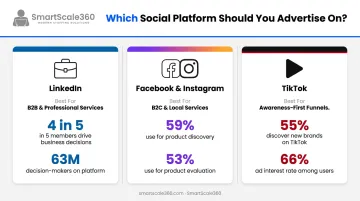
Platform Breakdown by Business Type
| Platform | Best For | Why It Works |
|---|---|---|
| B2B, professional services, law firms, financial advisors, marketing agencies | 4 out of 5 LinkedIn members drive business decisions, with 63M decision-makers and 2x the buying power of the average web audience | |
| Facebook & Instagram | B2C, local services, homecare agencies, franchises, retail | 59% product discovery, 53% product evaluation—strong for community-based businesses and local targeting |
| TikTok | Awareness-first funnels, consumer-facing industries, visually driven brands | 55% of TikTok users discover new brands on the platform; 66% say ads made them interested in a brand |
How to Validate Your Platform Choice
Research where your target audience actually goes—not where they theoretically should be. Each major platform publishes data that makes this easier to verify:
Research where your target audience actually goes—not where they theoretically should be. Each major platform publishes data that makes this easier to verify:
- LinkedIn: Demographic data on member industries, seniority levels, and company sizes
- Meta Audience Insights: Reach estimates by age, location, and interest category
- TikTok Business Portal: User composition broken down by vertical and behavior
Once you know where your audience is, match that to how the platform actually works. LinkedIn users expect professional content and tolerate longer-form posts. Instagram users scroll fast and respond to visual hooks. Choose based on native behavior, not just reach numbers.
The Case for Doing Less, Better
Pick one or two platforms and master them before expanding. Mastery means:
- A fully optimized profile with a clear CTA and direct contact options
- A consistent posting cadence (3–5 times per week, not sporadic bursts)
- Active, genuine engagement with your target audience in comments, DMs, and relevant groups
Spreading thin across five platforms rarely generates leads—it generates maintenance work. Two platforms, done consistently, will outperform five platforms done poorly.
Proven Strategies to Generate Leads on Social Media
Optimize Profiles for Lead Capture
Your profile is the first thing a prospect sees after your content catches their attention. Treat it like a mini landing page.
Every profile should include:
- A keyword-relevant bio that describes who you help and how
- A clear CTA ("Book a Free Consultation," "Get a Quote," "Download Our Guide")
- A direct link to a lead capture page—not just your homepage
- All available contact options: phone, email, messenger button
A weak profile undermines even great content. If someone clicks through and can't figure out what you do or how to reach you in five seconds, you've lost them before the conversation started.
Create Content That Earns Leads, Not Just Likes
The difference between content that gets engagement and content that gets leads is a clear, embedded offer. Every piece of content needs a destination.
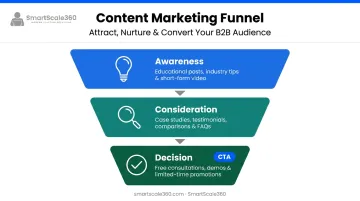
Match content type to funnel stage:
- Awareness — Educational posts, industry tips, short-form video that introduces a problem your business solves
- Consideration — Case studies, testimonials, comparisons, FAQs that help prospects evaluate their options
- Decision — Direct offers: free consultations, demos, limited-time promotions with a specific CTA
Posts that end with nothing more than a hashtag generate attention. Add a destination and they generate leads.
Use Native Lead Forms to Reduce Friction
LinkedIn Lead Gen Forms and Meta Lead Ads let prospects submit contact information without leaving the platform. That matters because every redirect to an external page introduces friction—and friction kills conversions.
According to WordStream's analysis, Facebook Lead Ads averaged a 12.54% conversion rate versus 10.47% for campaigns sending traffic to external landing pages. LinkedIn's own pilot data showed 90% of Lead Gen Forms customers beat their cost-per-lead goals compared to standard Sponsored Content.
Native forms pre-fill with profile data, removing typing barriers. For mobile users especially, this alone can double completion rates.
Offer Lead Magnets Tied to Real Pain Points
A lead magnet is a high-value asset your audience willingly trades their contact information to receive — but only if it solves something they're actively trying to fix. Forced or generic offers get ignored.
Effective lead magnets for SMBs include:
- Industry checklists ("10-Point Audit for Homecare Recruiting Compliance")
- How-to guides specific to a niche problem
- Free consultations or strategy sessions
- Short webinars or training videos
- Templates or calculators with immediate practical value
The magnet must address a specific problem your ideal customer is already wrestling with. A "free resource" on a topic your audience doesn't care about won't move the needle.
Run Contests and Incentive Campaigns
A well-designed contest can simultaneously expand organic reach and capture lead data. Enter by filling out a form, following the page, or tagging a relevant contact.
The prize matters as much as the mechanic. A generic gift card attracts everyone. A prize relevant to your ideal customer—a free month of your service, a consultation package, an industry-specific tool—attracts qualified prospects.
Retarget Warm Audiences
Cold audiences convert at lower rates than people who've already interacted with your brand. Retargeting uses Custom Audiences built from:
- Website visitors (tracked via the Meta Pixel or LinkedIn Insight Tag)
- Video viewers who watched 25%, 50%, or 75% of a video
- Form abandoners who started but didn't complete a lead form
Serve these audiences follow-up ads with stronger CTAs, new offers, or social proof. They already know who you are—they just need a better reason to act.
How to Convert and Nurture Social Media Leads
Capturing a lead is the beginning, not the outcome. Most prospects won't buy on first contact. What happens next determines your conversion rate.
Respond Fast—Very Fast
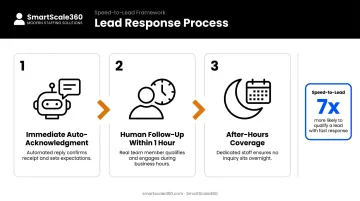
Speed-to-lead is one of the most significant and underrated factors in whether a social media inquiry becomes a customer. Research from Harvard Business Review found companies responding within one hour of receiving a query were nearly 7x more likely to qualify the lead than those waiting another hour—and more than 60x more likely than companies waiting 24 hours or longer.
For SMBs handling DMs and comment-based inquiries, a practical response protocol looks like:
- Immediate auto-acknowledgment — Set up an automated message confirming receipt and setting expectations
- Human follow-up within 1 hour — During business hours, a real person responds to qualify and engage
- After-hours coverage — Use a dedicated team member or remote staff to ensure no inquiry sits overnight
Segment Leads by Interest and Buying Stage
Not every lead deserves the same message. Sending identical follow-up to someone who downloaded a checklist and someone who asked about pricing wastes the signal they've already given you.
Basic segmentation approach:
- Resource downloaders → Educational nurture sequence, build trust before pitching
- Pricing inquiries → Direct sales conversation, move to consultation quickly
- Consultation bookers → Prep materials and confirmation sequence, reduce no-show rate
Tailored messaging at each stage outperforms broadcast follow-up every time.
Automate the First Touch, Then Personalize
Automation confirms receipt instantly — then a real person takes over to build the actual relationship.
Set up automated welcome messages or instant lead-response sequences to confirm receipt and deliver the lead magnet or next step immediately. Follow that with a personalized message within the hour that references what the prospect actually did—not a generic template. "I saw you downloaded our homecare recruiting guide—happy to answer any questions specific to your agency" lands differently than "Thanks for your interest in our services."
Nurture Unconverted Leads Over Time
Most leads don't buy immediately. That's not rejection—it's timing. A drip content approach keeps you visible and relevant until they're ready:
- Share educational posts that address common objections
- Post client testimonials and case studies regularly
- Send helpful tips related to their specific interest area
- Celebrate milestones or share relevant industry news
The goal is staying top-of-mind without being intrusive. A homecare agency posting weekly caregiver retention tips, for instance, stays relevant to prospects long before those prospects are ready to call.
Scale Lead Management Without Burning Out
That consistency requires volume — and volume requires capacity most SMBs don't have in-house. Responding to DMs, engaging comments, scheduling content, following up with leads, and updating CRM records across multiple platforms is a full-time job before you've done any actual client work.
SmartScale360's Lead Generation VAs and Social Media VAs handle exactly this. Their remote staff — college-educated, English-speaking professionals from the Philippines — work within your existing tools and time zone, covering:
- Prospect research and lead list management
- Nurture sequences and CRM data entry
- Real-time social media inquiry response
- Community management and comment engagement

The service runs on a flat monthly fee with no long-term contracts.
For SMBs in homecare, financial services, real estate, and franchises, this means every lead gets a response and every inquiry gets followed up — without the business owner becoming the bottleneck. Learn more at smartscale360.com/pages/consultation.
Measuring and Optimizing Your Social Media Lead Generation
Track Metrics That Indicate Pipeline Health
Follower count, post impressions, and total likes tell you nothing about revenue. Focus on:
- Lead volume — Number of qualified leads captured per week/month
- Lead-to-customer conversion rate — What percentage of captured leads become paying customers
- Cost per lead — For paid campaigns, what you're spending to acquire each lead (Facebook lead campaigns averaged $27.66 CPL in 2025, per WordStream's benchmark data, though this varies significantly by industry)
- Engagement-to-lead ratio — How much engagement is converting to actual lead actions
Set Up Proper Attribution
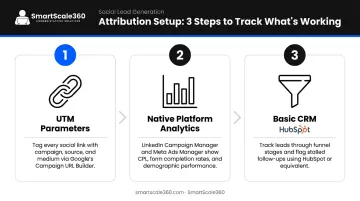
Attribution setup doesn't need to be complex — it just needs to be consistent:
- UTM parameters — Tag every link you share on social with campaign, source, and medium parameters using Google's Campaign URL Builder. This lets Google Analytics identify exactly which post or platform drove traffic and conversions.
- Native platform analytics — LinkedIn Campaign Manager and Meta Ads Manager both show cost per lead, form completion rates, and audience performance by demographic.
- A basic CRM — Even a simple spreadsheet beats tracking leads through email threads. A real CRM (HubSpot's free tier, or any platform your team already uses) lets you see where leads are in the pipeline and flag stalled follow-ups.
Run Monthly Performance Reviews
Monthly reviews keep your lead generation from drifting on autopilot. Run through this checklist each month:
Monthly review checklist:
- Which posts generated the most lead actions (not just likes)?
- Which platform is producing the best quality leads?
- What's the cost per lead trend—rising or falling?
- Which CTAs are converting and which aren't?
- Where in the funnel are leads dropping off?
A/B test one variable at a time—CTA copy, post format, offer type, posting time. Scale what produces qualified leads. Cut or rework what produces only vanity metrics.
Frequently Asked Questions
What is social media lead generation?
Social media lead generation is the process of using social platforms to attract potential customers, capture their contact information or purchase intent, and guide them through a sales funnel toward becoming paying customers. It goes beyond growing a following: it requires deliberate actions like form fills, DM conversations, or consultation bookings.
Which social media platform is best for lead generation?
LinkedIn is generally strongest for B2B and professional services, where decision-maker targeting is critical. Facebook and Instagram tend to perform best for B2C businesses and local service providers, where community reach and visual content drive conversions. The right choice depends on your business type and who you're trying to reach.
What is the 30 30 30 rule for social media?
The 30-30-30 rule is an informal content balance guideline: roughly 30% original branded content, 30% curated content from credible sources, and 30% promotional content, with the remaining 10% reserved for personal or engagement-driven posts. The split prevents your feed from reading as a constant sales pitch.
What is the 5 3 2 rule on Instagram?
For every 10 posts: 5 should be educational or entertaining content, 3 should be original branded content, and 2 should be personal or behind-the-scenes posts. This mix maintains audience trust while still promoting your business regularly.
How do small businesses generate leads on social media on a limited budget?
Start with organic tactics: optimize your profile with a clear CTA and lead capture link, post consistently valuable content, and engage directly with your audience in comments and relevant groups. Use native lead forms — free on both LinkedIn and Meta — before committing budget to paid ads.
How do you measure the success of social media lead generation?
Track number of leads captured, lead quality relative to your ideal customer profile, lead-to-customer conversion rate, and cost per lead for paid campaigns. Follower counts and total likes reflect visibility, not pipeline health — don't let them drive strategic decisions.