The math is brutal: you need capable people to grow, but full-time hiring is slow, expensive, and risky when your needs might shift in six months.
Staff augmentation offers a practical middle path. You bring in external professionals to work inside your team structure, on your terms, without the permanent overhead. It's a model that growing businesses across homecare, law, real estate, and marketing are using to stay nimble without giving up control.
This guide covers what staff augmentation actually is, how it compares to consulting and outsourcing, its key benefits and real challenges, and the best practices that separate successful engagements from costly ones.
Key Takeaways
- Staff augmentation adds external professionals to your team temporarily while you retain full management control
- Traditional hiring takes a median of 45 days to fill a role — augmentation can move significantly faster
- Offshore staff augmentation can reduce labor costs by 60–70% compared to local full-time hiring
- Common pitfalls like poor onboarding and knowledge gaps are preventable with the right processes in place
- The right staffing partner vets for skills, communication, and cultural fit alongside credentials
What Is Staff Augmentation and How Does It Work
Staff augmentation is the practice of bringing in external professionals on a temporary or project basis to work inside your existing team. Unlike outsourcing a function entirely, you remain in charge — you set priorities, assign tasks, review work, and manage the day-to-day relationship.
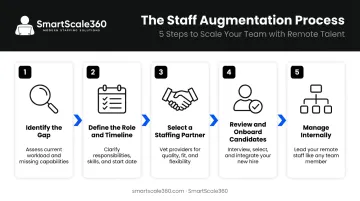
The process typically follows these steps:
- Identify the gap — Determine which skill, role, or capacity your internal team is missing
- Define the role and timeline — Clarify what success looks like and how long you need the support
- Select a staffing partner — Choose a provider that screens for both hard skills and communication ability
- Review and onboard candidates — Interview shortlisted candidates and get the right person integrated into your workflows
- Manage internally — The augmented staff member works alongside your team under your direction
Three Types of Staff Augmentation
The model you choose shapes everything from who you hire to how quickly they can contribute. These three categories cover most use cases:
- Commodity-based — Routine operational tasks like data entry, scheduling, or customer support where speed and volume matter most
- Skill-based — Specific functional expertise such as marketing, HR, bookkeeping, or legal administration
- Highly skilled — Specialized roles requiring technical or strategic depth, including software development, compliance, or financial analysis
Choosing the wrong category is one of the most common reasons augmented hires underperform. A highly skilled role filled with a commodity-level hire creates friction on both sides.
Staff Augmentation vs. Consulting vs. Outsourcing
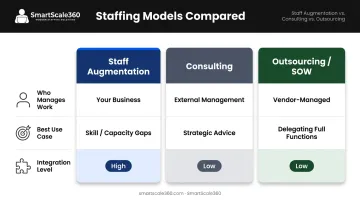
These three models are often confused. The distinction matters most when you're deciding how much control you want to retain over day-to-day work.
| Model | Who Manages the Work | Best Use Case | Level of Integration |
|---|---|---|---|
| Staff Augmentation | Your business | Filling skill/capacity gaps while keeping oversight | High — works inside your team |
| Consulting | The consultant | Strategic advice, assessments, independent recommendations | Low — advises externally |
| Outsourcing / SOW | The vendor | Delegating an entire function or deliverable | Low — vendor owns the outcome |
According to Staffing Industry Analysts, the key distinction between staff augmentation and SOW (Statement of Work) comes down to pricing and risk: staff augmentation is billed on a labor/time basis with your team directing the work, while SOW arrangements fix pricing around milestones and shift completion risk to the vendor.
If you need speed and flexibility but can't hand off an entire function without visibility into quality or execution, augmentation is the stronger choice. For SMBs, where a single poor outcome in a critical function can damage client relationships, keeping day-to-day oversight in-house is worth the tradeoff in coordination effort.
Key Benefits of Staff Augmentation for Growing Businesses
Faster Access to Talent
SHRM reports the median time-to-fill for both executive and non-executive roles in 2025 was roughly 45 days. For a business managing a project deadline or covering an unexpected gap, six weeks is a long time to wait.
Staff augmentation cuts that timeline sharply. A provider with an active, pre-screened talent pipeline can present qualified candidates in days, not weeks. That speed advantage is particularly valuable when your clients can't wait for a traditional hiring cycle to complete.
Significant Cost Savings
Full-time employees cost more than their salary. The Bureau of Labor Statistics reported that as of March 2026, civilian employer compensation averaged $49.32 per hour — with $15.60 of that going to benefits alone, representing nearly 30% of total compensation.
Stack in equipment, office space, payroll taxes, and recruiting fees, and the true cost of a full-time hire is substantially higher than the salary line.
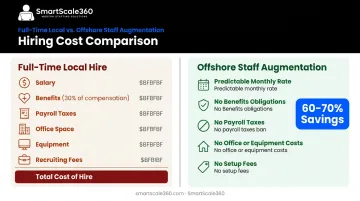
Offshore staff augmentation addresses each of those cost drivers directly. Working with a provider like SmartScale360 — which connects U.S. SMBs with college-educated, English-speaking professionals from the Philippines — can reduce labor costs by 60–70% compared to local hiring, while maintaining dedicated, role-specific support. That means:
- No employer payroll taxes or benefits obligations
- No office space or equipment costs
- Predictable monthly pricing with no setup fees or long-term contracts
Workforce Flexibility and Scalability
Staff augmentation lets you scale without the risk of layoffs. Bring on extra support for a product launch or busy season, then scale back when things normalize — all without carrying permanent headcount on your payroll.
This flexibility is becoming standard practice. The U.S. Chamber's Q4 2025 Small Business Index found that **29% of small businesses planned to hire seasonal workers** — up seven points year-over-year — showing that flexible staffing is already built into how savvy SMBs operate.
Access to Specialized Skills On Demand
Not every business needs a full-time compliance officer, data analyst, or paid advertising specialist. Staff augmentation gives you access to that niche expertise precisely when and for as long as you need it.
For example, a real estate firm might bring in a transaction coordinator during a high-volume quarter, or a law firm might add a legal research assistant for a complex case — without committing to a permanent hire neither would justify year-round.
Staying Focused on Core Business Activities
When business owners spend their days managing operational tasks that a skilled remote professional could handle, growth slows. Staff augmentation frees internal teams to focus on client relationships, revenue generation, and strategy — the work that actually moves the business forward.
For SmartScale360 clients in homecare, marketing, and financial services, that shift in focus — from daily admin to strategic priorities — is often the most tangible outcome after adding offshore support.
Common Challenges of Staff Augmentation
Integration and Cultural Fit
Augmented staff — especially remote or offshore professionals — can feel like outsiders if they aren't deliberately included. Without intentional onboarding and regular communication, they may operate in isolation, missing the context and culture that helps them contribute fully.
The risk isn't just about morale. Disconnected augmented staff tend to default to safe, low-initiative behavior — doing exactly what's asked and nothing more. The initiative and judgment you hired for goes unused.
Onboarding Takes More Effort Than Expected
Even highly experienced professionals need context. Access to your tools, understanding of your workflows, clarity on priorities and communication norms — none of that transfers automatically.
Without structured onboarding, the speed advantage of augmentation often evaporates in the first two to three weeks. The hire is capable; they just don't know enough yet to perform.
Knowledge Retention When Engagements End
When an augmented staff member's contract concludes, what they know about your processes, clients, and systems can walk out the door with them. Most businesses only recognize this cost after the fact.
Project context, process documentation, key relationship history — if none of that was captured during the engagement, you're starting from scratch with the next person.
Data Security and Compliance
Augmented staff — particularly those with access to sensitive client data, financial records, or regulated information — represent a third-party access point worth managing carefully. IBM's 2025 Cost of a Data Breach Report found that third-party and supply-chain compromise cost organizations an average of $4.91 million per breach.
For SMBs in healthcare, financial services, or legal services, the stakes are real. These protections are necessary operating standards, not optional extras:
- Non-disclosure agreements signed before access is granted
- Background screening appropriate to the role and data sensitivity
- Role-based access controls limiting exposure to only what's needed
- Clear offboarding procedures to revoke access when engagements end
Staff Augmentation Best Practices
Start with a Gap Analysis
Before posting a role or contacting a staffing partner, get specific. Which exact skills is your team missing? What's the capacity ceiling causing problems? Is this a short-term gap or an ongoing need?
A quick gap analysis prevents overhiring, mismatched placements, and the frustration of onboarding someone whose skills don't map to your actual problem.
Build a Structured Onboarding Process
Treat augmented staff with the same intentionality you'd apply to a full-time hire during onboarding. Cover:
- Access to tools and systems they'll use daily
- Introduction to the team and communication norms
- Clear explanation of priorities, deliverables, and timelines
- A first-week check-in to address gaps early
The closer an augmented staff member integrates with your team, the faster they contribute. That integration doesn't happen automatically — it's built through deliberate onboarding from day one.

Assign Clear Internal Ownership
Augmented staff perform best when there's a designated internal point of contact — someone who assigns work, gives feedback, and maintains accountability. Without that anchor, external staff default to self-direction, which rarely ends well.
Assign one person internally to own the relationship and make sure the augmented hire knows exactly who that is from day one.
Establish Communication Rhythms Early
Once ownership is clear, the next step is establishing how communication actually flows. Decide which channels to use, how frequently to check in, and what warrants a quick message versus a scheduled call. This matters most when working across time zones.
For example, many offshore staff — including those sourced from the Philippines — are accustomed to working U.S. business hours. Even so, setting explicit communication expectations early prevents the collaboration gaps that derail remote engagements.
Document Continuously, Not Just at the End
Process documentation is easy to defer and costly to lose. Build it into the engagement from the start — require it as part of the work, not as a final deliverable.
When the contract concludes, your business retains the workflows, SOPs, and context needed to keep operating — or to onboard the next person cleanly.
How to Choose the Right Staff Augmentation Partner
Evaluate Beyond the Resume
A staffing partner's job isn't to submit profiles — it's to present candidates who can actually do the work and work well within your team. Ask any prospective partner:
- How do you screen candidates beyond their credentials?
- Do you assess English proficiency and communication ability directly?
- What's your replacement policy if a placement isn't working out?
- Do you handle compliance and contracts on the candidate side?
SmartScale360 screens all candidates for English proficiency, verifies college-level education, and matches talent to the specific functional requirements defined during the initial consultation. If a client isn't satisfied with a placed staff member, SmartScale360 provides a free replacement at no additional cost.
Look for Transparency, Flexibility, and SMB-Friendliness
Most large staffing firms target enterprise clients: long contracts, complex pricing, and account managers stretched across hundreds of relationships. SMBs often end up as an afterthought.
What to look for instead:
- Transparent pricing — flat monthly rates, no hidden fees
- No long-term contracts — flexibility to scale or cancel as needs change
- No setup fees — low-risk entry point for first-time augmentation clients
- Personalized matching — a staffing partner who understands your specific business, not just your job description
SmartScale360 was built specifically for this gap. With 20+ years of outsourcing experience, no contracts, no setup fees, and a free replacement guarantee, it gives SMBs access to the same offshore talent pool that large corporations have used for years — without the enterprise price tag or commitment. The company serves clients across homecare, real estate, law, marketing, financial services, and franchises.

Evaluate Responsiveness and Ongoing Support
The relationship with a staffing partner doesn't end at placement. Issues come up — a workflow changes, a role expands, a staff member needs to be replaced. A good partner stays engaged, responds quickly, and adapts as your business evolves.
Look for a partner who offers clear escalation paths and consistent communication after onboarding. That ongoing responsiveness is often what separates a staffing relationship that lasts from one that stalls at the first sign of friction.
Frequently Asked Questions
What does staff augmentation mean?
Staff augmentation is the practice of adding external professionals to your team on a temporary or ongoing basis to fill skill or capacity gaps. Your business retains full control over the work, priorities, and day-to-day management. The augmented staff member works inside your team structure, not independently.
How does staff augmentation differ from consulting and SOW?
In staff augmentation, you manage the work directly. Consulting involves external experts advising independently, without day-to-day accountability to your team. With SOW (Statement of Work) or outsourcing, a vendor owns a defined outcome and carries the delivery risk.
Is staff augmentation cost-effective?
For most businesses, yes. It eliminates full-time hiring overhead like benefits, office space, payroll taxes, and equipment. Offshore staff augmentation, such as SmartScale360's model using Philippines-based professionals, typically reduces labor costs by 60–70% compared to equivalent local hires.
When should a small business consider staff augmentation?
Consider it when you face any of the following:
- A short-term skill gap or project that doesn't justify a full-time hire
- Seasonal demand spikes or an unexpected employee absence
- Specialized expertise (a compliance specialist, recruiter, or similar role) that isn't needed year-round
What are the biggest risks of staff augmentation and how do I avoid them?
The main risks are poor onboarding, knowledge loss when contracts end, team integration gaps, and data security concerns. Most are preventable with structured onboarding, clear communication protocols, ongoing documentation habits, and a staffing partner who screens candidates rigorously.
How do I know if a staff augmentation provider is right for my business?
Evaluate their screening process (do they assess communication and culture fit, not just credentials?), their flexibility (no long-term contracts?), pricing transparency, replacement policy, and whether they offer dedicated ongoing support, not just placement and exit.