
That's why outsourcing is getting a serious look from businesses that previously dismissed it as a "corporate thing." But the question "is it cheaper?" doesn't have a clean yes or no answer. Costs vary significantly based on where your provider is located, what pricing model you choose, the complexity of support you need, and what's hidden in the fine print.
This article breaks down what customer service outsourcing actually costs in 2025–2026, what drives prices up or down, and how to build a realistic budget before you sign anything.
Key Takeaways
- Offshore agents (Philippines, India) typically run $8–$15/hour or $1,200–$2,500/month per agent based on platform benchmarks
- Onshore US agents cost $30–$45/hour, with monthly per-agent costs reaching $5,000–$9,000
- In-house staffing costs extend beyond salary; benefits alone add roughly 43% on top of base wages
- Setup fees, QA add-ons, and scaling penalties are the most common budget surprises
- Dedicated agent models are the better fit for SMBs with consistent, moderate-to-high call or ticket volume
How Much Does Customer Service Outsourcing Cost?
There's no fixed rate. Pricing depends on geography, service complexity, and the model you choose. What catches businesses off guard: choosing the lowest headline rate without factoring in setup fees, QA costs, or software licensing — costs that show up later on the invoice.
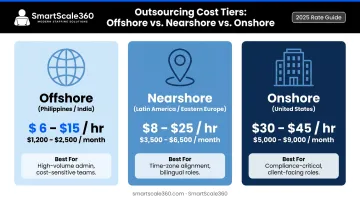
Here's how the three main tiers break down, using published platform and advisory benchmarks:
| Tier | Location | Hourly Rate | Monthly Per Agent | Best For |
|---|---|---|---|---|
| Offshore | Philippines, India | $6–$15/hr | $1,200–$2,500 | Cost-conscious SMBs, English-language support |
| Nearshore | Latin America, Eastern Europe | $8–$25/hr | $3,500–$6,500 | US time-zone overlap, bilingual agents |
| Onshore | United States | $30–$45/hr | $5,000–$9,000 | Regulated industries, highest QA standards |
Offshore Tier (Philippines, India)
Offshore providers typically include English-speaking agents handling standard channels — email, chat, or phone — with basic product training.
- Hourly rate: $8–$15/hour (Philippines); $6–$10/hour (India), per Clutch's call center pricing guide
- Monthly per-agent cost: $1,200–$2,500
- Best for: Cost-conscious SMBs needing scalable English-language support without round-the-clock complexity
If you're evaluating offshore providers, two contract terms matter most at the start: whether there's a setup fee and whether you're locked into a long-term commitment. SmartScale360 connects SMBs with college-educated, English-speaking dedicated agents from the Philippines on a month-to-month basis with no setup fee — which keeps the entry point low while you validate fit.
Nearshore Tier (Latin America, Eastern Europe)
Nearshore providers offer overlapping US time zones, bilingual or specialized agents, and slightly more complex service capabilities.
- Hourly rate: $8–$18/hour (Latin America); $12–$25/hour (Eastern Europe)
- Monthly per-agent cost: $3,500–$6,500
- Best for: US businesses wanting closer cultural alignment and time-zone overlap at a mid-range price point
Onshore Tier (US-Based)
US-based agents deliver native-level communication, deep product knowledge potential, and the highest QA standards by default.
- Hourly rate: $30–$45/hour
- Monthly per-agent cost: $5,000–$9,000
- Best for: Regulated industries — healthcare, legal, finance — where compliance and brand voice aren't negotiable
Key Factors That Affect Customer Service Outsourcing Costs
Pricing is shaped by a combination of operational, geographic, and service-level decisions. Understanding these before you get quotes helps avoid both underbudgeting and overpaying.
Type of Support and Complexity
Basic L1 support — FAQs, order tracking, standard inquiries — costs less than technical or specialized support. Advisory benchmarks suggest vertical-specific premiums in the range of 10–40% above base rates for healthcare, fintech, or SaaS support. Omnichannel support also costs more: according to ContactBabel, the average inbound call costs $7.20 — 47% more than email and 23% more than web chat.
Coverage Hours and Shift Requirements
Standard business-hours coverage is the most affordable setup. If you need 24/7 or after-hours support, plan for additional agents and shift premiums in the 15–30% range above base rates, per advisory benchmarks. Always ask providers to quote extended coverage as a separate line item.
Dedicated vs. Shared Agent Models
| Model | Cost | Best For |
|---|---|---|
| Shared agents | Lower | Low or unpredictable volume |
| Dedicated agents | Higher | Consistent volume, brand consistency |
Shared agents split their time across multiple clients — lower cost, but they carry less familiarity with your product and brand voice. A dedicated agent works exclusively for your business, and that focus tends to show in service consistency and customer satisfaction scores.
For SMBs with moderate, predictable volume, dedicated usually delivers the better quality-to-cost ratio. At very low volume, shared can be the smarter financial choice.
Volume of Customer Interactions
Ticket and call volume determines how many agents you need. A few patterns are worth knowing before you commit:
- High-volume businesses often qualify for volume-based discounts
- Low-volume businesses risk overpaying with a full dedicated agent when shared coverage fits their actual demand
- Estimating realistic monthly interaction counts before requesting quotes puts you in a stronger negotiating position
Language Requirements and Specialized Skills
English-only support is the most cost-effective baseline. Adding multilingual capability or industry-specific expertise — homecare compliance, legal terminology, financial regulations — increases cost. Multilingual agents are less common in standard talent pools, so providers typically charge more to source and retain them. When requesting quotes, ask specifically how language requirements are priced — it's rarely a flat rate.
Is Outsourcing Customer Service Cheaper Than Hiring In-House?
For most SMBs, yes — but only when you account for all costs on both sides.
The True Cost of In-House Customer Service
Base salary is just the starting point. The BLS reports the median annual wage for a US customer service representative was $42,830 as of May 2024. But benefits add roughly 43% on top of wages (per 2024 BLS Employer Costs for Employee Compensation data), pushing the loaded cost to approximately $61,236 per year — before you factor in:
- Office space and equipment
- HR and recruiting overhead
- Software subscriptions
- Management and supervisor time
- Onboarding and training costs
What Outsourcing Eliminates
Each line item above disappears with outsourcing. Your vendor handles recruiting, onboarding, management, QA, and software — bundled into a single monthly fee. For SMBs watching cash flow, swapping unpredictable overhead for a flat monthly cost makes budgeting significantly easier.
Sample Cost Comparison
This illustration uses BLS wage and benefits data alongside published offshore rate benchmarks. It excludes office space, equipment, and HR overhead from the in-house column — meaning the actual gap is likely larger.
| Scenario | Annual Cost |
|---|---|
| 2 US in-house CSRs (wages + benefits only) | ~$122,500 |
| 3 US in-house CSRs (wages + benefits only) | ~$183,700 |
| 2 offshore dedicated agents ($1,200–$2,500/mo) | $28,800–$60,000 |
| 3 offshore dedicated agents ($1,200–$2,500/mo) | $43,200–$90,000 |
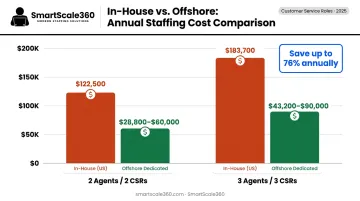
The offshore range reflects lower-end to higher-end skill tiers. Even at the top of that range, the savings versus in-house are substantial.
When In-House Might Still Win
- Deep proprietary knowledge required that takes months to build
- Regulated industries where data sovereignty makes offshore legally complex
- Businesses that already have underutilized in-house staff available to absorb volume
Hidden Costs Most Businesses Overlook
The quoted hourly or monthly rate is rarely the final number. Several charges can add up fast if you don't ask the right questions upfront.
Setup, Onboarding, and Training Fees
Many providers charge a one-time fee for recruiting, onboarding, and product-specific training. Industry benchmarks put this range at $500–$2,500 per agent. Some providers — including SmartScale360 — charge no setup fee, which removes this line item entirely. Ask every provider upfront whether onboarding costs are bundled or billed separately.
QA, Management, and Reporting Add-Ons
QA oversight, performance dashboards, and account management are sometimes billed separately as a percentage of total cost. Always request a fully itemized quote — if a provider gives you a single monthly number, ask specifically what's excluded. SmartScale360's flat monthly model includes management and reporting within the agreed scope, but as with any provider, confirm the full scope in writing before signing.
Scaling and Flexibility Penalties
Some providers charge premium rates for rapid scaling during peak seasons, or apply exit fees for reducing team size before a contract term ends. Before signing:
- Ask specifically whether there are costs to add or remove agents mid-contract
- Confirm whether seasonal scaling triggers a rate change
- Request the termination clause in writing
SmartScale360's model has no long-term contract and allows package modifications at any time — which eliminates this risk category for their clients.
How to Budget for Customer Service Outsourcing
The right budget isn't the lowest number. It's the one that reflects your actual support needs, your growth trajectory, and the total cost of ownership.
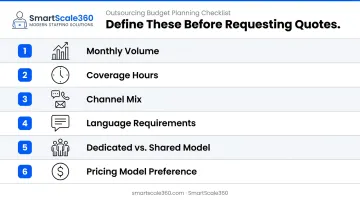
Before requesting quotes, define these inputs:
- **Monthly ticket or call volume** — including seasonal peaks, which determine minimum agent count
- Coverage hours — standard business hours vs. extended or 24/7
- Channel mix — phone, email, chat, or some combination (each has different per-interaction costs)
- Language requirements — English-only or multilingual — and whether accent-neutral communication is a priority for your customers
- Dedicated vs. shared model — based on volume consistency and brand-voice requirements
- Pricing model preference — per-agent monthly, per-hour, or per-ticket, depending on budget predictability goals
Once you have those inputs, request fully itemized quotes from at least two to three providers. Line items to confirm explicitly:
- Base agent cost (monthly or hourly)
- Setup, onboarding, or recruitment fees
- QA and reporting inclusion or add-on cost
- Software licensing or integration fees
- After-hours or holiday surge premiums
- Scaling and exit flexibility terms
A reputable outsourcing partner will walk through these items without hesitation. If a provider gives you a single blended rate and resists breaking it down, ask for itemization in writing before signing anything.
Frequently Asked Questions
How much does outsourcing customer service cost?
Offshore agents (Philippines, India) typically run $8–$15/hour or $1,200–$2,500 per agent per month based on platform benchmarks. Nearshore (Latin America, Eastern Europe) runs $14–$22/hour, while US onshore agents range from $30–$45/hour. Monthly per-agent costs vary based on skill level, channel mix, and service complexity.
What is the 10/5/3 rule in customer service?
The 10/5/3 rule is an in-person hospitality guideline covering proximity-based acknowledgment and greeting — not a contact center standard. Outsourced teams are contracted to SLA benchmarks by channel, such as live chat under one minute and email within four to twelve hours.
Is outsourcing customer service cheaper than hiring in-house?
For most SMBs, yes. A US customer service rep costs roughly $61,000 per year in wages and benefits alone — before office space, equipment, and management overhead. Two offshore dedicated agents run $28,800–$60,000 annually, with those overhead costs eliminated.
What hidden costs should I watch for when outsourcing customer service?
The most common surprises are setup and onboarding fees ($500–$2,500 per agent at some providers), QA and reporting billed as add-ons, after-hours or holiday surge premiums (typically 15–30% above base), and contract exit or scaling penalties. Always request a fully itemized quote before signing.
Which pricing model is best for small businesses outsourcing customer service?
A dedicated per-agent flat monthly model suits SMBs with moderate, predictable volume — offering cost control and consistency. Shared agent models fit lower or variable volumes, while per-ticket pricing works best for high-volume, simple interactions.
How many agents do I need when outsourcing customer service?
Agent count depends on your monthly ticket or call volume, response time targets, and coverage hours. A reputable outsourcing partner — including SmartScale360 — will help calculate the right team size during the initial consultation based on your specific inputs.