Building a quality in-house support team is expensive, time-consuming, and often out of reach for SMBs. That's why more businesses are turning to BPO — outsourcing customer service to specialized providers who handle support operations at a fraction of the in-house cost.
This guide covers everything you need to know: what customer service BPO actually is, its benefits and challenges, the skills to look for, and the best practices that separate high-performing outsourcing partnerships from disappointing ones.
Key Takeaways
- BPO customer service means outsourcing support to a dedicated third-party provider that acts as an extension of your team.
- Outsourcing can reduce labor costs by up to 60–70% while enabling 24/7 coverage through offshore talent markets like the Philippines.
- Key risks — brand voice drift, data security, and quality gaps — are manageable with the right partner and clear processes.
- Strong BPO reps combine communication skills, product knowledge, and emotional intelligence to deliver consistent support.
- Success hinges on clear SLAs, solid onboarding, and a dedicated (not shared-pool) staffing model.
What Is Customer Service in BPO?
Gartner defines customer service BPO as the delegation of customer service business process activities to third-party providers — covering customer interactions across voice, email, chat, and digital channels. In plain terms: instead of hiring, training, and managing a support team internally, a business contracts that work to a specialized external provider.
Customer service BPO specifically covers functions like:
- Handling inbound inquiries via phone, email, live chat, and social media
- Processing orders and updating customer records
- Resolving complaints and managing escalations
- Outbound follow-ups, satisfaction surveys, and renewal reminders
- Technical support, from basic FAQs to complex troubleshooting
Shared-Pool Call Centers vs. Dedicated Offshore Staffing
This distinction matters enormously for SMBs. Most people picture BPO as a large call center where agents rotate across dozens of client accounts — answering calls for one company in the morning and another in the afternoon. That shared-pool model works for high-volume enterprises but creates real problems for smaller businesses that need brand consistency.
Dedicated offshore staffing flips that model. Specific agents are assigned exclusively to one business, learning its products, tone, policies, and customers over time. SmartScale360, for example, places dedicated remote staff members who work solely for the client — not split across multiple accounts — and integrates directly into the client's existing software, scheduling, and communication tools.
For a homecare franchise or law firm where a single poor interaction can damage reputation, this distinction isn't minor. A generalist reading a script handles volume. A dedicated agent handles your customers.
How BPO Customer Service Works in Practice
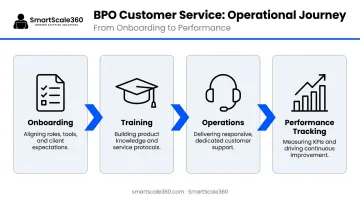
The operational flow is straightforward:
- Onboarding — The client provides documentation: brand guidelines, product details, FAQs, escalation procedures, and policies.
- Training — The BPO provider trains agents on the client's specific context and communication standards.
- Operations — Agents handle customer interactions through agreed channels, using the client's existing CRM or ticketing tools.
- Performance tracking — Both parties monitor results against defined KPIs and service-level agreements (SLAs).
Modern BPO providers bring CRM integration, ticketing systems, and AI-assisted workflows to the table. Clients typically don't need to invest in new infrastructure to get started — the provider's tooling slots into existing operations.
Key Benefits of BPO Customer Service for SMBs
Significant Cost Reduction
In-house customer service carries fixed overhead that compounds quickly: salaries, benefits, payroll taxes, office space, equipment, and HR management. Outsourcing converts that fixed cost structure into a predictable monthly expense — often at a fraction of the cost.
McKinsey research on customer-care operations cites 20% to 50% cost reduction potential through customer care transformation. For businesses using dedicated offshore staffing, the savings can go further. SmartScale360 clients, for instance, have documented labor cost reductions of up to 60% — as seen in a Home Instead franchise case study where three dedicated offshore staffing coordinators replaced the equivalent function of domestic hires at a fraction of the cost. The franchise owner's summary: "We hit the jackpot."
Access to a Larger Talent Pool
Offshore markets — particularly the Philippines — offer access to college-educated, English-proficient professionals who would be difficult or expensive to hire locally. The Philippine IT-BPM industry closed 2024 with 1.82 million jobs and $38 billion in revenue, reflecting the depth of available talent. The Philippines also ranks in the high-proficiency tier of the EF English Proficiency Index and scores above the global average in Pearson's four-skills English assessment.
Scalability Without Hiring Headaches
BPO providers can add support capacity during peak seasons, product launches, or growth spurts — and scale back down without the HR burden of hiring or layoffs. For industries like homecare, real estate, and franchises where demand swings seasonally, that flexibility is a genuine operational advantage.
24/7 Coverage Across Time Zones
Philippine-based staff operating during their business hours cover U.S. evening, overnight, and early morning shifts. Clients in different regions can offer around-the-clock support without managing multiple internal shifts or paying domestic staff overtime rates.
Focus on Core Business Activities
When routine support volume is handled externally, internal staff can redirect time toward revenue-generating work: business development, client relationships, and strategic growth. For founders and operators already stretched thin, that freed capacity often makes the difference between maintaining the status quo and actually scaling.

Common Challenges of BPO Customer Service and How to Overcome Them
Loss of Brand Voice
Outsourced agents who aren't deeply trained on a company's values, tone, and policies can come across as generic. The solution isn't more oversight — it's better onboarding. Provide comprehensive brand guidelines, real-scenario role-play exercises, and documented escalation procedures. Choose a partner willing to invest in this, not one focused purely on call volume.
A dedicated staffing model reinforces this: an agent working exclusively for your business builds genuine familiarity with your brand over time. A shared-pool agent rotating between clients simply cannot replicate that.
Data Privacy and Security Risks
Sharing customer data with a third party introduces real exposure, particularly for businesses in healthcare, financial services, or legal sectors. The KPMG 2026 Global Third-Party Risk Management Survey found only 18% of organizations have fully integrated third-party risk management with enterprise risk management, suggesting most businesses are under-prepared.
For healthcare businesses specifically, HHS confirms that HIPAA business associates are directly liable for certain HIPAA violations. Before signing any BPO agreement, vet the provider across these areas:
- Data security certifications and audit history
- Access controls and user permission policies
- Encryption standards for data in transit and at rest
- Regulatory compliance protocols for your specific industry
This is non-negotiable for regulated industries.
Communication and Cultural Barriers
Language nuances and cultural differences can create real friction in customer interactions. The most effective fix is selecting providers who screen rigorously for strong English fluency (not just functional adequacy) and cultural alignment with your customer base.
For US-facing businesses serving American consumers, this screening step should be a hard requirement during partner evaluation, not an afterthought.
Essential Skills to Look for in BPO Customer Service Representatives
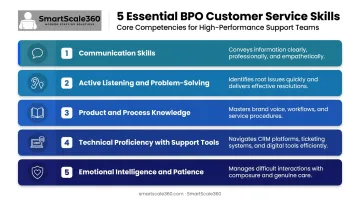
Not all support staff are equal. When vetting BPO candidates or evaluating a provider's talent pool, prioritize these competencies:
Communication skills (verbal and written) Strong English fluency — not just technical adequacy — is the baseline for US-facing businesses. Agents must adjust tone for different situations: a frustrated customer requires a different approach than a routine inquiry. Make fluency a non-negotiable screening criterion, not an afterthought.
Active listening and problem-solving Effective reps don't just read scripts. In practice, active listening means:
- Paraphrasing customer concerns before responding
- Asking clarifying questions rather than assuming
- Avoiding interruptions during the customer's explanation
- Confirming resolution before closing the interaction
SQM Group research found customer satisfaction is 35% higher when customers feel the agent showed genuine empathy.
Product and process knowledge Agents need command of the business's offerings, policies, and escalation procedures. This comes from thorough onboarding and a well-maintained knowledge base — ongoing, not a one-time training event.
Technical proficiency with support tools Familiarity with CRM platforms, ticketing systems (Zendesk, Freshdesk), live chat tools, and reporting dashboards is essential for efficiency and accurate record-keeping. Before committing to a provider, verify that candidates are already trained on your tools — or have a demonstrated track record of picking up new platforms fast.
Emotional intelligence and patience Handling difficult or upset customers requires composure. Reps with high emotional intelligence de-escalate tense interactions more effectively, reducing escalations and keeping customers from churning.
This is also one of the harder traits to teach after hiring — which is why it's worth screening for upfront rather than hoping it develops on the job.
Best Practices for Managing BPO Customer Service
Define Clear SLAs and KPIs Before Work Begins
Measurable performance standards create accountability. Common benchmarks to establish upfront:
- First-contact resolution (FCR): Salesforce benchmarks target around 70%; HDI guidance cites 70–80% for support centers
- Average handle time (AHT): General benchmark is approximately 5 minutes per interaction
- Customer satisfaction score (CSAT): Most teams target around 90%
- Escalation rate: Define the threshold and escalation pathway clearly
These benchmarks give both parties an objective way to evaluate success — and surface problems before they become patterns.
Invest in Thorough Onboarding and Ongoing Training
Provide agents with brand guidelines, product documentation, FAQs, and real-scenario exercises before they handle a single customer. Don't treat onboarding as a one-time event.
Schedule regular refreshers whenever products, policies, or promotions change. Agents who fall behind on product knowledge deliver inconsistent service — and customers notice.
Build a Hybrid Model for Sensitive Interactions
Not everything should go to BPO. A practical split:
| BPO-Ideal | Keep In-House |
|---|---|
| FAQs and routine inquiries | Major complaints or crisis situations |
| Order status and account lookups | VIP client relationships |
| Basic troubleshooting | Regulated disclosures or legal matters |
| Appointment scheduling | Complex, high-stakes negotiations |
Define a clear escalation pathway so agents know exactly when and how to hand off — before a difficult situation arises.
Monitor Quality Consistently
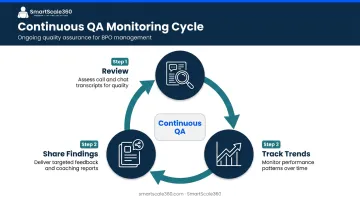
Quality doesn't maintain itself. Build structured audits into your workflow:
- Review call recordings, chat transcripts, and ticket resolutions against defined SLAs
- Share findings with agents and the BPO provider monthly — not just at contract renewal
- Track trends over time to catch recurring issues before they scale
Regular feedback, delivered consistently, is what keeps a BPO partnership improving rather than coasting.
Use Automation to Handle Volume, Not Replace Judgment
AI-powered chatbots and automated workflows can manage common, repetitive inquiries around the clock. Gartner predicts agentic AI will autonomously resolve 80% of common customer service issues by 2029, reducing operational costs by 30%. The goal isn't to replace human agents — it's to let technology handle volume so skilled staff focus where human judgment actually matters.
How to Choose the Right BPO Partner
Evaluate Industry Experience and English Proficiency
A BPO partner with experience in your industry onboards faster and requires less hand-holding. For homecare agencies, franchises, or law firms with specific compliance or communication requirements, industry familiarity translates directly into faster ramp-up and fewer costly misunderstandings.
For US-facing businesses, prioritize providers who screen rigorously for strong English communication skills and cultural alignment with American customer expectations. SmartScale360, for example, matches college-educated, English-speaking talent from the Philippines to specific client roles — with no setup fees or long-term contracts — making it a useful benchmark for what a low-friction entry model looks like.
Assess Transparency, Flexibility, and Pricing
Once you've confirmed industry fit, dig into the commercial terms. Look for:
- Clear, predictable pricing (flat monthly rates, not hourly variables)
- Flexibility to scale without punitive contract terms
- Transparent performance reporting
- Dedicated vs. shared agent model — ask specifically
Beware of low-cost providers who hide fees in setup costs, training charges, or rigid volume minimums. The cheapest option rarely delivers the brand consistency SMBs need.
Ask for References and Review Their QA Process
Pricing and flexibility tell you what a provider costs — references tell you whether they deliver. Request referrals from businesses in similar industries and ask how the provider handles underperformance, agent turnover, and service disruptions.
A strong QA process — regular audits, feedback loops, and clear escalation procedures — is a reliable sign of a partner built for the long term, not just the initial sale.
Frequently Asked Questions
What is the role of customer support in BPO?
In a BPO context, customer support reps act as the front-line representatives of the client business, handling inquiries, resolving issues, and maintaining customer relationships across channels like phone, email, and live chat. They operate as an extension of the internal team, following the client's brand standards and processes.
How do you handle customer support in BPO?
The BPO provider receives training and documentation from the client, then agents handle customer interactions through agreed channels. Performance is tracked against defined SLAs, with regular QA reviews ensuring quality and consistency over time.
What skills are required for BPO customer support?
The most critical skills are strong English communication (verbal and written), active listening and problem-solving, product and policy knowledge, proficiency with support tools (CRM, ticketing systems), and emotional intelligence for handling difficult interactions.
What are the main benefits of outsourcing customer service for small businesses?
The core benefits are cost reduction (fixed overhead becomes a predictable monthly expense), access to skilled talent, and 24/7 coverage without managing internal shifts. Businesses can also scale support up or down without the hiring and HR burden that comes with growing an in-house team.
What is the difference between a BPO call center and dedicated offshore staff?
A traditional BPO call center uses shared agent pools serving multiple clients at the same time. Dedicated offshore staffing assigns specific agents exclusively to one business, which produces deeper product knowledge, stronger brand voice alignment, more consistent service quality, and a lower risk of context-switching errors.
How do I know if my business is ready to outsource customer service?
Strong indicators: your support volume is growing faster than your team can handle, you're missing response time targets, you need coverage outside standard business hours, or your internal team spends too much time on routine inquiries instead of strategic work.