Offshore teams solve more than a cost problem. They solve a capacity problem. When skilled professionals are hard to find locally and US employer compensation averages $46.60 per hour in total costs, building a dedicated offshore team becomes a strategic decision, not just a financial one.
This article is a practical playbook for SMB owners and entrepreneurs who want to manage offshore teams effectively — from setting up communication systems that actually work, to choosing a partner that handles the administrative complexity so you can stay focused on growth.
Key Takeaways
- Offshore teams give SMBs access to college-educated, English-speaking talent that's difficult to source and afford locally
- US employers are facing a widening talent shortage — offshoring fills the gap
- Structured communication, clear goals, and a culture of inclusion determine whether offshore teams thrive
- Choosing the right offshore partner eliminates most operational headaches before they start
- Look for offshore partners offering dedicated staff, transparent pricing, and no long-term contracts
Why SMBs Are Building Offshore Teams
An offshore team is not a pool of freelancers you tap on demand. It's a group of dedicated professionals working exclusively for your business from another country — people integrated into your workflows, accountable to your goals, and genuinely invested in your culture.
The distinction matters. Freelancers deliver tasks; offshore team members build institutional knowledge.
The Strategic Case for Offshoring
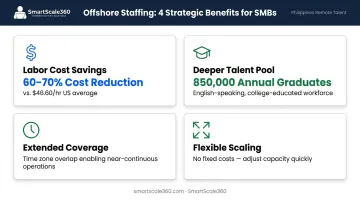
Labor cost savings are the headline number. US private-industry employer compensation averages $46.60 per hour when wages and benefits are combined. The Philippines offers substantial labor-arbitrage potential by comparison, and SMBs working with providers like SmartScale360 report cost reductions of 60–70% depending on role type and industry.
The talent pool is deeper than most SMBs realize. The Philippines generated 1.82 million IT-BPM jobs and $38 billion in revenue in 2024. The country ranks 28th globally in English proficiency on the EF English Proficiency Index, with roughly 850,000 graduates entering the workforce annually from over 2,400 higher-education institutions. That's a depth of educated, English-speaking talent most local SMB markets can't match.
Time zone gaps can work in your favor. With the right handoff processes, offshore coverage extends your operational window rather than limiting it. A US-based business with Filipino team members handling scheduling, customer inquiries, or recruiting can maintain near-continuous coverage across the standard business day.
Scaling up doesn't have to mean scaling risk. Offshore staffing lets you add capacity quickly without the fixed costs of benefits, equipment, office space, and local employment law compliance. For law firms, homecare agencies, and seasonal businesses where demand fluctuates, that flexibility is a meaningful operational advantage.
The Real Challenges (and How to Frame Them)
Every offshore team faces predictable friction. The businesses that succeed treat these as manageable systems problems, not deal-breakers.
Three Challenges Worth Knowing Up Front
Communication gaps — Miscommunication costs US businesses an average of $12,506 per employee per year according to Grammarly's 2023 State of Business Communication report. Offshore teams compound this risk through time zone distance and the absence of non-verbal cues. The solution is documented workflows and defined communication protocols — not more meetings, which tend to create noise rather than clarity.
Cultural misalignment — Different regions have different communication norms, holiday calendars, and professional expectations. Left unaddressed, this creates friction. Sourcing from regions with strong cultural affinity to the US — like the Philippines, where American English has been the educational standard since early schooling — naturally narrows that gap before onboarding even begins.
Team cohesion — Remote workers who feel disconnected from company culture disengage quickly. SHRM found that 85% of employees feel more engaged when leaders communicate transparently. The challenge of cohesion is a leadership challenge as much as a logistics one.
Each of these challenges has a practical fix — and the sections below break down exactly how to apply them.
7 Strategies for Successfully Managing Your Offshore Team
1. Establish Crystal-Clear Communication Protocols
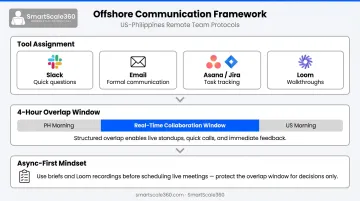
Start with a Communication Charter — a simple document that defines which tools to use for which types of communication. For example:
- Slack → Quick questions, daily check-ins, team updates
- Email → Formal communication, external stakeholders
- Asana or Jira → Task-level comments and project tracking
- Loom → Video walkthroughs for complex processes
Beyond tool assignment, protect a 4-hour daily overlap window for real-time collaboration. This is the window where US Eastern or Central hours intersect with the Philippine work day in an evening shift arrangement. Use this window for stand-ups, sprint planning, and decisions that require back-and-forth.
Outside that window, adopt an async-first mindset. Before scheduling a meeting, ask whether the same outcome could be achieved with a well-written brief or a short Loom video. Microsoft's research found workers send or receive 50+ messages outside core hours, with 29% active by 10 p.m. — meeting-heavy cultures push communication into unsustainable hours for everyone on the team.
2. Build a "One Team" Culture
How you treat offshore team members shapes how they show up. Contractors act like contractors; colleagues act like colleagues — and the difference shows in daily output.
Start with structured onboarding that covers your company's mission, values, team structure, and day-to-day workflows — not just the job description. SHRM research shows that standardized onboarding produces 50% greater new-hire productivity. A Filipino scheduler who understands why your homecare agency exists will make better decisions at 7 p.m. than one who only knows the task list.
Practical rituals to reinforce inclusion:
- A dedicated "watercooler" Slack channel for non-work conversation
- Celebrating birthdays and work anniversaries publicly
- Including offshore team members in company-wide announcements and wins
- Introducing new offshore hires to the full team, not just their direct manager
This isn't soft — it's the difference between an engaged employee and a disengaged one. Gallup found employees receiving valuable feedback are 5x more likely to be engaged and 48% less likely to be looking for another job.
3. Use the Right Technology Stack
You don't need a complex setup — you need the right categories covered:
| Category | Purpose | Examples |
|---|---|---|
| Project Management | Task visibility, deadlines, accountability | Asana, Trello, Jira |
| Communication | Daily interaction and quick updates | Slack, Microsoft Teams |
| Documentation | Single source of truth for processes | Notion, Confluence, Google Drive |
| Video Walkthroughs | Async training and process explanation | Loom |
| Time Tracking | Workflow visibility and accountability | Time Doctor, Hubstaff |
SmartScale360 provides Google Business Suite as a baseline communication and collaboration platform, with the flexibility for clients to integrate whatever tools their business already uses. The goal is to make offshore team members feel and function like natural extensions of your existing setup.
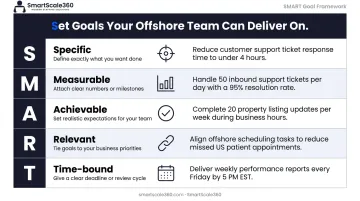
4. Set SMART Goals and Document Everything
Vague expectations produce vague results. Apply SMART criteria to every offshore role:
- Specific — "Handle all inbound scheduling calls" not "help with scheduling"
- Measurable — Define what success looks like numerically where possible
- Achievable — Match workload to capacity realistically
- Relevant — Tie each task to a business outcome
- Time-bound — Assign clear deadlines, even for recurring tasks
Pair goal-setting with thorough documentation. Locke and Latham's landmark research across 35 years of goal-setting studies confirmed that specific, difficult goals consistently outperform vague "do your best" directives. Document your processes, your code of conduct, your escalation paths — everything lives in a shared knowledge base your offshore team can access without having to ask.
5. Empower Your Team and Maintain Accountability
Micromanagement is the fastest way to demotivate a high-performing offshore team member. Instead, assign ownership — give each person a domain they're responsible for, not just tasks to execute.
Pair empowerment with structure:
- Daily stand-ups — 15 minutes to surface blockers and align on priorities
- Weekly 1-on-1s — Focus on development, challenges, and long-term goals
- Monthly reviews — Tie performance back to SMART goals
These check-ins aren't about supervision. They're about removing friction and demonstrating that you're invested in their success.
6. Build a Consistent Feedback Loop
Feedback works when it's specific, timely, and two-directional. Don't wait for quarterly reviews to tell someone what's working or what isn't.
Effective feedback practices:
- Acknowledge strong performance publicly and specifically ("Your scheduling follow-through this week meant zero missed shifts")
- Address problems early with behavior-focused language, not personality judgments
- Create a genuine channel for offshore team members to surface concerns or process improvement ideas
The second part — listening — is often overlooked. Your offshore team sees operational friction you don't. A monthly "what's slowing you down?" conversation often surfaces fixes that improve efficiency across the entire organization.
7. Invest in Professional Development
Professionals who see a future with your company stay longer and perform at a higher level. When a skilled offshore coordinator has been embedded in your operations for 18 months, replacing that institutional knowledge costs far more than any training investment.
Ways to invest:
- Provide access to relevant online courses or certifications
- Assign a senior onshore team member as an informal mentor
- Create a visible path for expanded responsibility over time
Small investments in development compound over time — and they signal to your team that their growth matters to you, not just their output.
Choosing the Right Offshore Partner
The quality of your offshore partner determines how hard the rest of this becomes. A strong partner eliminates most of the administrative and compliance complexity (classification, payroll, HR, and candidate vetting) so you can focus on management rather than operations.
What to Look for in a Partner
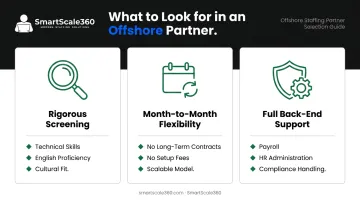
The right partner does more than source candidates. Look for these three things:
- Rigorous screening: Vets for technical skills, English proficiency, and cultural fit — not just volume. Sourcing from regions with a strong talent pipeline, like the Philippines, reduces integration friction from day one.
- Month-to-month flexibility: Long-term contracts and setup fees add unnecessary risk for SMBs. A flexible model lets you scale up or down as business demands shift, without sunk-cost pressure.
- Full back-end support: Payroll, HR administration, and compliance — not just recruitment. The DOL's 2024 final rule on worker classification makes proper classification non-negotiable, and a good partner handles that on your behalf.
Companies like SmartScale360 are built specifically for SMBs, offering dedicated, college-educated staff from the Philippines with no long-term contracts or setup fees. They handle the HR and administrative heavy lifting, including candidate screening, Google Business Suite provisioning, and ongoing support, so you can focus on building your business rather than managing compliance.
Consider the Home Instead franchise case: Lynette Stroud initially planned to hire one remote scheduler. After the candidate presentation, she hired three. Those three Staffing Coordinators — John, Yanni, and Ice — took over full scheduling, billing support, shift documentation, and seven-day coverage.
Within months, clients were requesting them by name. Labor costs dropped by up to 60%. Lynette's own assessment: "We hit the jackpot." The difference was a partner who handled the recruitment so she could focus entirely on the integration.
Conclusion: Scale Smartly with a Global Team
Managed well, offshore teams give SMBs access to skilled talent, extended operational coverage, and cost advantages that corporations have quietly kept to themselves for years.
The formula isn't complicated: clear communication protocols, documented processes, a culture that includes everyone, the right tools, and a staffing partner who handles sourcing and screening so you don't have to.
Put those pieces in place, and the advantages compound quickly. The talent shortage shows no signs of easing, and labor costs remain at their highest in over two decades. Businesses that build offshore team management into their operations now will hold a structural advantage over those still waiting.
Ready to build your high-performing offshore team without the guesswork? Contact SmartScale360 at 802-345-9548 or zach@smartscale360.com to learn how SmartScale360 matches you with the right offshore talent for your specific roles.
Frequently Asked Questions
What does an offshore team mean?
An offshore team is a group of dedicated professionals located in a different country who work exclusively for your business as long-term team members. Unlike freelancers, they're fully integrated into your operations, accountable to your workflows, and aligned with your company culture.
What is the difference between an offshore team and an onsite team?
The primary difference is physical location. Onsite teams share a workspace; offshore teams work remotely from another country. This requires intentional communication strategies, digital tools, and management practices that replace the natural coordination that happens in a shared office.
How do you manage offshore teams effectively?
Four core principles make the biggest difference:
- Establish clear communication protocols
- Build team culture through inclusive onboarding and regular rituals
- Set SMART goals with full documentation
- Use the right tools for project management and collaboration
What are the most essential tools for managing an offshore team?
The key categories are project management (Asana, Jira), daily communication (Slack, Microsoft Teams), documentation (Notion, Google Drive), and video walkthroughs for async training (Loom). SmartScale360 provides Google Workspace as a baseline for all clients.
How do you build a strong company culture with an offshore team?
Start with structured onboarding that covers company values and introduces the full team. Reinforce inclusion through regular virtual touchpoints, public recognition, and treating offshore members as full colleagues with the same accountability and belonging as anyone in-house.
Is offshoring only for large corporations?
No. Modern providers like SmartScale360 have built their models specifically for SMBs and startups. Flexible terms, no setup fees, and dedicated staff models make offshore staffing as accessible for a 10-person business as for an enterprise — and the cost savings of 60-70% on labor tend to have an even greater proportional impact at smaller scale.