
Introduction
Running a business means constantly doing things that aren't your actual business. Payroll, scheduling, customer intake, lead follow-up — these functions are necessary, but they pull owners and teams away from the work that actually generates revenue.
That's exactly why BPO has accelerated across virtually every industry. According to Grand View Research, the global BPO market reached $328.4 billion in 2025 and is projected to grow to $695.8 billion by 2033 at a 9.9% CAGR. Labor costs are a primary driver — the BLS reports that wages, salaries, and benefits together represent the dominant share of private-industry compensation, and for many businesses, payroll is the single largest line item on the budget.
Despite how common BPO has become, many small business owners misunderstand how it actually works — which functions to outsource, how to select a provider, and how to manage a remote team effectively. Poor execution leads to missed savings and real frustration.
This guide gives you a clear, practical breakdown of BPO so you can decide whether it belongs in your business — and how to use it without the common pitfalls.
Key Takeaways
- BPO is the practice of contracting a third-party provider to manage specific, ongoing business functions — not one-off tasks
- Covers both back-office (HR, payroll, accounting) and front-office (customer service, sales, marketing) functions
- Follows a clear process: identify the right tasks, select a provider, define the engagement, and track performance
- Primary drivers are cost reduction, access to specialized expertise, and freeing internal teams to focus on growth
- BPO is no longer just for large corporations — SMBs now have the same access through offshore staffing
What Is Business Process Outsourcing (BPO)?
BPO is when a company contracts an external organization to manage an entire business function — not a single task, but an ongoing operational responsibility. According to Gartner, BPO involves delegating one or more business processes to an external provider that owns, administers, and manages those processes against defined performance metrics.
What Separates BPO from Other Outsourcing
BPO is not:
- Hiring a freelancer for a one-time project
- Subscribing to software that automates a task
- Bringing in a consultant for a short engagement
BPO involves structured, ongoing delivery of a complete business process by an external team — with accountability tied to performance metrics.
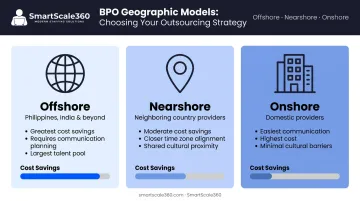
The Three Geographic Models
| Model | Description | Tradeoff |
|---|---|---|
| Offshore | Provider in another country (Philippines, India) | Greatest cost savings; requires communication planning |
| Nearshore | Provider in a neighboring country | Moderate savings; closer time zone alignment |
| Onshore | Provider within the same country | Easier communication; higher cost |
Two Broad Categories
- Back-office BPO — Internal operations: HR, payroll, accounting, compliance, data entry
- Front-office BPO — Customer-facing: support, sales, scheduling, marketing
Sub-types like Knowledge Process Outsourcing (KPO) and Legal Process Outsourcing (LPO) fall under this umbrella, covering more specialized or knowledge-intensive functions. Understanding these categories sets the stage for the bigger question: how does a BPO arrangement actually work in practice?
How Does BPO Work?
BPO moves through a predictable sequence: identifying what to hand off, choosing the right provider, structuring the engagement, and managing for results.
Identifying the Right Processes to Outsource
The process typically starts when a business recognizes it's spending too much time or money on something that isn't its core strength. Common triggers include:
- Team overload on administrative or repetitive tasks
- Skills gaps that would be expensive to fill in-house
- Rising labor costs outpacing growth
- Scaling pressure requiring rapid capacity increases
Not all processes are suited for BPO. Functions involving high-level strategic decisions or proprietary knowledge typically stay in-house. Transactional and repeatable processes — payroll, customer intake, data entry, scheduling — are prime candidates.
Selecting a BPO Provider
Vendor selection starts with defining scope, then moves through researching providers, reviewing proposals, checking pricing, and assessing cultural fit.
Key criteria to evaluate:
- Proven track record in your specific industry
- Strong English-language proficiency (especially for offshore providers)
- Clear data security practices and confidentiality protocols
- Transparent, predictable pricing with no hidden fees
- Flexibility to scale up or down as needs shift
For SMBs that need dedicated remote staff rather than a large call center model, providers like SmartScale360 match businesses with college-educated, English-speaking offshore talent from the Philippines — with no contracts or setup fees. This makes BPO accessible at a fraction of traditional staffing costs.
Establishing the Engagement
The engagement is structured through:
- Defining roles and responsibilities for each function
- Establishing service level agreements (SLAs) that specify performance standards
- Setting up communication protocols — check-ins, reporting cadence, tools
- Onboarding the BPO team to existing systems, workflows, and expectations
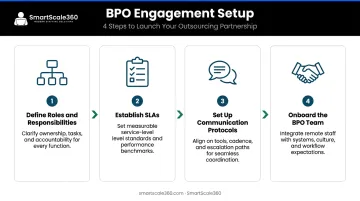
This transition phase is critical. Clear process documentation directly affects how quickly the provider delivers results. Deloitte's outsourcing lifecycle framework describes SLAs as covering service-delivery performance, customer satisfaction, relationship alignment, and transformation progress. It also recommends building in periodic SLA reviews from the outset.
Managing for Output and Results
Ongoing BPO management includes regular check-ins, performance reviews against SLAs, feedback loops, and adjusting scope as the business evolves. The output: freed internal capacity, reduced labor costs, consistent execution, and more time directed toward revenue-generating work.
What Business Functions Are Commonly Outsourced?
Back-Office Functions
These are the most commonly outsourced across industries, according to Clutch's survey of U.S. small business owners, with accounting leading at 37%:
- HR administration and onboarding
- Payroll processing and tax compliance
- Bookkeeping and financial reporting
- Recruitment and candidate screening
- Data entry and records management
- IT support
Finance and accounting BPO held the largest service share at 21.4% of the global BPO market in 2025 (Grand View Research).
Front-Office Functions
Deloitte Digital's 2023 Global Contact Center Survey found 58% of service organizations already outsource at least some agent capacity, with that figure projected to reach 64%. Front-office functions outsourced most commonly include:
- Customer service and support
- Appointment scheduling
- Lead qualification and follow-up
- Social media management and content creation
- Sales support and outreach
Industry-Specific Examples
The right mix varies by industry:
- Homecare agencies — caregiver scheduling coordination, client intake, recruiting support
- Law firms — document review, legal research, client intake and follow-up (Thomson Reuters found ~66% of surveyed law firms outsource support roles)
- Real estate businesses — transaction coordination, lead follow-up, CRM management
- Marketing agencies — content creation, SEO support, overflow campaign work
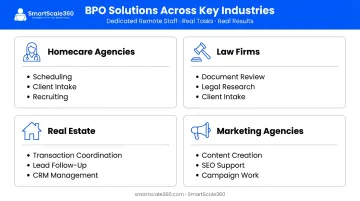
These categories aren't theoretical. SmartScale360 places dedicated remote staff across all of them. For a Home Instead franchise managing 100+ clients and 250+ caregivers, SmartScale360 placed three remote Scheduling Coordinators. They covered full caregiver scheduling, billing support, shift documentation, and mileage tracking across staggered shifts Monday through Sunday.
Benefits of BPO for Small and Growing Businesses
Cost Reduction
Labor is typically the largest operational expense for most businesses. BPO — especially offshore BPO — sharply cuts costs by eliminating the overhead tied to full-time in-house employees:
- Employee benefits (health insurance, PTO)
- Office space and equipment
- Payroll taxes and HR administration
- Recruitment and training costs
SmartScale360's clients report labor cost reductions of up to 60–70% compared to equivalent domestic hires. That figure accounts for total employment cost, not just base salary.
Focus on Core Business
When non-core tasks move to an external team, business owners reclaim time for work that actually drives growth. A law firm attorney, for instance, shouldn't be managing scheduling or chasing down documentation: that time belongs on casework and client relationships. BPO makes that trade possible without sacrificing operational quality.
Access to Specialized Expertise
BPO providers are specialists in the functions they deliver. That specialization means businesses access capabilities — compliance knowledge, customer service training, technical skills — that would take years and significant budget to build in-house. You get the expertise without carrying the cost of developing it.
Scalability and Flexibility
BPO allows businesses to scale up or down based on demand without the friction of hiring or laying off staff. This is particularly valuable for:
- Seasonal businesses with variable workloads
- Fast-growing SMBs expanding into new markets
- Franchises managing multiple locations
Predictable Budgeting
Unlike the variable costs of in-house staffing — raises, turnover, unplanned recruitment — BPO engagements offer transparent monthly pricing. SmartScale360's flat monthly fee model, with no setup fees and no long-term contracts, is a direct example of how this predictability works in practice.
Potential Risks of BPO (And How to Manage Them)
Data Security and Confidentiality
When a third party handles sensitive business or customer data, risk is real. ISACA reported a 49% year-over-year increase in third-party security incidents as of May 2024. Mitigate this by:
- Vetting providers for security certifications (SOC reports, HIPAA compliance where relevant)
- Requiring clear confidentiality agreements and NDAs
- Confirming secure access protocols before granting system access
Loss of Control and Quality Consistency
External teams can drift from your standards if expectations aren't clearly set from day one. To keep quality consistent:
- Establish clear SLAs before work begins
- Document processes before handing them off
- Schedule regular performance reviews
- Build periodic SLA renegotiation into the contract (a practice Deloitte recommends)
Communication and Alignment Challenges
Offshore BPO can introduce time zone friction if not managed well. Providers that prioritize English proficiency, cultural alignment, and dedicated (not pooled) staffing models reduce this risk considerably. SmartScale360, for example, aligns each remote staff member's working hours to the client's schedule, including nights, weekends, and custom shifts, which removes the typical time zone barrier entirely.
Frequently Asked Questions
What is business process outsourcing?
BPO is the practice of contracting a third-party provider to manage specific, ongoing business functions — covering both back-office operations like HR and payroll and front-office functions like customer service and sales support. The external provider owns and manages the process against defined performance metrics, freeing the business to focus on its core work.
What are examples of business process outsourcing (BPO)?
Common examples include a homecare agency outsourcing caregiver scheduling and client intake; a law firm outsourcing document review and administrative coordination; a real estate business outsourcing transaction coordination and lead follow-up; or a marketing agency outsourcing content creation and social media management.
Which is better: BPS or BPO?
BPS (Business Process Services) is a broader category that includes the technology platforms used to deliver services. BPO specifically refers to outsourcing the people-driven execution of a process. For most SMBs evaluating cost and operational relief, BPO through a staffing-focused provider is the more practical and accessible approach.
What is the difference between offshore, nearshore, and onshore BPO?
Offshore BPO involves providers in distant countries (Philippines, India) and typically offers the greatest cost savings. Nearshore means working with providers in neighboring countries. Onshore means domestic outsourcing. Each involves different tradeoffs in cost, time zone alignment, and communication ease.
What are the biggest risks of business process outsourcing?
The most common risks are:
- Data security exposure when sensitive information is shared with a third party
- Inconsistent quality if expectations and SLAs aren't clearly defined
- Communication challenges in offshore arrangements
All three are manageable through careful provider selection, structured onboarding, and regular performance reviews.
Is BPO a good option for small businesses and entrepreneurs?
Yes — offshore staffing providers have made BPO accessible at price points once reserved for large corporations. The key is finding a provider experienced with smaller, growth-focused businesses rather than enterprise-scale call centers. Look for a dedicated staffing model rather than a shared agent pool; providers like SmartScale360 are built specifically for this segment.