The result: many businesses are treating IT outsourcing less as a cost-cutting measure and more as a growth strategy. According to Clutch, 83% of U.S. small businesses planned to maintain or increase outsourced-service spending in 2023, with 22% actively seeking new outsourced IT providers.
This article breaks down the most impactful advantages of IT outsourcing — what each benefit actually changes in your operations, which metrics it moves, and when it matters most.
Key Takeaways
- Outsourcing IT roles replaces unpredictable hiring costs with a flat, predictable monthly rate
- SMBs gain access to skilled remote IT staff — web development, support, and tech coordination — without full-time hiring overhead
- Scalable IT capacity means businesses can expand or contract support without hiring cycles
- Avoiding IT outsourcing costs more than money — slower resolution times and leadership distraction compound quickly
- SmartScale360 provides dedicated, college-educated offshore IT staff at flat monthly rates with no contracts or setup fees
What Is IT Outsourcing?
IT outsourcing means contracting external specialists to manage specific technology functions — help desk support, infrastructure management, cybersecurity, software operations, or web development — instead of staffing those roles in-house.
The model scales to any business size. A 10-person company might hire a single offshore IT administrator. A 200-person firm might delegate its entire support desk to an external team. Either way, the decision comes down to the same practical question: what do you actually need, and what's the most cost-effective way to get it?
Businesses outsource IT to:
- Cut labor and overhead costs
- Access specialized expertise they can't afford to hire full-time
- Scale capacity without committing to permanent headcount
- Free leadership time for revenue-generating work
Key Advantages of IT Outsourcing for Business Growth
The benefits below connect directly to cost, efficiency, quality, risk reduction, and scalability. They also compound: early cost savings create budget room for growth investments, while expert management frees your team from the day-to-day troubleshooting that crowds out strategic work.
Advantage 1: Significant Reduction in Labor and Operational Costs
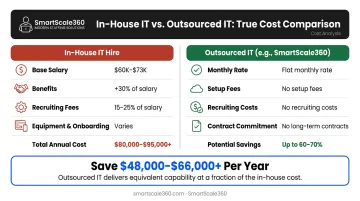
Labor cost reduction is the most immediate and measurable payoff. When you outsource IT, you replace a full-time salary, benefits, payroll taxes, equipment, and office space with a predictable service fee.
Consider what a single in-house IT hire actually costs. The BLS reports median annual wages of $60,340 for computer user support specialists and $73,340 for network support specialists — before benefits. With benefits adding roughly 30% on top, a mid-level IT hire quickly runs $80,000–$95,000 annually in total employment cost. That doesn't include recruiting fees (typically 15–25% of salary), equipment, or onboarding time.
Outsourcing replaces all of that with a flat monthly rate. SmartScale360, for example, offers dedicated offshore IT staff at flat monthly rates (no setup fees, no long-term contracts) with clients reporting labor cost reductions of up to 60–70% compared to equivalent in-house hires.
KPIs this moves:
- Total labor cost as a percentage of revenue
- Monthly IT budget variance
- Cost-per-hire and employee overhead ratio
- Operating margin
When it matters most: This advantage hits hardest for businesses scaling past 10–50 employees, where the jump to a full in-house IT team becomes a major fixed cost with a disproportionately small strategic return.
Advantage 2: Access to Specialized Expertise Without Full-Time Overhead
A single in-house IT generalist cannot cover cybersecurity, cloud infrastructure, network management, compliance, help desk operations, and software development. Yet that's exactly what many SMBs expect from one or two internal hires.
Outsourcing gives you access to a team of specialists instead. Providers maintain certified staff who stay current on evolving threats, tools, and best practices. You benefit from that collective expertise without bearing the cost of continuous internal training or certification renewals.
The talent shortage makes building in-house expertise even harder. ConnectWise research found 76% of SMBs lack the in-house skills to properly address security issues — and 94% had experienced at least one cyberattack, with 78% concerned a cyberattack could put them out of business entirely.
When specialists manage specific IT domains daily, decision quality improves. Resolution times drop and security gaps close. A generalist juggling five areas at once simply cannot match that depth.
SmartScale360's staffing model reflects this: dedicated offshore staff are matched to specific IT support functions (help desk, QA, web development) based on skills and experience assessed during an initial consultation, rather than placed as a generic all-purpose hire.
KPIs this moves:
- Mean time to resolution (MTTR)
- System uptime percentage
- Security incident frequency
- IT-related error rates
When it matters most: During cloud migrations, compliance upgrades, or any period of rapid technology change , where the cost and timeline of hiring and training internally would delay outcomes by months.
Advantage 3: Scalability That Aligns IT Capacity with Business Demand
In-house IT teams are sized for average demand. That means you're either overstaffed during slow periods or understaffed when demand spikes , and you're paying full-time costs either way.
Outsourcing makes IT costs variable rather than fixed. A business managing a seasonal surge, rapid headcount growth, or a major infrastructure project can expand IT support on short notice. When demand normalizes, support scales back without layoffs or idle labor.
Compare this to the alternative: SHRM's 2025 benchmarking data puts the average non-executive cost-per-hire at $5,475, with screening and interviewing alone averaging 8–9 days each. That's before the actual start date, onboarding period, or productivity ramp-up. For SMBs, depending on in-house hiring to respond to growth spikes is a structural risk.
KPIs this moves:
- IT staffing cost variability
- Time-to-resource (how quickly new IT capacity is deployed)
- Project completion velocity
- Support ticket SLA compliance during peak periods
When it matters most: For businesses in active growth phases, managing multi-location expansions, or operating in industries with seasonal demand cycles , where inflexible in-house IT capacity creates either waste or bottlenecks.
What Happens When IT Outsourcing Is Missing or Ignored
Businesses that try to manage IT entirely in-house — without sufficient expertise or budget — don't just face higher costs. They face operational drag that compounds over time.
Common consequences include:
- Inconsistent system performance and longer downtime incidents that affect productivity across the whole business
- Higher error rates from generalist staff handling specialist tasks they weren't trained for
- Reactive firefighting that delays strategic projects and pulls leadership into operational problems
- Hidden cost accumulation — turnover, retraining, and emergency fix expenses that rarely show up in a single budget line
- Security exposure that compounds fast — CISA notes small businesses are three times more likely to be targeted by cybercriminals than larger companies
For SMBs, this is especially costly. Labor already accounts for up to 70% of total business expenses — when that spend is concentrated on reactive IT management instead of growth-driving work, the gap between lean and overextended operations widens fast.
How to Get the Most Value from IT Outsourcing
IT outsourcing delivers its best results when treated as an ongoing partnership — not a one-time vendor transaction. Before engaging a provider, define the specific outcomes you want to affect: cost targets, uptime standards, response time benchmarks.
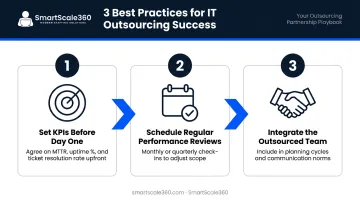
Three practices that separate high-performing outsourcing arrangements:
- Set KPIs before day one: Agree on metrics (MTTR, ticket resolution rate, uptime %) at the start of the engagement, not after problems appear.
- Schedule regular performance reviews — Monthly or quarterly check-ins turn gaps into scope adjustments rather than reasons to exit the arrangement.
- Integrate the outsourced team into your workflows. Businesses that treat outsourced staff as an extension of their internal team — included in planning cycles and communication norms — see faster results and fewer handoff gaps.
SmartScale360's model is built for this kind of ongoing arrangement. Clients get dedicated remote staff matched to specific roles — whether that's administrative support, customer service, HR, or IT coordination — operating on flat monthly rates with no long-term contracts. The no-contract structure makes it easy to start small and scale as confidence and need grow.
Businesses that use outsourcing consistently — not sporadically — build more reliable systems, reduce IT-related interruptions, and free up leadership time for client relationships, strategic hiring, and growth initiatives that matter.
Conclusion
The core advantages of IT outsourcing — reduced labor costs, access to specialized expertise, and scalable capacity — each connect directly to outcomes that matter: margins, system reliability, and the ability to grow without being constrained by headcount decisions.
For SMBs, the case is straightforward. You gain access to the same caliber of IT talent and infrastructure that larger enterprises use, without the same overhead. Businesses that approach this strategically — with clear expectations, defined KPIs, and regular performance reviews — see those benefits compound over time.
The decision compounds when you treat it as an ongoing strategy rather than a one-time cost cut. If you're ready to put that strategy in motion, SmartScale360 connects SMBs with college-educated, English-speaking remote talent — no contracts, no setup fees, and built on 20+ years of outsourcing experience.
Frequently Asked Questions
What are the advantages of outsourcing IT services?
The primary advantages are cost savings, access to specialized expertise, and operational flexibility. Outsourcing removes the burden of full-time IT hiring while giving businesses access to a broader range of skills, so internal teams can focus on core priorities rather than routine IT maintenance.
How much can a business save by outsourcing IT services?
Savings vary by model and geography. Offshore staffing arrangements can significantly reduce labor costs compared to equivalent in-house hires: SmartScale360's clients report reductions of up to 60–70%. The clearest way to assess savings is to compare total cost of employment (salary + benefits + overhead) against a flat outsourcing fee.
Is IT outsourcing a good option for small businesses?
It's particularly well-suited for SMBs. Without the overhead of full-time hires, smaller teams gain access to enterprise-level expertise at predictable, variable costs — exactly the flexibility they need to stay lean and keep IT operations reliable.
What is the difference between IT outsourcing and managed IT services?
IT outsourcing is the broader term for delegating IT functions to an external provider. Managed IT services is a specific model where a provider takes ongoing responsibility for monitoring, maintaining, and supporting your IT systems under a defined service agreement. Think of it as a formalized, continuous outsourcing arrangement with clearly defined scope.
What are the biggest risks of IT outsourcing and how can they be managed?
Key risks include communication gaps, data security concerns, and dependence on one provider. These are mitigated through clear SLAs, thorough provider vetting, and regular performance reviews. Choosing providers who offer dedicated staff rather than a rotating team also reduces handoff gaps.
How do I know which IT functions to outsource first?
Start with non-core but time-intensive functions: help desk support, system monitoring, data entry, and administrative IT tasks. These offer the clearest cost advantage and the lowest transition risk. Freeing up that capacity internally tends to surface where deeper outsourcing investment makes sense next.