

The gap isn't awareness. It's execution. Without a defined strategy, law firm social media tends toward one of three outcomes: sporadic posting that loses momentum, content that creates ethical exposure, or an abandoned account that quietly signals neglect to anyone who looks.
This guide walks through what your firm needs before the first post goes out, a step-by-step process for building a sustainable strategy, the variables that determine whether it actually works, and the mistakes that cause most firms to stall.
Key Takeaways
- Social media only works when audience, goals, and platform are defined before posting begins
- Platform choice depends on your practice area — not personal preference
- Bar advertising rules apply to every post, comment, and video
- Posting 1–3 times per week consistently outperforms sporadic high-volume activity
- Tracking engagement metrics alongside intake source data connects social activity to real client growth
Why Social Media Still Matters for Law Firms
Referrals still drive most legal business — but social media has become the credibility check that happens before a prospect picks up the phone.
FindLaw's 2024 Consumer Legal Needs Survey found that 63% of people who used the internet to research an attorney they later contacted used social media in that process. That figure shifts how you should think about social media's role: it's less about direct lead generation and more about confirming that your firm is legitimate, active, and worth contacting.
The trust-building function is real. Over time, these signals accumulate with prospective clients and referral sources alike:
- Educational content demonstrates competence before a single conversation happens
- Consistent posting signals that the firm is stable and active
- Community involvement makes a firm feel approachable rather than transactional
- Referral sources are more likely to recommend attorneys they see regularly
The competitive angle matters too, particularly in consumer-facing practice areas. A personal injury or family law firm that posts regularly and engages consistently has a visible presence advantage over a firm with a dormant account or no presence at all.
What You Need Before You Start
A social media presence is only as valuable as what it points back to. Get these three foundations right before you create a single account or schedule a single post.
A Website Worth Sending Traffic To
Social media should drive people to your website — not substitute for it. At minimum, your site needs current practice area pages, attorney bios with photos, and a clear intake form or contact option. If your website hasn't been updated recently, fix that first.
Business Accounts With Firm Ownership
LinkedIn, Facebook, and Instagram all offer business account formats with analytics, scheduling, and admin controls. Set these up correctly from the start — and confirm that the firm, not a vendor or individual employee, holds the login credentials. Staff turnover shouldn't cost you your accounts.
A Clear Internal Policy
Before going live, identify who owns content creation, posting, and comment responses. Document a basic social media policy covering:
- Tone and voice standards
- Posting frequency expectations
- How to handle negative reviews or sensitive comments
- Ethics review requirements before anything goes live
Without it, posting becomes reactive — and reactive posting is where compliance issues and off-brand content slip through.
How to Build Your Law Firm's Social Media Strategy: Step by Step
Step 1: Define Your Audience and Goals
Start with your client profile. Consumer-facing practices — personal injury, family law, criminal defense — attract a different audience than B2B areas like corporate law, employment, or estate planning. That distinction shapes everything: tone, platform, content format, and how direct you can be.
Then set specific goals before posting anything:
- Visibility → Track reach, impressions, follower growth
- Lead generation → Track website clicks, intake form completions
- Referral network growth → Track engagement from other professionals, DMs
- Client retention → Track repeat engagement from existing clients
Without defined goals, you have no way to tell whether your activity is generating results or just filling a feed.
Step 2: Choose the Right Platforms
Pick one or two platforms and build them well before expanding. Here's how the primary platforms map to law firm use cases:
| Platform | Best For |
|---|---|
| B2B practices, professional networking, referral sources, thought leadership | |
| Consumer-facing practices, local community visibility, client reviews | |
| Firm culture, visual storytelling, reaching younger demographics | |
| YouTube | Long-form educational content, FAQ videos, case explainers |
| TikTok | Younger audiences in areas like tenant rights or consumer protection |
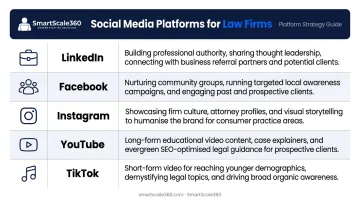
The deciding factor isn't where you're most comfortable — it's where your prospective clients already spend time.
Step 3: Build a Consistent Content Strategy
Content pillars give your posting structure without making it repetitive. Most law firms can build around four recurring themes:
- Educational content — legal tips, myth-busting, process explainers
- Community involvement — local events, pro bono work, firm milestones
- Social proof — anonymized case outcomes, client testimonials (with compliance review)
- Firm culture — team introductions, behind-the-scenes moments, attorney Q&As
Plan 1–3 posts per week using a simple content calendar. Tools like Hootsuite, Buffer, or Sprout Social handle scheduling so your posting rhythm doesn't depend on someone remembering to log in.
Step 4: Engage Authentically
Most law firms put effort into posting and stop there. Engagement is where the actual relationship-building happens — and most firms skip it entirely.
Responding to comments, asking questions in posts, acknowledging community mentions, and engaging with referral partners' content turn a broadcast channel into a genuine relationship tool. Platforms also reward this behavior through their algorithm — accounts that generate interaction get shown to more people.
Reputation management belongs here too. Responding professionally to negative reviews — without disclosing client information — signals that your firm takes feedback seriously. Ignoring negative comments doesn't make them disappear.
Step 5: Stay Compliant With Bar Advertising Rules
Bar associations treat social media content as attorney advertising. The same rules that govern print ads apply to every post, comment, and video your firm publishes.
The most critical restrictions:
- No outcome guarantees — phrases like "we win cases" or "you'll get compensation" violate ABA Model Rule 7.1, which prohibits false or misleading communications about services
- No client information without written consent — ABA Model Rule 1.6 applies fully to social content; this includes responding to negative reviews in ways that reveal representation details
- Disclosures on testimonials — NYSBA guidance recommends language like "Prior results do not guarantee a similar outcome" on any post featuring case outcomes or client statements
- No specific legal advice in public comments — responding in ways that could create an attorney-client relationship without a formal engagement creates liability
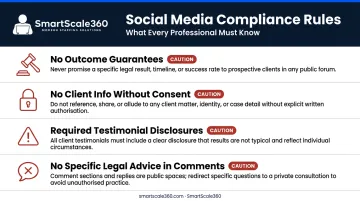
AI tools can help draft content faster, but they don't screen for compliance. Every post needs attorney sign-off before it goes live.
A pre-publish checklist — covering outcome language, confidentiality, truthfulness, and jurisdiction accuracy — takes 60 seconds and prevents exposure that's hard to walk back.
Step 6: Measure What's Working
Track two categories of data:
Quantitative metrics (available in every platform's analytics dashboard):
- Engagement rate (likes, comments, shares relative to reach)
- Reach and impressions
- Website clicks from social
- Follower growth over time
Qualitative signals (require intentional setup):
- Add a "How did you hear about us?" field to your intake form
- Note which posts generate direct messages or offline referral conversations
- Track whether specific content types consistently drive more inquiries
The Clio Legal Trends Report found that growing law firms use client intake and CRM software 44% more than shrinking firms. The firms that connect marketing activity to intake data are the ones that can tell whether social media is actually working.
Review metrics monthly. Adjust content based on what's generating clicks and inquiries — not just likes.
Key Factors That Shape Your Results
Two firms can follow the same strategy and get different outcomes. These variables explain why.
Practice Area and Audience Fit
Consumer-facing practice areas generate more social engagement by nature. A personal injury firm has inherently shareable content — rights explainers, process walkthroughs, relatable scenarios. An M&A practice is reaching a much smaller, harder-to-find audience on social platforms.
Neither is wrong — but the content strategy, platform choice, and realistic expectations should reflect that difference. Firms that build a specific client persona (demographics, concerns, how they search for help) consistently outperform those posting generic legal content to an undefined audience.
Posting Consistency and Content Quality
Social algorithms favor accounts that post regularly and generate engagement. Inconsistency doesn't just mean fewer impressions — it actively erodes the momentum you've built.
A firm posting two to three times per week with focused, useful content will outperform one posting daily with low-effort filler. Quality and consistency compound over months, not days.
Ethical Compliance Rigor
One non-compliant post — an implied guarantee, an identifiable client detail, a credential claim that doesn't hold up — can generate a bar complaint and undo months of brand-building. The reputational damage is disproportionate to the original error.
Firms with a documented pre-publish review process post with confidence. Those without one tend to abandon social media entirely after an incident.
Delegation and Resource Allocation
Social media requires consistent time across content creation, scheduling, engagement, and analytics. For most attorneys, those hours compete directly with billable work.
Attorneys who try to manage everything personally rarely sustain consistency. Firms that assign social media to a dedicated staff member — or bring in offshore support through a provider like SmartScale360 — maintain a far more consistent presence.
SmartScale360's virtual assistants handle the core tasks law firms typically struggle to staff:
- Content creation and post scheduling
- Community management and comment responses
- Performance tracking and monthly reporting

The model runs on a flat monthly fee with no setup costs or long-term contracts — a practical fit for small and mid-sized firms that need consistent execution, not just a strategy document.
Common Social Media Mistakes Lawyers Make
- Posting only awards and service announcements — without educational content or personality, you generate low engagement and build no trust with potential clients
- Skipping the compliance review — casual language implying guaranteed outcomes, reposting client communications without consent, or assuming personal-account norms apply to firm profiles; these errors are hard to reverse once published
- Launching on too many platforms at once — spreading across five platforms with insufficient resources leads to inconsistent posting on all of them; build one channel well before expanding
- Generating followers without a path to action — no intake form link, direct message protocol, or contact information means marketing effort doesn't convert into consultations
Conclusion
Social media works for law firms when it's built on a defined strategy, executed consistently, and protected by a real compliance review process. The firms that treat it as a long-term visibility and trust-building tool, not a quick lead generator, are the ones that see compounding results over 6 to 12 months.
For most firms, the real barrier is execution capacity, not strategy. Attorneys who delegate scheduling, content coordination, and engagement monitoring to a dedicated resource — whether in-house or through an offshore staffing partner like SmartScale360 — are far better positioned to maintain the consistency that actually drives results.
Start simple. Pick one platform, build the habit, and scale only once consistency is locked in.
Frequently Asked Questions
What are the best social media platforms for lawyers?
LinkedIn, Facebook, and Instagram are the strongest starting points for most firms. LinkedIn fits B2B and referral-driven practices; Facebook works well for consumer-facing areas like family law and personal injury; Instagram suits firms focused on culture and visual storytelling. Start with one platform that matches your client base before adding others.
How often should lawyers post on social media?
One to three times per week is a sustainable and effective baseline for most small and mid-sized firms. Consistency matters more than volume — a steady rhythm of quality posts will outperform sporadic high-volume activity that drops off after a few weeks.
What ethical rules apply to lawyers on social media?
Bar advertising rules apply to all social media content. The key restrictions cover outcome guarantees, client confidentiality, truthful credential claims, and required disclosures on testimonials. Rules vary by jurisdiction, so check with your state bar for guidance specific to your market.
Can lawyers use AI tools to create social media content?
Yes, AI can help with drafting and scheduling efficiently. It does not, however, replace the attorney's obligation to review every post for accuracy, ethical compliance, and jurisdictional fit before it goes live.
How do law firms measure social media ROI?
Track quantitative metrics (engagement rate, website clicks, follower growth) through platform analytics, and pair them with qualitative intake signals like "How did you hear about us?" form responses. A monthly review cadence is enough for most small firms to spot what's working.
Should lawyers outsource their social media management?
Outsourcing operational tasks — scheduling, content coordination, and reporting — is a practical option for busy firms. The key condition: a licensed attorney must review and approve all content before publication.