For healthcare organizations, that shift changes everything. A strong social media presence is no longer a marketing bonus; it's patient acquisition infrastructure.
The challenge is execution. Healthcare teams face a narrow path between regulatory compliance, clinical workloads, and the consistency that effective social media demands. This article covers the platforms that actually work, content strategies built for healthcare audiences, HIPAA guardrails that won't paralyze your team, and how to scale without burning out your staff.
Key Takeaways
- 94% of patients use online reviews to evaluate providers before booking
- Facebook and Instagram lead healthcare social media; use LinkedIn specifically for staff recruitment
- HIPAA violations carry real financial risk — a 2022 social media settlement cost one dental practice $23,000
- Measure appointment requests and referral traffic, not just likes and followers
- Dedicated remote social media staff can reduce labor costs by up to 60% versus in-house hires
Why Social Media Is a Game-Changer for Healthcare Marketing
Why Social Media Belongs in Every Healthcare Marketing Strategy
The audience is already there. CDC data shows 58.5% of U.S. adults searched online for health or medical information in the second half of 2022, and 41.5% used the internet to communicate with a doctor's office. A JAMA study using 2024 health survey data found that more than 1 in 5 U.S. adults reported making health-related decisions based on social media content — meaning your social presence directly influences clinical behavior, not just brand awareness.
Building Trust Before the First Visit
Patients "shop" for healthcare providers much like they shop for anything else. They compare profiles, read comments, and assess how an organization communicates. An active, consistent social presence keeps your organization visible during that research window. Practices that post regularly position themselves as credible and accessible; those that don't lose ground to competitors who do.
Social media also serves patient retention between visits. A well-timed health tip, a seasonal vaccination reminder, or a brief wellness post — each touchpoint reinforces the relationship without requiring any direct clinical contact.
Two Underused Benefits: Recruitment and Crisis Communication
Healthcare organizations dealing with staffing shortages have a direct recruitment tool in social media. Content that shows what working there actually looks like draws clinical and administrative candidates who are evaluating culture before they ever apply:
- Staff spotlights and day-in-the-life posts
- Behind-the-scenes facility content
- Recognition posts and team milestones
The AHA's 2025 Workforce Scan cited South Carolina's "H is for Hiring" initiative as a real-world example of social media driving healthcare workforce outreach at scale.
Crisis communication works the same way. When a public health event, local outbreak, or emergency hits, an active social profile becomes a broadcast channel that reaches the community faster than press releases or website updates — and counters misinformation with credible, expert-sourced guidance.
Choosing the Right Platforms for Your Healthcare Organization
No healthcare organization needs to be everywhere. A focused strategy on two or three well-matched platforms consistently outperforms a scattered presence across five. The goal is to match the platform to your patient population and content format.
| Platform | Best For | Primary Audience |
|---|---|---|
| Community updates, reviews, crisis communication, service announcements | Broad adult reach, older demographics, caregivers | |
| Visual education, patient experience, recruitment branding, short video | Younger adults, wellness audiences | |
| TikTok | Short-form educational video, awareness content | Younger demographics (under 35) |
| Employer brand, physician leadership, clinical/administrative recruiting | Healthcare professionals | |
| YouTube | Long-form explainers, service-line education, public health content | Broadest adult platform; all age groups |
Match your platform to your practice type:
- Homecare and specialty practices typically see the strongest engagement on Facebook, where caregivers and older patients spend time
- Pediatric, wellness, and fitness-adjacent practices benefit more from Instagram and TikTok
- If recruiting clinical or administrative talent is a priority, LinkedIn deserves a dedicated content track
- Health systems and multi-service organizations can use YouTube as a long-form library — provided production quality stays consistent
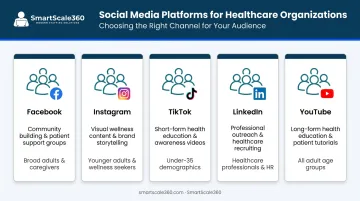
Start with your two best-fit platforms, build them well, and expand only when the data and capacity support it.
Proven Content Strategies for Healthcare Social Media
Educational content is the engine of healthcare social media. Short videos, infographics, and plain-language health tips build authority while giving the algorithm something to distribute. The formats that consistently work:
- Short educational videos — symptom explainers, procedure overviews, seasonal health reminders
- Infographics — medication guides, preventive care checklists, local health statistics
- Timely content — when a health topic trends in the news, organizations that publish accurate, clinically reviewed responses earn significant reach from audiences already searching for answers
- Behind-the-scenes posts — staff spotlights, office tours, new equipment reveals, day-in-the-life content on Instagram Stories or TikTok reduce the anxiety many patients feel about care settings
Patient Testimonials and Social Proof
According to Press Ganey research, 94% of referred patients use online reviews to validate referrals. That makes patient success stories some of the most persuasive content you can produce — with one firm requirement: explicit written consent before featuring anyone, and full removal of any identifying information per HIPAA guidelines.
A "Patient of the Month" series can structure this content predictably. General outcome stories (without names, dates, or diagnoses) posted with prior authorization are far safer than ad hoc testimonials. Once you have a consistent stream of credible patient stories, the next step is getting that content in front of the right audiences.
Hashtags and Interactive Formats
Healthcare-specific hashtags — awareness month tags, condition-specific communities, local health topics — extend content reach beyond your existing followers. Branded hashtags let you build a searchable archive of your own content over time.
Interactive formats add a different dimension: live Q&A sessions, polls, and community contests generate real-time engagement and surface actual patient questions. Scheduling these consistently, on the same day and time each week, builds audience habits that grow steadily over time.
Navigating HIPAA Compliance Without Slowing Down Your Strategy
HIPAA violations on social media carry real financial consequences. In 2022, HHS Office for Civil Rights settled with New Vision Dental for $23,000 after the practice responded to patient reviews in ways that disclosed Protected Health Information. A similar 2019 settlement with Elite Dental Associates cost $10,000 for the same category of violation.
Protected Health Information (PHI) is any individually identifiable information related to a person's past, present, or future health, healthcare, or payment for care. Names, dates, diagnoses, locations, photos, and even combinations of seemingly anonymous details can qualify.
The Non-Negotiable Rules
- Obtain written patient authorization before featuring anyone in photos, videos, or testimonials
- Remove names, dates, specific diagnoses, and any detail combinations that could identify a patient before publishing
- Redirect health questions from public comment threads to a secure, private channel — never answer them publicly
- Document your social media policy and make sure every staff member — including those who mention work on personal accounts — understands it
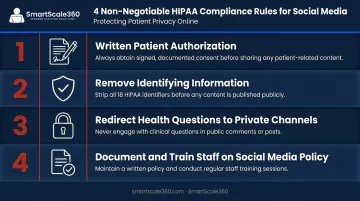
The Silence Problem
Following these rules doesn't mean going quiet — but many healthcare organizations treat them as a reason to stop posting altogether.
Fear of compliance errors leads to infrequent or absent social media activity. That silence has a cost: competitors who post accurate, clinically reviewed content build the community trust your organization is forfeiting. Content reviewed by a clinical lead before publishing carries very low compliance risk, and organizations that post consistently 3–4 times per week typically see significantly more profile engagement and inbound patient inquiries.
Measuring What Matters: Social Media ROI in Healthcare
Follower counts and likes are not business metrics. Rival IQ's healthcare live benchmark puts average engagement at roughly 0.04% on Facebook and 0.30% on Instagram — meaning engagement alone tells you very little about whether social media is generating patients or revenue.
The metrics that connect social to business outcomes:
- Appointment requests and contact form submissions sourced from social
- Website referral traffic from social channels (tracked via UTM parameters)
- Phone inquiries attributed to specific campaigns
- Review volume and average star rating trends
- Recruitment leads generated through LinkedIn or Instagram employer content
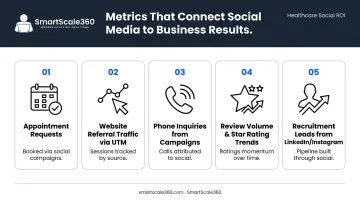
These numbers give leadership something concrete to act on — which brings the next challenge: presenting them effectively.
Reporting to Leadership
When presenting social media performance to clinical or administrative leadership, anchor the report to organizational priorities: patient acquisition, reputation management, community health outcomes, and competitive positioning.
The SHSMD healthcare marketing framework organizes value around four areas leadership already speaks fluently:
- Growth — patient volume and market share
- Brand — awareness, trust, and reputation
- Stakeholder engagement — community relationships and internal alignment
- Communications impact — reach, response, and message clarity
Mapping social media activity to these categories makes the business case clear and keeps budget conversations grounded in organizational strategy.
Social listening — monitoring what patients and community members say across platforms — fills in what surveys miss. Sentiment analysis regularly surfaces access complaints, communication frustrations, and positive experiences before they show up in formal satisfaction data, giving your team a faster feedback loop to act on.
Scaling Healthcare Social Media Without Burning Out Your Team
Physicians and clinical administrators have patient care as their primary obligation. Asking them to also manage a content calendar, respond to comments, and pull analytics reports is a formula for either burnout or abandoned social accounts. BLS data shows marketing managers earned a $161,030 median annual wage in May 2024 — and healthcare occupations already generate roughly 1.9 million openings per year from 2024 to 2034. The staffing pressure is real in both directions.
Build a Repeatable System First
Before adding any headcount, structure the content function so it doesn't require daily reinvention:
- Plan posts two to four weeks in advance using a shared content calendar
- Batch content creation — write captions, source graphics, and record short videos in one sitting per week
- Maintain an evergreen library of health education posts that can be recycled or updated seasonally
This reduces the cognitive load of "what do we post today" — the question that kills most healthcare social strategies.
Delegate to a Dedicated Remote Staff Member
For most healthcare and homecare organizations, the practical move is handing off the day-to-day content work entirely. Content scheduling, community management, analytics reporting, ad management, and graphic sourcing don't require clinical expertise — they require consistency and time, which clinical staff rarely have.
Homecare agencies like those served by SmartScale360 are doing exactly this. SmartScale360 matches healthcare clients — including Home Instead and Griswold — with college-educated, English-speaking remote social media and digital marketing specialists who own the full workload: creating and publishing content, monitoring comments, tracking performance metrics, and managing paid campaigns.
SmartScale360's model allows organizations to reduce labor costs by up to 60% compared to a comparable in-house U.S. marketing hire. There are no setup fees and no long-term contracts, so agencies can scale hours up during campaigns and pull back when volumes drop — a meaningful advantage when margins are tight.
Frequently Asked Questions
Which social media platform is best for healthcare marketing?
The right platform depends on your patient population. Facebook reaches broad community audiences and older demographics; Instagram works for visual content and younger patients; LinkedIn suits professional networking and recruiting; TikTok reaches under-35 audiences through short educational video. Start with two platforms and expand from there.
How can healthcare organizations stay HIPAA compliant on social media?
Obtain written patient authorization before featuring anyone, never share identifying health information publicly, and redirect personal health questions to secure private channels instead of public comment threads. All staff who post on your accounts should be trained on a documented social media policy before they're given access.
What types of content perform best for healthcare social media?
Across healthcare audiences, the formats that consistently drive engagement include: short educational videos, health tip infographics, staff spotlights, patient success stories (with written consent), and live Q&As. Timely responses to trending health news also perform well when your team can move quickly.
How often should healthcare organizations post on social media?
Consistency matters more than volume. Aim for three to five posts per week on your primary platforms, adjusted based on what your engagement data shows and what your team can sustain without sacrificing quality. A predictable posting schedule outperforms sporadic bursts of activity.
How do you measure the ROI of social media in healthcare marketing?
Focus on outcome-linked metrics: appointment requests and contact form submissions from social, website referral traffic by channel, phone inquiries tied to specific campaigns, review volume trends, and recruitment leads generated. Engagement rates provide useful context, but they're not business results on their own.
Can small or independent healthcare practices benefit from social media marketing?
Social media gives independent practices a low-cost channel to build community trust and compete with larger health systems on authenticity rather than ad spend. A consistent, locally relevant presence on one or two platforms can drive meaningful patient acquisition without requiring enterprise-level marketing resources.