Introduction
Selling to healthcare organizations is genuinely hard. Buying committees span 5 to 16 stakeholders across multiple departments, and sales cycles stretch well beyond six months.
Regulatory constraints shape every touchpoint. The buyers themselves — clinicians, administrators, IT leaders, procurement officers — are professionally trained skeptics who scrutinize vendor claims the way they evaluate clinical evidence.
The cost of a weak strategy shows up fast. Without precise segmentation, compliant messaging, and consistent multi-channel execution, even genuinely effective healthcare solutions get lost before they reach the right decision-makers. According to Gartner's 2025 B2B buyer research, 74% of B2B buyer teams demonstrate unhealthy conflict during the decision process — meaning even when you reach the right account, internal friction can kill a deal.
This guide covers what B2B healthcare marketing actually is, who you're selling to, the strategies that consistently move deals forward, how to stay compliant, and how to measure results that matter.
Key Takeaways
- Healthcare buying committees typically include 5–16 stakeholders; marketing must engage the full group, not one contact
- Personalization should use professional and firmographic signals only, not patient-level data
- Speed-to-lead matters: responding within one hour makes qualification nearly 7x more likely
- Content marketing and ABM are the highest-leverage strategies for long healthcare sales cycles
- Compliance is a credibility asset with professional buyers, not just a legal checkbox
What Is B2B Healthcare Marketing?
B2B healthcare marketing covers the promotion and sale of medical products, software platforms, staffing solutions, and specialized services to healthcare organizations — hospitals, health systems, clinics, homecare agencies, pharmaceutical companies — rather than to individual patients. Unlike consumer health advertising, it targets buying committees and operational decision-makers, not people managing their own care.
B2B vs. B2C Healthcare Marketing
| Dimension | B2B Healthcare | B2C Healthcare |
|---|---|---|
| Target audience | Organizations and buying committees | Individual patients or consumers |
| Sales cycle | 6+ months, often 12–18 | Days to weeks |
| Purchase decision | Multi-stakeholder consensus | Individual or family |
| Primary buying goal | Operational ROI, compliance, outcomes | Personal health or wellness |
The 4 Ps in a B2B Context
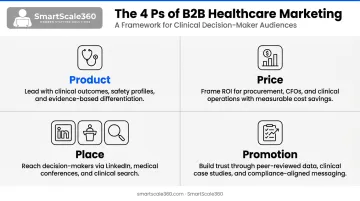
Those B2B distinctions above reshape how the classic marketing framework actually works in practice:
- Product: Frame value in clinical and operational outcomes, not feature lists. "Reduces nurse documentation time by 40%" lands harder than "intuitive interface."
- Price: Present total cost of ownership with ROI proof built for a CFO's budget review — a one-line price tag won't cut it.
- Place: Meet buyers where they research: LinkedIn, trade publications like HIMSS, specialty conferences, and organic search.
- Promotion: Lead with evidence. Healthcare professionals are trained to evaluate data, and marketing hype damages credibility fast.
Who Are You Selling To? B2B Healthcare Segmentation
"Healthcare" is not a single buyer. A homecare agency purchase decision may involve an owner-operator, an operations director, a compliance coordinator, and a billing manager — each with different priorities and genuine veto power. Define exactly which roles you're targeting before you write a single piece of content.
The Four Core Buyer Personas
| Persona | Primary Concerns | Content That Resonates |
|---|---|---|
| Owner-operators / executives | Cost reduction, ROI, operational efficiency | Business case documents, cost comparisons, peer benchmarks |
| Clinical / operations directors | Workflow fit, staff reliability, outcome quality | Case studies, process documentation, outcome data |
| HR / recruiting leads | Hiring speed, retention, compliance | Role-match examples, screening criteria, onboarding support |
| Billing / compliance staff | Regulatory adherence, vendor credibility | Compliance certifications, audit history, reference lists |
Each persona above needs its own entry point. Owner-operators want to know what it costs and what they stop doing. Operations directors want to know whether the staff can hit the ground running. Leading with the wrong message to the wrong role stalls deals before they start.
That pattern shows up in purchase data too. Buyers across healthcare subsectors consistently prefer expanding relationships with known vendors before evaluating new ones — which means your messaging as a new provider needs to address risk directly: what happens if the hire doesn't work out, what onboarding looks like, and what flexibility you offer.
Segmenting by Organization Type
Different healthcare subsectors have different procurement structures, budget cycles, and buying triggers:
- Homecare agencies — operational pain points drive decisions (recruiting, scheduling, billing); regulatory compliance is a recurring trigger; often owner-led with faster decisions
- Independent clinics — faster purchasing cycles, price-sensitive, often a single decision-maker
- Hospital systems — formal procurement committees, longer cycles, heavy IT and compliance governance
- Pharma / life sciences — separate regulatory environment; content must align with FDA promotion standards
Account-Based Marketing for Healthcare
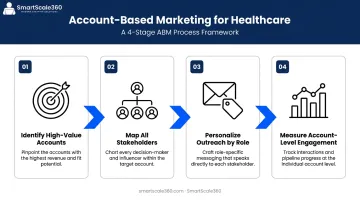
Because healthcare purchases require consensus across multiple roles, ABM fits this environment better than broadcast marketing to a general list. The four-step process:
- Identify high-value accounts using your ICP (agency size, specialty, geography, accreditation status, current staffing model)
- Map all stakeholders within each target account — not just one contact
- Personalize outreach by role — the operations director gets workflow messaging; the owner gets the cost model
- Measure account-level engagement across all stakeholders to time sales outreach correctly
Your ICP sharpens over time. Look at which agency sizes, care specialties, or service regions converted most consistently in your existing customer base — then weight your prospecting accordingly.
Proven B2B Healthcare Marketing Strategies
Content Marketing and Thought Leadership
Medical professionals respond to evidence. Promotional content gets dismissed; well-sourced clinical analysis gets shared. The highest-converting content assets for healthcare B2B are:
- Clinical case studies showing peer-organization results ("how a regional home health agency reduced caregiver turnover by 30%") — these provide direct proof of concept for skeptical buyers
- White papers and research summaries that synthesize peer-reviewed data relevant to your buyer's clinical or operational challenges
- ROI calculators and financial models built for CFOs and finance committees reviewing the business case
Case studies from comparable organizations carry particular weight because they answer the buyer's implicit question: "Has this worked for someone like us?"
LinkedIn and Professional Outreach
LinkedIn is the primary channel for B2B healthcare reach. The platform's targeting lets you filter by titles like "Director of Clinical Operations," "VP of Patient Care," or "Healthcare Administrator" — reaching exactly the committee members you need.
Effective LinkedIn strategy combines:
- Thought leadership publishing on the company page (insights, not announcements)
- Personalized direct outreach that leads with a relevant observation or data point, not a pitch
- Engaging with industry conversations in healthcare-specific groups and forums
Email Nurture Sequences
Healthcare email performs well when it's relevant. Campaign Monitor's benchmark data shows healthcare services email open rates averaging 23.7%, compared to a 21.5% all-industry average.
Build segmented sequences tied to specific pain points. A few practical examples:
- A "reducing caregiver turnover" track for homecare administrators
- A "revenue cycle efficiency" sequence for hospital CFOs
- Lead with value in every email — ask for a meeting only after you've earned attention
SEO and Website Optimization
Institutional buyers search for solutions. Your content needs to rank for the precise, technical queries your buyers actually use — "homecare scheduling software," "EHR integration middleware," "HIPAA-compliant patient communication platform" — not generic health terms.
Healthcare content must demonstrate expertise, authoritativeness, and trustworthiness (what Google's quality raters evaluate as E-E-A-T). This means:
- Author credentials visible on content
- Citations to peer-reviewed sources
- Specific, verifiable outcome claims
Webinars and Virtual Events
Educational webinars — "Workforce Management Best Practices for Home Health Agencies," "Navigating CMS Reimbursement Changes" — attract clinical and administrative professionals who are lifelong learners by training. Benefits:
- Establish the vendor as a trusted authority, not just a seller
- Produce a warm follow-up list sorted by engagement level
- Build personal connection through live Q&A, accelerating trust across long sales cycles
Scaling Marketing Execution Without Blowing Your Budget
Running a full B2B healthcare marketing program — content production, outbound outreach, email nurture, SEO, and events — requires significant team bandwidth. Healthcare companies and B2B vendors with lean internal marketing teams often face an execution gap between strategy and capacity.
Outsourcing to dedicated remote staff is a proven solution. SmartScale360 provides college-educated, English-speaking remote staff from the Philippines at 60–70% lower labor costs than U.S.-based equivalents, covering roles that directly support marketing execution:
- Lead generation and outreach coordination
- Social media management and content creation
- Email marketing automation
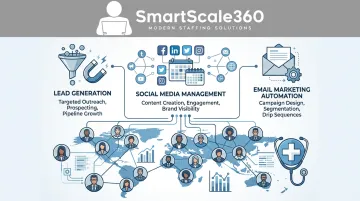
For healthcare marketing teams running long sales cycles across multiple channels, this model keeps execution moving while the core team stays focused on strategy.
Navigating Compliance in B2B Healthcare Marketing
The regulatory exposure in healthcare marketing is concrete. HHS/OCR data shows 374,321 HIPAA complaints filed and $144,878,972 in total settlements and civil money penalties through October 2024. CAN-SPAM violations can reach $53,088 per separate non-compliant email. Federal fines aside, a single misstep in a relationship-driven market carries lasting reputational damage that no settlement can fully undo.
The Personalization-vs-Privacy Line
HIPAA limits how patient data can be used in targeting. The practical rule for B2B healthcare marketers: personalize on professional and firmographic signals only.
✅ Acceptable: job title, facility type, specialty, stated pain point, firmographic data ❌ Not acceptable: any individual's health condition, patient-level data, PHI
Buyers respond to messages that address their professional context. Staying within these boundaries also happens to produce better results — clinical audiences disengage quickly from targeting that feels intrusive or irrelevant to their role.
Claims Must Be Substantiated
The FTC requires health-related benefit and safety claims to be truthful and supported by competent, reliable scientific evidence. That means avoiding absolute terms like "cures" or "guarantees" without supporting data, and instead anchoring claims with specific study citations or qualified language such as "clients have reported" or "may help reduce."
Clinical buyers are trained to evaluate evidence. An honest, well-sourced claim is more persuasive to this audience than vague promotional claims.
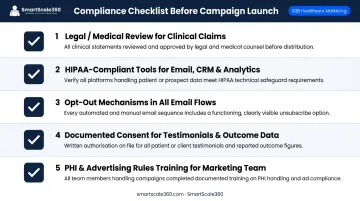
Compliance Checklist for Healthcare Campaigns
- Legal or medical review on any content making clinical outcome claims
- HIPAA-compliant tools for email, CRM, and marketing analytics (including tracking pixels on regulated properties)
- Opt-out mechanisms built into all email flows
- Documented consent for any testimonials or outcome data used in marketing
- Basic PHI and advertising rules training for marketing team members before campaign launch
How to Measure B2B Healthcare Marketing ROI
The Metrics That Matter
Lead volume is a misleading primary metric when sales cycles are long and deal sizes are high. Track these instead:
- MQL-to-SQL conversion rate: the clearest signal of lead quality, not lead quantity
- Cost per lead by channel: which channels produce the most qualified pipeline per dollar
- Pipeline contribution: marketing-sourced opportunities as a share of total pipeline value
- Sales cycle velocity: time at each stage, which reveals where deals stall
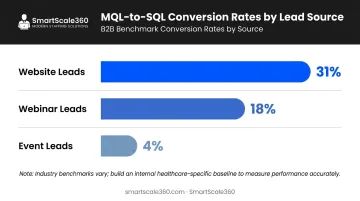
General B2B benchmarks from Geckoboard show MQL-to-SQL conversion rates varying significantly by source: website leads convert at roughly 31%, webinar leads at 18%, and event leads at 4%. Healthcare-specific benchmarks aren't widely published from authoritative sources, so building your own internal baseline is the most reliable approach.
Speed-to-Lead Is Not Optional
Even in a 12-month sales cycle, the first hour after a lead comes in is critical. Harvard Business Review's foundational research found that firms contacting leads within one hour were nearly 7x more likely to qualify the lead than firms waiting another hour — and more than 60x more likely than firms waiting 24 hours or longer. In a competitive healthcare market, a slow follow-up hands the opportunity to a rival vendor.
Attribution for Multi-Touch Buying Cycles
Healthcare decisions involve many interactions across months, and no single attribution model tells the whole story. In practice:
- Use multi-touch attribution (or at minimum track first- and last-touch sources)
- Keep CRM records clean so marketing-sourced revenue ties back to specific campaigns
- Build a shared dashboard covering early-stage metrics (open rates, webinar attendance, content downloads) alongside late-stage outcomes (SQLs, pipeline value, closed revenue)
Forrester notes that no single multitouch attribution model answers every demand question. Use a blended view, and revisit your model quarterly as your channel mix shifts.
Frequently Asked Questions
What is the 95/5 rule for B2B healthcare marketing?
Developed by the Ehrenberg-Bass Institute, the 95/5 rule holds that only 5% of your B2B target market is actively ready to buy at any given moment. For healthcare marketers, this means prioritizing brand awareness with the other 95% — so when they eventually enter a buying cycle, your brand is top of mind.
What are the main types of B2B healthcare marketing?
The primary types include content marketing and thought leadership (white papers, case studies, blogs), account-based marketing targeting specific high-value institutions, LinkedIn and email outreach, webinar and event marketing, SEO and organic search, and targeted paid media. Each type serves a different stage of the long healthcare buying cycle, and the strongest programs combine several.
What are the Ps of B2B healthcare marketing?
The four Ps adapted for B2B healthcare: Product (clinical outcomes, not features), Price (total cost of ownership with ROI proof), Place (LinkedIn, search, trade publications, conferences), and Promotion (evidence-based, HIPAA-compliant messaging that educates).
How long is a typical B2B healthcare sales cycle?
B2B healthcare sales cycles commonly run six months to well over a year, depending on institution size, deal complexity, and buying committee size. Marketing's role is to nurture prospects consistently throughout — building familiarity and trust until they're ready to decide.
How do you stay HIPAA-compliant in B2B healthcare marketing?
Personalize outreach using professional and firmographic data only — job title, facility type, stated pain point — never patient-level health information. Use HIPAA-compliant CRM and email tools, document consent processes, and get legal review on any content making outcome claims. Demonstrating privacy discipline is itself a trust signal with regulated buyers.