Introduction
Every invoice that lands in your inbox carries a hidden cost beyond the amount due. Someone has to open it, code it, chase approvals, schedule the payment, and field the vendor call when it's late.
According to Ardent Partners' 2024 State of ePayables survey of 212 AP and finance leaders, the average all-inclusive cost to process a single invoice is $9.40, with a cycle time of 9.15 days and a 14% exception rate. Multiply that across hundreds of invoices per month, and AP becomes one of the costliest back-office functions a small business manages.
This guide gives financial managers and business owners a clear picture of AP outsourcing: what's included, what it costs, and how to choose a model that fits your business. By the end, you'll know exactly what to look for in a provider.
Key Takeaways
- AP outsourcing transfers the full invoice-to-payment cycle — processing, approvals, payments, vendor management, and reporting — to a third party
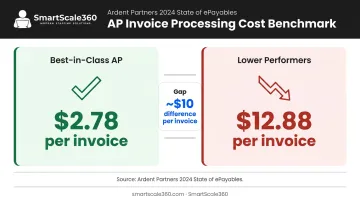
- Best-in-Class AP operations process invoices at $2.78 per invoice versus $12.88 for lower performers — a gap that outsourcing helps close
- Three models exist: traditional BPO firms, managed AP software platforms, and dedicated offshore staffing — each with distinct cost structures and control levels
- Clear warning signs include vendor complaints, missed early-payment discounts, 1099 chaos, and AP consuming 8+ hours per week of owner or staff time
- The right partner depends on invoice volume, control requirements, and whether you need a shared team or a dedicated specialist
What Is Accounts Payable Outsourcing?
AP outsourcing means hiring a third-party provider to manage some or all of your accounts payable function — from invoice receipt and data capture through approval routing and payment execution — rather than relying on internal staff alone.
What It Is Not
Two distinctions trip up most buyers:
- Not AP automation software — Software tools like Bill.com or Ramp keep the process in-house; they automate steps but still require your team to manage them. Outsourcing transfers the actual management to an external party.
- Not bookkeeping — Bookkeeping records what already happened. AP outsourcing actively manages real-time payment operations on your behalf.
The Three Outsourcing Models
| Model | How It Works | Best For |
|---|---|---|
| Traditional BPO firms | Shared offshore teams handling multiple clients simultaneously | High invoice volume, price-sensitive buyers |
| Managed AP services | Software platforms with human oversight layered on top | Businesses wanting automation + support |
| Dedicated offshore staffing | A single trained AP professional works exclusively for your business | SMBs needing accountability and vendor familiarity |
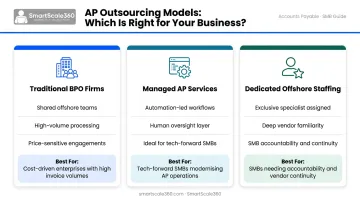
Most SMBs gravitating toward outsourcing for the first time find dedicated staffing the safest entry point — one person who knows your vendors, your approval thresholds, and your exceptions. Traditional BPO makes more sense once invoice volume grows past the point where a single staffer can keep up.
Key Benefits of Outsourcing Your AP Function
Cost Reduction Beyond the Salary Line
The obvious saving is headcount. But the real cost of an in-house AP hire goes well beyond salary. According to Robert Half's 2026 national benchmarks, AP Clerks earn $43,250–$54,750 and AP Specialists $51,750–$63,250 annually. Stack employer FICA (7.65%), health insurance, retirement contributions, equipment, and workspace on top, and the fully loaded cost climbs well above those base figures.
SmartScale360 places dedicated offshore AP professionals — working exclusively for one client — at approximately 60% below the cost of a US in-house hire, with no setup fees and no long-term contract.
Specialized Expertise Without Full-Time Risk
Outsourced AP professionals work across multiple compliance scenarios daily: vendor negotiation, early-payment discount capture, W-9 collection, and 1099 tracking. A generalist internal hire may cover these functions adequately; a dedicated AP specialist does them every day. That daily repetition builds depth that generalists rarely match.
That depth has a measurable payoff. A 2/10 net 30 term offers a 2% discount for paying within 10 days, which translates to an annualized return of roughly 36.7% that most businesses leave uncaptured simply because no one is watching for it.
Scalability Without Headcount Risk
When invoice volume spikes — during a growth phase, an acquisition, or a seasonal peak — an outsourced AP function scales with you. The alternative is a 4-6 week recruiting and onboarding cycle every time you outgrow your current capacity. That lag has real costs: missed payments, strained vendor relationships, and team burnout.
Fraud Prevention and Error Reduction
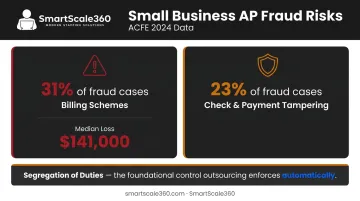
The fraud exposure in AP is not theoretical. According to ACFE's 2024 Report to the Nations, small organizations under 100 employees face disproportionate risk:
- Billing schemes affected 31% of fraud cases, with a median loss of $141,000
- Check and payment tampering hit 23% of small-organization cases
Outsourcing naturally enforces segregation of duties — the person entering invoices is separate from the person approving payments — which is a foundational internal control that many small businesses struggle to maintain with limited staff.
Time Reallocation
AP departments spend 22.5% of their time handling supplier inquiries alone, per Ardent Partners' 2023 research. For a business owner personally handling AP, that represents hours every week pulled away from client relationships, growth strategy, and revenue-generating work. Outsourcing reclaims that time.
What Does an Outsourced AP Team Handle?
Invoice Receipt and Processing
The AP team receives invoices in all formats — paper, email, PDF, EDI — digitizes them, codes each to the correct expense account, matches them to purchase orders or contracts, and routes them through your approval workflow. You never touch a routine invoice.
Payment Execution and Scheduling
Once approved, the team manages payment timing based on due dates, cash flow, and early-payment discount windows. Common payment methods include:
- ACH transfers, which are the fastest and lowest-cost option
- Paper checks, still required by some vendors despite higher processing costs
- Credit and virtual cards, useful for rebates and detailed spend tracking
Proactive payment timing — paying early to capture discounts or extending terms strategically to preserve cash — is a value-add that experienced AP teams provide.
Vendor and Supplier Management
Vendor management is where AP inefficiency tends to compound — small breakdowns in onboarding, communication, or tracking add up fast. Operational tasks include:
- New vendor onboarding and verification
- W-9 collection before first payment
- Ongoing vendor communication for payment status inquiries
- Dispute resolution for billing discrepancies
- Year-round 1099 tracking
The 1099 piece deserves emphasis. The IRS imposes penalties of $60–$680 per information return depending on how late or incorrect a filing is. Year-round tracking — not a December scramble — eliminates this risk. It's a specific gap that good AP outsourcing closes.
Approval Workflows and Internal Controls
Outsourcing AP does not mean surrendering control over payment decisions. You set the rules: which payments require owner sign-off, which route automatically, which get flagged for review. The provider manages the workflow structure; you retain approval authority over anything that matters.
Reporting and Cash Flow Visibility
A capable outsourced AP team delivers:
- AP aging reports
- Upcoming payment obligation forecasts
- Spend analysis by vendor or category
- Exception reports for flagged items
With these reports in hand, you can anticipate cash needs, negotiate better terms, and catch problems before they hit your bank account — not after.
Pros and Cons of AP Outsourcing
Advantages
- Lower fixed overhead — Replaces a full-time salary and benefits package with a predictable monthly service cost. For dedicated offshore staffing models, savings typically reach 60-70% compared to equivalent US-based hires.
- No training or continuity gaps — The outsourced team arrives with AP expertise in place. No onboarding delay, no coverage gaps when internal staff leave.
- Built-in controls — Providers enforce segregation of duties by default, reducing fraud risk without additional process design effort.
- Software flexibility — Quality providers work within your existing stack: QuickBooks Online, Xero, NetSuite, Bill.com, and similar platforms.
That said, outsourcing AP isn't without trade-offs. Here's what to watch for before committing.
Disadvantages and Risks
- Communication delays — When AP is managed externally, urgent payment decisions may require going through a third party. Evaluate whether the provider offers a dedicated contact or a shared service queue — the difference is significant.
- Data security exposure — Handing a third party access to vendor banking details and payment systems introduces risk. Reputable providers use encrypted storage, role-based access controls, and clear data handling agreements. Verify these before signing.
- Vendor relationship risk — If the provider pays late or communicates poorly, it reflects on your business. A dedicated specialist who knows your vendors handles this more reliably than a shared team rotating across dozens of clients.
- Low-volume businesses — If you process fewer than 15-20 invoices per month, the time and effort to set up an outsourcing relationship may outweigh the savings. AP software alone may be a sufficient first step.
How Much Does Accounts Payable Outsourcing Cost?
Pricing Models
Two primary structures exist:
- Per-invoice pricing — Common with traditional BPO and managed AP services. Costs scale directly with volume, which suits businesses with predictable monthly invoice counts.
- Flat monthly staffing cost — Common with dedicated offshore staffing models. One fixed monthly fee for a dedicated professional, regardless of invoice count within a normal workload range.
The Ardent Partners benchmark gives useful context: Best-in-Class AP organizations process invoices at $2.78 per invoice, while lower performers average $12.88. For high-volume, manual in-house teams, that $10+ gap per invoice adds up fast — and closing it is exactly what a well-run outsourcing arrangement targets.
In-House AP for Comparison
A fully loaded US-based AP Clerk costs more than the salary line suggests:
| Cost Component | Benchmark |
|---|---|
| Base salary (AP Clerk) | $43,250–$54,750/year |
| Base salary (AP Specialist) | $51,750–$63,250/year |
| Employer FICA | 7.65% of wages |
| Benefits (all private industry) | ~30.1% of total compensation |
| Equipment, software, workspace | Additional overhead |
Per BLS March 2026 data, adding employer FICA and a ~30% benefits burden pushes the fully loaded annual cost of an in-house AP hire well above the base salary figure in the table above.
Factors That Affect Outsourcing Cost
- Invoice volume and complexity
- Number of legal entities
- Payment method mix (checks cost more to process than ACH)
- Integration requirements with your accounting software
- Dedicated vs. shared staffing model
For businesses that want cost predictability without a long-term commitment, SmartScale360's dedicated offshore staffing model offers a flat monthly rate with no setup fee and no contract. Clients scale the engagement up or down as needs change, without being locked into a multi-year BPO agreement.
Signs Your Business Needs to Outsource AP — and How to Choose a Partner
Signs Your AP Process Needs Help
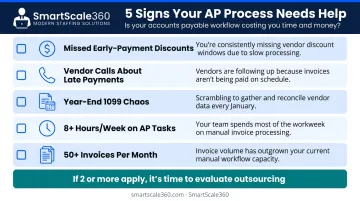
These are real operational disruptions, not abstract thresholds:
- Missed early-payment discounts — You're routinely paying net 30 when you could capture 2% by paying in 10 days
- Vendor calls about late or missing payments — Your vendor relationships are taking damage from payment delays
- Year-end 1099 chaos — December becomes a scramble to reconstruct a year's worth of vendor payment data
- 8+ hours per week of owner or staff time on AP — Time that isn't going toward revenue or growth
- Invoice volume consistently above 50 per month — Manual management is a productivity drain at this scale
What to Look for in an AP Outsourcing Partner
Evaluation criteria:
- Dedicated vs. shared staffing — A dedicated specialist builds vendor familiarity and personal accountability. A shared team services dozens of clients simultaneously.
- Software integration — Confirm they work inside your existing tools: QuickBooks, Xero, Bill.com, NetSuite, or whatever you use.
- Communication model — Do you have a direct contact, or are you submitting tickets to a queue?
- 1099 tracking — Confirm whether year-round 1099 management is included or an add-on.
- Pricing transparency — Flat monthly fee vs. per-invoice pricing, and whether there are setup fees or minimum commitments.
Approval workflow clarity:
Before signing with any provider, nail down exactly how payment approvals work. Specifically, ask:
- Which payments require your sign-off before processing
- What triggers a flag for your review vs. routes automatically
- Whether the provider builds workflows around your preferences or applies a one-size-fits-all structure
SmartScale360 builds AP support around this model: a dedicated offshore specialist assigned exclusively to your business, working inside your existing software, with direct communication rather than a ticketing system. Engagements run month-to-month, so there's no contract pressure if your needs change.
Frequently Asked Questions
What is accounts payable outsourcing?
AP outsourcing means hiring a third-party provider (a BPO firm, managed AP service, or dedicated offshore specialist) to handle the invoice-to-payment cycle on your behalf. This typically includes invoice processing, payment execution, vendor management, and AP reporting.
How much do accounts payable outsourcing services cost?
Costs vary by model: per-invoice fees for traditional BPO, flat monthly platform fees for software-based services, or a fixed monthly rate for a dedicated offshore specialist. For context, the fully loaded cost of a US-based AP Clerk, including benefits and overhead, runs well above the $43,250–$54,750 base salary range.
What tasks can an outsourced AP team handle?
Core scope includes invoice receipt and coding, approval workflow management, payment execution, vendor onboarding, W-9 and 1099 tracking, and AP reporting. Scope varies by provider — confirm which functions are included versus billed as add-ons before engaging.
What are the biggest risks of outsourcing accounts payable?
The main risks are data security exposure, reduced real-time control over urgent payments, and vendor relationship damage from provider errors. Vet security practices carefully and choose a dedicated-staffing model over a shared team to reduce these risks.
Is accounts payable outsourcing right for small businesses?
It makes the most sense for businesses processing more than 20–50 invoices per month or where the owner personally spends several hours per week on AP. Very early-stage businesses with minimal invoice volume may find AP software a sufficient first step before moving to outsourcing.
What's the difference between a BPO firm and a dedicated offshore AP specialist?
A BPO firm uses a shared team rotating across many clients, so accountability is diffuse. A dedicated offshore AP specialist works exclusively for your business, knows your vendors, and answers directly to you, typically at 60–70% below the cost of a US-based in-house hire.