Insurance BPO outsourcing is the practice of delegating specific business processes — policy administration, client communication, data entry, compliance support — to a specialized third-party provider so your agency can focus on selling, retaining clients, and growing.
This guide is written specifically for independent agency owners and small-to-mid-sized agencies. You'll learn what BPO is, which tasks to outsource, how the process works, and what to look for in a partner.
Key Takeaways
- BPO outsourcing means hiring a specialized external team to handle non-core processes like policy admin, renewal outreach, and data entry
- The best candidates for outsourcing are repetitive, rule-based tasks that don't require a licensed agent's judgment
- BLS data projects roughly 47,000 insurance sales agent openings per year through 2034 — replacing departing staff is getting harder and more expensive
- Filipino offshore talent — college-educated and English-speaking — cuts hiring costs by up to 60% compared to domestic hiring
- The right partner offers no long-term contracts, transparent pricing, and the flexibility to scale as your agency grows
Why Insurance Agency Owners Are Turning to BPO
The Labor Cost Squeeze Is Real
Labor is the largest operating expense for service businesses — and insurance agencies are no exception. According to SmartScale360's internal benchmarks, a fully loaded U.S. CSR costs $55,000–$80,000 annually when you account for wages, benefits, payroll taxes, office space, and equipment. That's before you factor in recruiting.
SHRM data puts the average cost per hire at nearly $4,700 — a recurring expense every time a CSR leaves. And they do leave. Compensation is climbing fast: a 2024 Insurance Journal report on agency salary data found that support staff and CSR compensation rose 9.6% in 2023 alone, with owners reporting significant difficulty recruiting qualified client-service staff.
The Talent Pipeline Is Shrinking
Those recruiting costs hit harder when the candidate pool itself is shrinking. The BLS projects approximately 47,000 insurance sales agent job openings per year from 2024 to 2034 — a large portion driven by retirements and workforce exits, not growth. For small and mid-sized agencies without the brand recognition or compensation flexibility of large carriers, competing for that shrinking talent pool is an uphill fight.
What BPO Actually Solves
That pressure — rising costs, shrinking supply — is exactly what BPO is built to absorb. Outsourcing addresses three problems at once:
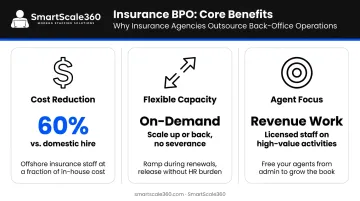
- Cost reduction: Offshore staffing runs roughly 60% below the fully loaded cost of a domestic hire
- Flexible capacity: Scale your BPO team up during renewal season or after acquiring a new book, then scale back without severance or COBRA obligations
- Agent focus: Every hour a licensed agent spends on data entry is an hour not spent generating new business or strengthening client relationships
The offshore talent pools that large carriers have used for years are now accessible to independent agencies through outsourcing providers — and at pricing structured for agencies with 5 staff, not 500.
What Insurance Agencies Can Outsource
Tasks that are repetitive, rule-based, and don't require a licensed agent's professional judgment are prime outsourcing candidates. Activities that involve advising on coverage, binding policies, or negotiating terms must stay with licensed staff.
The categories below cover where most agencies find the clearest, fastest wins.
Client-Facing Operations
Offshore staff can handle a meaningful portion of client communication without ever touching a licensed function:
- Inbound and outbound renewal reminder calls
- Certificate of insurance (COI) requests and processing
- Document request follow-up
- Basic coverage inquiry routing using agency-provided scripts
- First-notice-of-loss (FNOL) claims intake
- Extended coverage hours — offshore staff in different time zones handle after-hours inquiries without overtime costs to your in-house team
Back-Office Administration
This is where BPO delivers the most immediate time savings for most agencies. Common back-office tasks well-suited for outsourcing include:
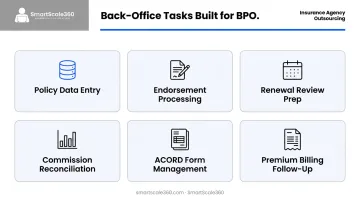
- Policy data entry and updates in your AMS (AMS360, EZLynx, Applied Epic, HawkSoft, QQCatalyst)
- Endorsement, cancellation, and reinstatement processing
- Renewal review packet preparation for producers
- Commission reconciliation and carrier download exception handling
- ACORD form management and document indexing
- Premium billing follow-up
These tasks are high-volume and process-driven. A well-trained offshore team member executes them accurately with clear SOPs in place.
Compliance and Reporting Support
Compliance support tasks are another underused outsourcing category:
- Maintaining policy records for audit readiness
- Tracking producer license renewal deadlines
- Generating routine AMS reports
- Preparing regulatory filing documentation
Licensing rule to verify: Licensing rules vary by state. Under the NAIC Producer Licensing Model Act, activities involving selling, soliciting, or negotiating insurance require a producer license. Before assigning any customer-facing or judgment-based task to an offshore team member, verify the applicable rules in every state your agency services.
How Insurance BPO Outsourcing Works
Most agency owners are surprised by how straightforward the process is. Here's how it typically unfolds.
Step 1: Identify the Right Processes
Start by auditing your own operations:
- List every recurring task your team handles weekly
- Categorize each one — does it require a license or specialized judgment?
- Estimate weekly time spent on each task
- Identify bottlenecks — where do things pile up or get delayed?
That audit becomes your outsourcing roadmap. Most agencies do best starting with one or two well-defined functions — policy data entry or renewal outreach are common first steps — rather than trying to hand off everything at once.
Once you know which tasks to move, the next step is finding the right partner to take them on.
Step 2: Vet and Select a BPO Partner
Evaluating partners comes down to a handful of non-negotiable criteria:
- Insurance industry experience: Does the provider understand AMS platforms, ACORD forms, and insurance workflows — or will you be training them from scratch?
- Talent screening: How do they test for English proficiency, insurance knowledge, and professional skills?
- Data security: What access controls, NDAs, and contractual safeguards protect your clients' nonpublic personal information?
- Engagement model: Can you start without a long-term contract and add or reduce staff as your workload shifts?
SmartScale360 works with insurance agencies on exactly this basis — no contract, no setup fee, dedicated staff matched to your specific roles, whether that's policy admin, CSR support, or renewals.
Step 3: Onboard and Integrate
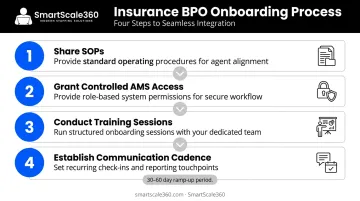
The first 30–60 days are a ramp-up period. How well you document your workflows upfront directly determines the quality of output you get back. Key onboarding steps:
- Share your SOPs — document every task the offshore team member will own
- Grant controlled AMS access — minimum permissions needed for each function
- Conduct initial training sessions — walk through agency-specific processes
- Establish a communication cadence — daily check-ins, shared task management tools, and clear escalation paths
Agencies that invest the most in those first 30 days consistently report the smoothest transitions and the fastest productivity gains from their offshore staff.
What to Look for in an Insurance BPO Partner
Not all BPO providers are equally equipped to serve insurance agencies. Three criteria separate capable partners from risky ones.
Start with insurance familiarity. A generalist BPO firm without insurance experience will require substantially more hand-holding and is more likely to make costly errors in your AMS. Look for a partner whose staff is already trained on platforms like EZLynx, Applied Epic, and AMS360 — not one learning alongside you.
Data security is the next filter. Under NAIC Model Law 668, licensees must conduct due diligence when selecting third-party service providers and require those providers to implement appropriate safeguards for nonpublic client information, confirmed by contract. Before granting system access, verify:
- Security protocols and data handling policies
- A signed NDA prior to any onboarding
- Data use restricted to only the tasks assigned
Flexibility and fit matter more than most agency owners expect. The right partner won't lock you into a long-term commitment before you've had a chance to evaluate the arrangement. SmartScale360, for example, operates on a no-contract, no-setup-fee model with dedicated staff matched to your agency's existing workflow. That means you can pilot the engagement with one VA handling endorsements and renewals, assess the results, and expand from there.
Common Misconceptions About Insurance BPO
"BPO is only for large carriers." Not anymore. The same offshore talent pools that national insurers have used for decades are now accessible to independent agencies through providers that specialize in small-to-mid-sized clients. For lean agencies, the labor cost savings represent an even larger share of the operating budget — which makes the ROI argument stronger, not weaker.
"Offshore staff won't communicate well." This concern made more sense 20 years ago. Today, the data tells a different story:
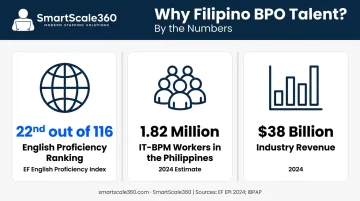
- The Philippines ranked 22nd out of 116 countries in English proficiency, scoring "high proficiency" in EF's 2024 English Proficiency Index
- IBPAP reported 1.82 million IT-BPM workers and $38 billion in revenue for 2024 — a mature, professional industry
- Reputable providers screen for English fluency, U.S. business norms, and insurance-specific knowledge before a candidate ever reaches your desk
"Setting up BPO is complicated and disruptive." The setup investment is real but limited — a few weeks of documentation, access configuration, and training sessions. After that ramp-up, managing an offshore team member is much like managing any remote hire. Most agencies recover that setup time within the first month of delegation.
Frequently Asked Questions
What is insurance BPO outsourcing?
Insurance BPO outsourcing means contracting a specialized third-party provider to handle non-core processes (policy administration, client communication, data management) so licensed staff can focus on revenue-generating work. Providers typically operate offshore with teams trained on insurance-specific workflows and platforms.
What tasks can an insurance agency outsource to a BPO?
Common categories include policy data entry, endorsement processing, renewal outreach, COI requests, billing follow-up, document indexing, ACORD form management, and compliance reporting support. Licensed activities (coverage advice, policy binding, and underwriting decisions) must remain with in-house staff.
How much can an insurance agency save with BPO outsourcing?
Savings vary by role and provider, but agencies can typically cut labor costs by 50–60% compared to a fully loaded U.S. CSR hire ($55,000–$80,000 annually). The most useful comparison is total domestic employment cost versus the monthly BPO engagement fee, including recruiting, benefits, and overhead.
Is it safe to give an offshore BPO team access to client data?
Reputable BPO partners operate on secure, controlled-access systems with contractual data protection obligations. Before granting access, verify the provider's security protocols, require an NDA, and limit permissions to what each task actually needs — NAIC model guidance requires agencies to document this due diligence.
How long does it take to onboard an insurance BPO team member?
Most administrative roles take 2–4 weeks to ramp up, depending on workflow complexity and SOP quality. The agency's investment in clear documentation upfront is what most determines how quickly the offshore team can perform accurately.
What is the difference between insurance BPO and hiring a virtual assistant?
A virtual assistant is typically a solo generalist contractor with limited oversight. A BPO partner provides vetted, role-specific staff pre-screened for insurance knowledge and English proficiency, with managed oversight and the ability to scale. For ongoing, process-driven insurance agency work, BPO is the more reliable and growth-ready model.
Ready to explore what insurance BPO could look like for your agency? SmartScale360 offers a free consultation and role-scoping session with no commitment required. Reach the team at (802) 345-9548 or zach@smartscale360.com.