Introduction
Real estate runs on responsiveness. A missed follow-up, a stale listing, or an inbox that's three days behind doesn't just create friction — it costs deals.
Yet most agents spend 15+ hours a week on work that has nothing to do with clients: updating CRMs, scheduling appointments, posting on social media, chasing documents.
A virtual assistant is a remote professional hired specifically to absorb that administrative load, so agents can redirect their hours toward showings, client relationships, and closings.
This article is written for solo agents, small teams, and growing brokerages in the US who are hitting capacity and losing time to low-value work. The term "real estate VA" gets used constantly, but how the service actually works — what's included, what affects outcomes, what to avoid — rarely gets explained at an operational level. This guide covers all of it.
Key Takeaways
- Real estate VAs handle administrative, marketing, operational, and sales-support tasks remotely — not licensed activities
- Offshore VAs typically cost 60–70% less than an in-house assistant when salary, benefits, and overhead are factored in
- Quality depends on task clarity and real estate familiarity — not just hourly rate
- VAs cannot show properties, negotiate contracts, or solicit listings — state rules apply
- Start part-time with a defined task set before scaling to full-time support
What Are Virtual Assistant Services for Real Estate Agents?
A real estate virtual assistant is a remote worker (sourced through a staffing provider or hired independently) who performs defined administrative, operational, or marketing tasks for a licensed agent or broker.
Agents routinely spend hours on work that doesn't require a license — time that could go toward closing deals instead. A VA takes over the repeatable, process-driven tasks, freeing the agent to focus on clients.
How This Differs from Similar Roles
Real estate VA services are often confused with adjacent roles that serve different functions:
| Role | Primary Focus | Licensed? |
|---|---|---|
| Real estate VA | Broad admin, marketing, operations | No |
| Transaction coordinator | Contract-to-close process only | No (typically) |
| Inside sales agent (ISA) | Lead qualification and conversion | Varies |
| Licensed assistant | Client-facing and licensed tasks | Yes |
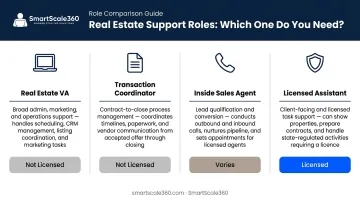
A VA operates entirely off-site and handles unlicensed support tasks. Some agents use a VA and a transaction coordinator simultaneously — they're not substitutes for each other.
Why Real Estate Agents Rely on VA Services
The Operational Problem
According to NAR's 2023 Member Profile, only **17% of REALTORS use at least one personal assistant** — which means the majority are absorbing administrative work themselves. That time loss compounds: during busy transaction periods, follow-ups slip, marketing stops, and CRM records fall out of date.
An overwhelmed agent doesn't get to pause the pipeline — leads keep coming in while existing deals demand attention.
What real estate specifically demands — consistent lead follow-up, CRM hygiene, listing updates, social media presence, appointment coordination — is work that must happen regularly but doesn't require licensure. It's also exactly the kind of work that can be documented, systematized, and delegated.
The Cost Rationale
Hiring in-house creates immediate overhead that most solo agents and small teams can't justify:
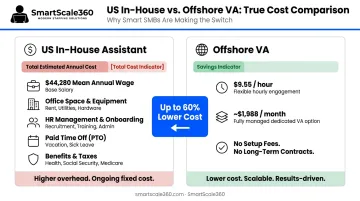
- BLS data shows the mean annual wage for a real estate administrative assistant is $44,280, plus benefits
- Total compensation for office and admin roles runs approximately $36.74/hour when benefits are included
- An in-house hire also requires office space, equipment, HR management, and paid time off
Offshore VAs (commonly sourced from the Philippines) cost substantially less. Provider pricing published by BELAY puts US-based VAs at $30–$75/hour, while offshore providers like Virtudesk publish rates around $9.55/hour. Managed options like MyOutDesk start around $1,988/month for full-time support.
SmartScale360 benchmarks the gap at up to 60% below a US in-house hire — comparing a $45,000–$65,000 US-based transaction coordinator against an offshore equivalent with no setup fee and no long-term contract.
What Goes Wrong Without VA Support
- Leads go cold during active transaction periods
- CRM data becomes unreliable, making follow-up inconsistent
- Social media and email marketing stop entirely
- Listing details go stale or contain errors
- Agents burn out managing low-value work during peak seasons
The combination of remote work infrastructure and a deep pool of real estate-trained offshore talent has made VA support a practical option for agents at every production level — not just top producers with large teams.
What Tasks Does a Real Estate Virtual Assistant Handle?
Real estate VAs cover a wide range of work — from marketing and listing coordination to inbox management and lead follow-up. The common thread: these are tasks that consume agent hours without requiring a license.
Marketing Support
Real estate VAs regularly handle:
- Creating and scheduling social media posts
- Designing listing flyers and marketing materials in Canva
- Drafting and sending email campaigns
- Updating agent websites and blog content
- Tracking basic marketing performance metrics
These are recurring tasks with predictable formats — highly delegable once templates and brand guidelines are set.
Operations and Listing Coordination
Transaction and listing coordination covers a lot of ground:
- MLS and CRM data entry
- Creating and updating listing presentations
- Coordinating photography, staging, and inspection schedules
- Managing contracts and transaction documents
- Preparing performance reports
- Following up with vendors and service providers
SmartScale360's real estate VAs are screened for proficiency with platforms like Dotloop, SkySlope, DocuSign, Brokermint, Follow Up Boss, and kvCORE — tools that require real estate operational experience, not generic admin familiarity.
Administrative and Communication Tasks
- Inbox triage and email organization
- Calendar management and appointment scheduling
- Responding to routine client inquiries
- Recording meeting notes
- Maintaining organized document file structures
These are the tasks most likely to fragment an agent's productive hours throughout the day.
Sales-Support Tasks
Beyond operations and admin, VAs can extend into sales support — with agent review and approval on anything client-facing:
- Researching buyer and seller leads
- Updating CRM records with call notes
- Following up with cold leads in the pipeline
- Setting appointments for the agent
One firm boundary: VAs cannot show properties, negotiate offers, solicit listings, or perform any activity that requires a real estate license. What's permitted varies by state — confirm with your state real estate commission before assigning client-contact or transaction-adjacent tasks.
Key Factors That Determine How Well VA Services Work
Most VA arrangements that underperform do so for predictable, avoidable reasons.
Task Definition Clarity
This is the single biggest variable. Vague instructions produce inconsistent results. Well-documented processes and checklists produce consistent, scalable output. Follow Up Boss recommends tracking your own time for a full month before hiring — identifying exactly which tasks are consuming hours and whether they can be systematized. That time audit shapes smarter delegation decisions than any job posting ever will.
Industry Familiarity and Tool Proficiency
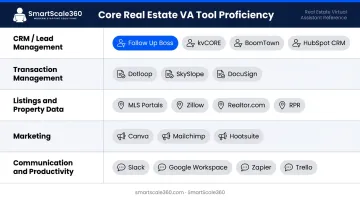
A VA who already understands real estate workflows and is proficient in the tools the agent uses requires far less ramp-up time. Common tools real estate VAs are expected to know:
| Category | Tools |
|---|---|
| CRM / Lead management | Follow Up Boss, kvCORE, BoomTown, LionDesk, Chime |
| Transaction management | Dotloop, SkySlope, Brokermint, DocuSign |
| Listings and property data | MLS portals, Zillow, Realtor.com |
| Marketing | Canva, Mailchimp, Adobe |
| Communication and productivity | Google Workspace, Zoom, Slack, Zapier |
Local vs. Offshore Considerations
Offshore VAs — particularly from the Philippines — offer strong English proficiency (the Philippines ranks 28th globally in the EF English Proficiency Index with a "High Proficiency" classification) and real estate administrative experience at roughly 60% less than equivalent US in-house staff. Providers like SmartScale360 source college-educated, English-speaking staff matched to specific roles, putting offshore talent within reach for smaller agents and teams — not just large brokerages.
Local VAs make sense for client-facing or highly market-specific roles. For administrative, marketing, and operational work — which is where most agents start — offshore talent handles the load at a fraction of the cost. That cost difference also affects how agents should think about scope.
Scope Sizing and Hours
Starting with too few hours leaves tasks undone. Starting with too many creates management overhead the agent isn't ready for. A part-time or project-based arrangement is usually the right entry point — enough to test workflows and communication before expanding the scope.
Common Misconceptions — and When VA Services Aren't the Right Fit
Two Misconceptions Worth Addressing
"A VA can handle anything an in-house assistant could." Not true. Unlicensed VAs are legally restricted from performing licensed activities — and those restrictions vary by state. California's DRE guidelines and Texas TREC's rules, for example, differ significantly in what unlicensed assistants can do. Assigning restricted tasks creates legal exposure. NAR provides state-specific guidance at nar.realtor/personal-assistants, and agents should verify their state commission's rules before delegating any client-contact or transaction work.
"Offshore VAs produce low-quality work." Quality comes down to screening, role fit, and task clarity — not geography. A college-educated VA with real estate experience and strong English proficiency, matched to a well-defined role, will outperform a poorly scoped local hire. The variable is process quality, not location.
When VA Services Aren't the Right Fit
- The agent doesn't have enough repeatable, delegable task volume to justify the arrangement
- All required work involves licensure
- Workflows haven't been documented, making delegation impossible
- The role requires physical presence
A VA hired to solve undefined problems will not deliver results. The arrangement works when the agent comes in with documented workflows, clear task definitions, and the tools to make delegation possible.
Frequently Asked Questions
What tasks can a real estate virtual assistant legally handle without a license?
Unlicensed VAs can handle administrative, marketing, data entry, CRM management, and communication tasks. They cannot show properties, negotiate contracts, solicit listings, or conduct any activity requiring a real estate license. Rules vary significantly by state — agents should consult their state real estate commission's guidelines before assigning any client-facing or transaction-adjacent work.
How much does a virtual assistant for real estate agents typically cost?
Offshore VAs typically range from $8–$15/hour through managed providers, while US-based VAs run $30–$75/hour. Cost depends on hours, task scope, experience level, and whether you source independently or through a staffing provider. SmartScale360, for example, positions its real estate VAs at up to 60% below US in-house costs with no setup fees or long-term contracts.
What is the difference between a real estate VA and a transaction coordinator?
A transaction coordinator focuses specifically on managing the contract-to-close process — contingency tracking, document management, and coordinating with title, lenders, and inspectors. A real estate VA covers a broader ongoing scope: admin, marketing, CRM, and operations. Some agents use both simultaneously for different functions.
Can an overseas virtual assistant work effectively for a US-based real estate agent?
Yes. Offshore VAs — particularly from the Philippines, which holds a High Proficiency classification on the EF English Proficiency Index — work effectively on tasks like CRM management, marketing, and administration. Clear processes and communication protocols are the primary success factors, not geography.
How long does it take to onboard a real estate virtual assistant?
Most agents are up and running within one to two weeks. Agents with documented workflows and tool access in place tend to onboard fastest — starting with a focused task set before expanding scope keeps the transition smooth.
What tools should a real estate virtual assistant know how to use?
Core tools include CRMs like Follow Up Boss or kvCORE, transaction platforms like Dotloop or SkySlope, MLS systems, Google Workspace or Microsoft Office, Canva for design work, and communication platforms like Slack or Zoom. Providers like SmartScale360 screen VAs for real estate-specific tool proficiency before placement.