Introduction
Offshore customer service outsourcing means hiring trained agents in another country to handle your customer interactions on your behalf. Until recently, this was something only large corporations could access. That's changed.
US salary increase budgets hit a 20-year high of 4.4% in 2023, according to SHRM — and for small businesses already running lean, absorbing those increases while competing for local talent is genuinely difficult. Customer expectations aren't going down to meet tighter budgets.
This guide gives you a practical, honest look at how offshore customer service works for SMBs:
- What offshore customer service outsourcing actually is and how it differs from domestic options
- Why small and mid-sized businesses are adopting it now, not just large enterprises
- How the process works step by step, from vendor selection to onboarding
- When it's the right fit — and when it isn't
Key Takeaways
- Offshore customer service outsourcing connects SMBs with dedicated, college-educated agents in the Philippines at a fraction of domestic hiring costs.
- Labor costs drop significantly compared to domestic hiring, without sacrificing English fluency or education level.
- Success depends on scoped roles, rigorous provider vetting, strong onboarding, and consistent performance monitoring.
- The "offshore equals poor quality" assumption is outdated, particularly when your provider screens rigorously for skills and English fluency.
- Not every SMB is ready; process maturity and management bandwidth matter before you commit.
Why SMBs Are Turning to Offshore Customer Service Outsourcing
Hiring locally has gotten expensive — and the math is hard to ignore. Labor costs can account for up to 70% of total business expenses, and that figure hasn't budged even as margins tighten across industries.
The Financial Case
Offshore agents in countries like the Philippines can be hired at a fraction of the cost of a domestic equivalent. SmartScale360, which connects US SMBs with dedicated Philippine-based staff, cites labor cost reductions of up to 60% compared to US hires — without trading down on education level or English proficiency.
For a small business running a customer service team of three or four people, that savings could fund an entire additional hire — reinvested into sales, operations, or product development.
Scalability Without the Overhead
Cost savings are only part of the picture. Offshore staffing also changes how SMBs handle growth:
- No recruitment costs when adding capacity
- No benefits or equipment overhead for new agents
- No long-term headcount commitments during seasonal surges
- Adjustable packages that scale up or down as demand shifts
This matters most for businesses with uneven demand — e-commerce brands during Q4, home care agencies managing caregiver shortages, or law firms with fluctuating caseloads.
Extended Coverage Without Burning Out Your Team
Offshore agents in the Philippines operate across different time zones, which lets SMBs extend service hours without paying night-shift premiums to local staff. Philippine labor law does require a night differential for overnight shifts, so factor that into provider conversations — but even with that addition, the cost stays well below domestic equivalents.
Leveling the Playing Field
Amazon, Bank of America, and Google have used offshore customer service for years. The infrastructure that made this possible — trained talent pools, communication tools, management frameworks — is now accessible to businesses with five employees, not just five thousand. For SMBs still relying entirely on local hires, that's a competitive gap worth closing.
How Offshore Customer Service Outsourcing Works: A Step-by-Step Guide for SMBs
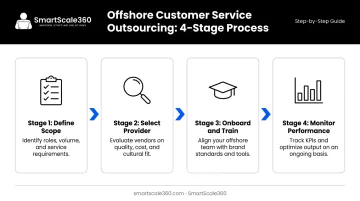
Offshore customer service outsourcing follows a clear, four-stage process: define your scope, select the right provider, onboard your team, and monitor performance. Each stage builds on the last.
Step 1: Define Your Customer Service Needs and Scope
Before you talk to a single provider, get specific about what you're actually offshoring.
Tasks well-suited to offshore delivery:
- Inbound inquiry handling (phone, email, live chat)
- Order tracking and status updates
- Appointment scheduling and confirmations
- Complaint resolution using defined protocols
- Social media DM management
Tasks that need more careful consideration:
- Highly technical support requiring real-time product expertise
- Conversations requiring licensed professionals (healthcare advice, legal counsel)
- Situations where customers strongly expect a local representative
Starting with a clearly scoped, lower-stakes role reduces risk for first-time offshoring SMBs. You can expand the scope once the model shows results.
Step 2: Select and Vet the Right Offshore Provider
Not all providers are built the same. When evaluating options, focus on these criteria:
| Criteria | What to Look For |
|---|---|
| English proficiency | Structured screening process, not self-reported |
| Cultural alignment | Western market familiarity, communication style |
| Staff model | Dedicated agents vs. shared/pooled — dedicated wins for SMBs |
| Technology compatibility | Can they work in your existing CRM and helpdesk? |
| Data security | Ask specifically about HIPAA, GDPR, or FTC Safeguards Rule compliance if relevant |
| Contract flexibility | Month-to-month preferred; no setup fees |
SmartScale360 is built specifically for this market — connecting US SMBs with dedicated, college-educated, English-speaking agents from the Philippines, with no contracts and no setup fees. Their agents work inside platforms like Zendesk, Gorgias, Freshdesk, Intercom, and HubSpot Service Hub, so there's no tech overhaul required.
The dedicated model matters: an agent who works exclusively for your business learns your brand, your products, and your customers. A shared pool doesn't.
Step 3: Onboard and Train Your Offshore Team
Offshore agents are not plug-and-play. They need the same context any new hire would — just delivered remotely.
A solid onboarding process includes:
- Brand voice and tone — Define whether agents should sound formal, conversational, or empathetic, and give examples
- Product and service knowledge — Walk through the most common customer questions and their correct answers
- Call and chat scripts — Cover high-frequency scenarios so agents have structure from day one
- Escalation protocols — Specify exactly when and to whom an agent should hand off a conversation
- Tool access — Provision CRM logins, ticketing system credentials, and any communication channels upfront
The quality of your own onboarding materials directly determines early results. The more structured your documentation, the faster the agent ramps up.
Step 4: Monitor Performance and Iterate
Set your KPIs before the team goes live — not after something goes wrong. Performance requires active oversight, especially in the first 60–90 days.
Key metrics to track:
- First Response Time (FRT) — How quickly are customers getting a reply?
- CSAT scores — Are customers satisfied with the interaction?
- Resolution rate — Are issues being resolved, or just responded to?
- Call/chat handling time — Efficiency without sacrificing quality
Schedule regular check-ins, run periodic call or ticket reviews, and treat the offshore team like any other part of your business — because they are. Providers like SmartScale360 also offer free replacement if an agent isn't working out, which removes some of the performance risk.
Key Factors That Determine Offshore Outsourcing Success for SMBs
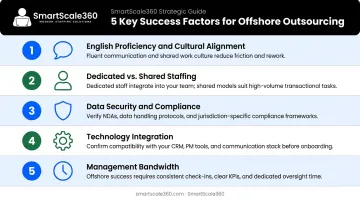
Offshore outsourcing success comes down to five factors. Get these right and the arrangement works. Miss one and it creates friction that compounds over time.
English proficiency and cultural alignment: The Philippines ranks 28th globally and second in Asia on the EF English Proficiency Index 2025, with a "High Proficiency" rating. The country's IT-BPM industry generated $38 billion in revenue and employed 1.82 million people in 2024, making it the world's second-largest offshore delivery location. Cultural familiarity with Western markets is a real operational advantage — one that shows up in tone, communication style, and customer rapport.
Dedicated vs. shared staffing: Agents assigned exclusively to your account retain your brand knowledge and deliver consistent experiences. Pooled agents don't. For SMBs with relatively small customer service volumes, dedicated staffing is almost always the right choice.
Data security and compliance: If your business operates in healthcare, financial services, or legal, ask providers directly about HIPAA BAAs, FTC Safeguards Rule compliance, and data handling protocols. Going offshore doesn't remove your compliance obligations — it changes how you manage them.
Technology integration: Your offshore team needs to work inside your existing systems — Zendesk, Freshdesk, HubSpot, whatever you're using. Confirm compatibility before signing anything. Providers who pre-train staff on major platforms save you significant onboarding time.
Management bandwidth: Someone internally needs to own the offshore relationship — providing feedback, handling escalations, and running performance reviews. If you're already stretched, account for this time before you commit. A good rule of thumb: budget 2–4 hours per week, per offshore team member, especially in the first 90 days.
SmartScale360 structures its engagements specifically around these pressure points — dedicated agents, no long-term contracts, and staff pre-matched to your tools and vertical — so SMBs aren't managing around gaps from day one.
Common Misconceptions SMBs Have About Offshore Customer Service
"Offshore always means bad quality"
This reputation was earned by early, low-investment implementations — generic call centers with high agent turnover and zero brand knowledge. Modern offshore providers, particularly in the Philippines, operate very differently. Dedicated agents who are screened, role-matched, and properly onboarded can represent SMB brands as effectively as an in-house hire.
Testimonials from SmartScale360 clients illustrate this: one Home Instead Regional Director described her offshore VA as someone who "asks a lot of questions, quick learner, takes the lead and engages in conversations" — the opposite of scripted and passive.
"Customers won't be able to understand the agents"
The Philippines regularly scores among the highest in Asia on English proficiency indexes — the EF English Proficiency Index has ranked it in the top tier regionally for several years. Providers that screen specifically for accent neutrality and fluency address this concern before a client ever speaks to an agent. When proper screening is in place, communication barriers are the exception, not the rule.
"This is only for big companies"
The cost structures and complexity of offshore outsourcing once required enterprise-scale resources to manage — making it a realistic option only for large organizations. Today, providers serve businesses with as few as five employees, offering access to the same talent pool Fortune 500 companies have used for decades. No contracts and no setup fees have removed the financial risk that previously kept SMBs out of the conversation.
When Offshore Customer Service Outsourcing May Not Be the Right Fit
Offshore outsourcing isn't the right move for every SMB. Recognizing the warning signs early saves time, money, and a lot of frustration.
You're not ready if:
- Your customer service process isn't documented. An offshore team can only follow structure that exists. If every interaction is ad hoc, offshore agents will inherit that inconsistency at scale.
- Your service requires real-time deep technical expertise. Troubleshooting complex software or hardware in live environments often needs someone with hands-on product experience that's hard to replicate offshore.
- Your customers expect licensed professionals. Healthcare advice, legal counsel, and financial guidance require appropriate credentials — offshore agents can handle adjacent tasks, but not the professional judgment itself.
- Cost is your only reason for exploring it. If there's no plan for oversight, no defined scope, and no onboarding investment, offshore outsourcing almost always underperforms expectations regardless of the provider.
If any of these apply, address the internal gaps first — document your processes, define your scope, and establish oversight expectations. Once that groundwork exists, offshore staffing becomes a much stronger investment.
Frequently Asked Questions
What are offshore support services?
Offshore support services are customer-facing or business process functions — answering inquiries, resolving complaints, managing orders — handled by trained agents located in another country, typically in a lower-cost labor market like the Philippines or India.
Is outsourcing illegal in the US?
Outsourcing is legal and widely practiced across industries of all sizes. Businesses should verify compliance with applicable data protection regulations — such as HIPAA for healthcare or the FTC Safeguards Rule for financial services — when sharing customer data with offshore partners.
How much can an SMB save by outsourcing customer service offshore?
SmartScale360 cites labor cost reductions of up to 60-70% compared to US-based hires. Actual savings vary by provider, role complexity, and number of agents, but the difference is significant enough to reshape a small business's cost structure.
What is the difference between offshore, nearshore, and onshore customer service outsourcing?
- Onshore: Same-country delivery at the highest cost
- Nearshore: A neighboring country like Mexico or the Caribbean — moderate cost, minimal time zone difference
- Offshore: Further abroad at the lowest cost, requiring more active management of time zones and cultural alignment
How do I maintain quality control with an offshore customer service team?
Set clear KPIs from day one — response time, CSAT, resolution rate. Run regular check-ins, review calls or tickets periodically, and invest in ongoing training. Consistent oversight, not a one-time setup, is what keeps standards high.
Which countries are the best destinations for offshore customer service outsourcing?
The Philippines leads for English-speaking customer service, combining high English proficiency, cultural familiarity with Western markets, and strong BPO infrastructure. India is widely used as well, and tends to be particularly well-suited for technical support roles.