
Virtual bookkeeping is often discussed in vague terms: "cost savings," "flexibility," "scalability." Those words mean nothing until you connect them to what actually changes week to week — whether you can see your numbers, make faster decisions, and stop doing tasks that someone else should be handling.
This article breaks down the concrete, operational case for working with a virtual bookkeeping firm: what it costs, what it replaces, and why the businesses that commit to it consistently outperform those that don't.
Key Takeaways
- Virtual bookkeeping firms manage your financial records remotely, no full-time employee required
- The median US bookkeeper salary alone is $49,210/year — before benefits, equipment, or office costs
- Published virtual bookkeeping plans run $199–$995/month, with offshore-staffed models cutting labor costs up to 60–70%
- Specialized expertise and real-time data access reduce compliance risk and sharpen decisions
- Unstructured bookkeeping creates cash flow blind spots, tax penalties, and a hidden growth ceiling
What Is a Virtual Bookkeeping Firm?
A virtual bookkeeping firm is a team of remote professionals who manage your financial records entirely through cloud-based software and digital communication. No on-site staff, no dedicated office space. Just accurate, current books handled by specialists who work in your accounting platform of choice.
What They Actually Handle
The scope typically includes:
- Transaction categorization and coding
- Bank and credit card reconciliation
- Accounts payable and accounts receivable management
- Payroll support
- Month-end close and financial reporting (P&L, balance sheet, cash flow statements)
- Support for 1099 preparation, sales tax filings, and year-end packages
Virtual bookkeeping firms serve small to mid-sized businesses across most industries: retail, professional services, real estate, homecare, law, marketing, and franchises. If you need professional financial management without the overhead of a full accounting department, you're a fit.
What They Are Not
A virtual bookkeeping firm is not a replacement for a CPA or CFO. Think of it as the operational foundation: keeping records accurate, current, and organized so that everything above it (tax preparation, financial planning, investor reporting) runs faster and with fewer errors. Clean books going into tax season are worth far more than scrambling to reconstruct six months of transactions in February.
Key Advantages of a Virtual Bookkeeping Firm for Small Businesses
The advantages below connect to outcomes small business owners actually track: overhead costs, owner time, financial accuracy, and the ability to grow without financial records falling apart. These are operational changes, not abstract efficiency gains.
Cost Reduction Without Sacrificing Quality
Hiring a full-time in-house bookkeeper costs far more than the salary line on your budget. The Bureau of Labor Statistics reports a $49,210 median annual wage for bookkeeping, accounting, and auditing clerks as of May 2024. That's salary only.
Add in the employer's share of payroll taxes, health insurance, retirement contributions, paid leave, equipment, and office space — and the fully loaded annual cost of an in-house bookkeeper often lands well above $65,000–$80,000 for many US businesses.
Virtual bookkeeping firms change that math entirely:
| Provider | Monthly Cost | Annual Cost (Est.) |
|---|---|---|
| Bench | $199–$399/month | $2,388–$4,788 |
| Merritt Bookkeeping | $250/month | $3,000 |
| Bookkeeper360 | $399–$599/month | $4,788–$7,188 |
| Xendoo | $395–$995/month | $4,740–$11,940 |
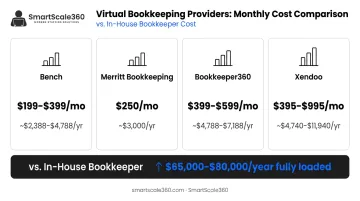
For businesses using offshore-staffed providers like SmartScale360 — which supplies college-educated, English-speaking bookkeeping specialists primarily from the Philippines — clients routinely cut labor costs 60–70% below comparable US in-house rates, without compromising on software expertise or communication quality.
Every dollar not spent on bookkeeping overhead is a dollar available for marketing, hiring, or operations. For a startup watching every line item or an owner-operator currently doing their own books, that difference is material.
Bottom-line impact: monthly labor costs, bookkeeping overhead as a percentage of revenue, reinvestment budget freed up.
Scalability That Matches Business Growth Without Hiring Delays
In-house bookkeeping capacity is fixed. When transaction volume increases — a new product line, a second location, a seasonal surge — you face the same choices: ask an already-stretched employee to absorb more work, or hire someone new.
According to Robert Half's 2024 research, 43% of finance and accounting hiring managers reported difficulty filling accounts payable, accounts receivable, and bookkeeping positions — and 48% struggled to hire fast enough to secure qualified candidates. Meanwhile, SHRM data puts the average time-to-fill across roles at 41 days in 2024. That's over a month without adequate coverage, during which your records fall behind.
Virtual bookkeeping firms solve this differently:
- No headcount decisions required — the firm draws on a broader team and adds capacity as needed
- No geographic constraint — you're not limited to whoever is available in your local market
- No onboarding lag — scaling support doesn't mean starting over with a new hire
For SmartScale360 clients, this means a business can expand from one dedicated bookkeeper to multiple seats quickly, with no new contracts required. Their no-contract, monthly per-seat model is designed specifically for businesses whose needs shift with the season or growth phase.
The measurable difference shows up in time-to-scale, financial record backlog during growth phases, and cost per additional bookkeeping hour.
Real-Time Financial Visibility and Access to Specialized Expertise
Cloud-based bookkeeping platforms give you access to current financial data — not month-old reports printed and mailed, but live figures you can pull up on demand. Cash position, receivables aging, expense trends, and burn rate are all accessible when you need them — not when the report finally arrives.
The Federal Reserve's 2024 Small Business Credit Survey found that 56% of employer firms reported difficulty paying operating expenses and 51% experienced uneven cash flow. Decisions made without current financial data — on hiring, vendor terms, pricing, or growth investments — compound that risk.
Beyond visibility, virtual bookkeeping firms bring specialist depth that a single in-house hire rarely matches:
- Cross-industry experience — bookkeepers who work across multiple clients and industries stay current on tax law changes, software updates, and reporting requirements
- Platform expertise — SmartScale360's bookkeeping specialists work in QuickBooks Online, Xero, NetSuite, Sage Intacct, FreshBooks, Bill.com, Gusto, ADP RUN, and more
- Compliance awareness — exposure to varied business structures means faster identification of reporting gaps or compliance issues
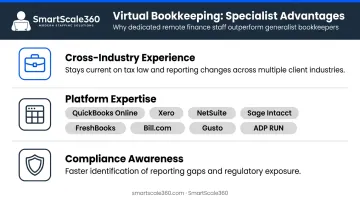
A single in-house employee working in isolation cannot cost-effectively maintain that breadth. Virtual firms build it into their team structure.
Where it shows up: reporting frequency, time-to-insight on cash flow changes, and compliance risk exposure.
What Happens When Small Businesses Skip Virtual Bookkeeping
Bookkeeping gets deprioritized during busy periods, reconciliations get skipped, and by the time the problem surfaces — a loan application, a tax deadline, a cash shortfall — the backlog is expensive to fix.
Specific consequences include:
- Financial statements riddled with errors, leaving owners with no reliable data on which products or services are actually profitable
- Missed deductions that cost real money — the IRS accuracy-related penalty alone runs 20% of the underpayment amount
- Penalties for late or incorrect filings that stack fast — failure-to-file runs up to 25% of unpaid tax, and failure-to-pay can add another 25% on top
- No ability to delegate or hand off financial tasks when records are months behind and disorganized
Those penalties only cover the direct damage. Once the backlog exists, unwinding it costs money too. Catch-up bookkeeping typically starts around $1,000 per project — and that figure doesn't include the owner's time spent reconstructing records.
The longer-term cost is a growth ceiling that's hard to see until it's already limiting the business. Without clean, current financials, qualifying for credit becomes difficult, larger contracts stay out of reach, and pricing decisions get made on instinct instead of data. The owner stays reactive — and the opportunities that require financial credibility simply don't materialize.
How to Get the Most Value From a Virtual Bookkeeping Firm
Virtual bookkeeping delivers its highest value when the business treats it as an ongoing operational system — not a one-time cleanup or an annual tax-prep exercise.
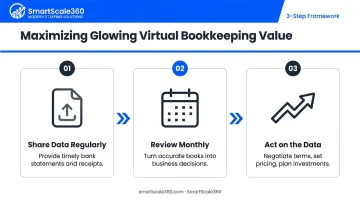
What consistent engagement looks like in practice:
- Share data regularly — provide timely access to bank statements, receipts, and expense records so your bookkeeper maintains current records rather than catching up on backlogs
- Review monthly, not quarterly — monthly financial reviews turn accurate books into decisions: spotting which revenue streams are most profitable, catching costs before they compound, confirming cash flow supports upcoming commitments
- Use the data for decisions — don't just receive reports; use them to negotiate vendor terms, set pricing, evaluate hiring timing, and plan growth investments
For businesses weighing both cost and expertise, pairing a virtual bookkeeping setup with a dedicated offshore staffing partner adds a practical second layer. SmartScale360 matches businesses with college-educated, English-speaking bookkeeping specialists from the Philippines — covering full-cycle bookkeeping, AR/AP management, and payroll support at roughly 60% below the cost of an in-house hire, with no contracts or setup fees.
Businesses that keep clean books, review them monthly, and actually act on what they show tend to catch problems earlier and move on opportunities faster. That consistency — not any single report — is what makes virtual bookkeeping worth the investment.
Frequently Asked Questions
What does a virtual bookkeeping firm do?
A virtual bookkeeping firm manages your business's financial records remotely — covering transaction recording, bank reconciliation, accounts payable and receivable, payroll support, and financial reporting. Everything runs through cloud-based software, with no physical presence required.
Is a virtual bookkeeping firm a legitimate business?
Yes. Virtual bookkeeping firms are fully legitimate professional services, staffed by credentialed bookkeepers and accountants. They operate under the same professional standards as traditional firms, just delivered remotely through secure digital platforms.
How much does a virtual bookkeeping firm cost for a small business?
Published plans range from $199 to $995 per month, depending on transaction volume, reporting frequency, and service scope. Compare that to the median US bookkeeper salary of $49,210/year — before benefits and overhead — and the cost difference is substantial, often exceeding $40,000 annually.
What is the difference between a virtual bookkeeper and an in-house bookkeeper?
The core difference is cost structure and flexibility. An in-house bookkeeper is a full-time employee with salary, benefits, equipment, and overhead costs. A virtual bookkeeper delivers the same functions remotely for a monthly fee, with the ability to scale up or down as your business needs change.
Is my financial data safe with a virtual bookkeeping firm?
Most virtual bookkeeping firms use bank-level encryption, secure client portals, two-factor authentication, and confidentiality agreements. Platforms like Bench document SOC 2 compliance and AES-256 encryption. In many cases, these protocols exceed what a small business could implement internally.
How do I know if my small business needs a virtual bookkeeping firm?
You're likely ready if your books are consistently behind, your financial records are inaccurate, or managing them yourself is eating into time better spent running the business. It's also worth considering when revenue is growing but doesn't yet justify a full-time hire.