Introduction
Running a small business means wearing too many hats — and at some point, that workload starts stalling growth. According to the Bureau of Labor Statistics, total compensation for office and administrative support workers averages $36.42 per hour, which translates to roughly $75,750 annually when annualized. For most small businesses, that cost is simply out of reach for every function that needs covering.
Virtual assistants offer a real alternative. The market, though, is crowded: AI tools, freelance platforms, offshore agencies, and dedicated staffing providers each promise different things at different price points. Pick the wrong one and you're looking at wasted budget, missed deliverables, and more headaches than you started with.
This guide cuts through the noise — covering what VAs actually do, what separates a strong hire from a costly mistake, and how to find the right fit for your business.
Key Takeaways
- Small businesses with 10–99 employees spend an average of 25 hours per week on manual data entry and reconciliation alone — prime tasks for delegation
- VA options range from AI automation tools to freelance platforms to dedicated offshore staffing — each suited to different budgets and task types
- The right match depends on task complexity, industry experience, communication requirements, and scalability needs
- Dedicated offshore VAs typically deliver the strongest cost-to-value ratio for businesses needing consistent, multi-function support
- Getting the match right starts with auditing your weekly tasks before you search for a VA
What Is a Virtual Assistant for Small Business?
A virtual assistant is a remote professional — human or software-based — hired to handle specific business tasks that don't require a full-time, in-office employee. The cost is a fraction of traditional hiring, and the scope is flexible.
The VA market has expanded considerably. The human virtual assistant services market was valued at $8.66 billion in 2024 and is projected to reach $29 billion by 2032. Today's options span three distinct categories.
Types of Virtual Assistants
| Type | Best For | Trade-Off |
|---|---|---|
| AI/Software Tools | Repetitive, rule-based tasks (scheduling, email sorting) | Limited to structured workflows; no judgment or nuance |
| Freelance VAs (Upwork, Fiverr) | Project-based or occasional work | Flexible, but inconsistent availability and no continuity |
| Dedicated Offshore VAs | Ongoing, multi-function roles requiring consistency | Requires upfront matching effort; higher monthly cost than freelance |
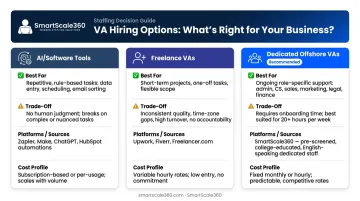
The right type depends on what you need done. AI tools and freelancers work well for narrow, defined tasks — but dedicated offshore VAs function as a true extension of your team, showing up daily, working your hours, and building institutional knowledge over time. SmartScale360, for example, matches businesses with dedicated offshore staff rather than rotating freelancers.
What Can a Virtual Assistant Do for Your Small Business?
A well-matched human VA typically covers:
- Administrative support — calendar management, email filtering, data entry, document prep
- Customer service — inbound inquiries, complaint resolution, live chat
- Social media management — content scheduling, community engagement, analytics
- Bookkeeping basics — invoicing, expense tracking, billing follow-up
- Research and lead generation — prospect lists, market research, CRM updates
A 2024 Intuit survey of businesses with 10–99 employees found they spend an average of 25 hours per week on manual data entry and reconciling data, with 91% reporting this manual work directly undermines productivity. That's more than half a full-time week spent on tasks a VA can handle.
Key Factors to Consider When Choosing the Right Virtual Assistant
The variety of VA options makes the choice feel overwhelming. These six factors help you match your specific needs to the right engagement type and provider.
Factor 1: Define Your Business Needs Before You Search
The most common mistake is searching for a VA before identifying which tasks to delegate. The result: poor matches, rework, and disappointment.
Start with a simple task audit:
- List every recurring task you or your team handles weekly
- Flag tasks that are repetitive and time-consuming but don't require your direct authority
- Categorize by skill type — admin, customer-facing, technical, financial
This exercise tells you whether you need a generalist VA, a specialist (bookkeeping, legal, real estate), part-time support, or a full-time dedicated staff member. Skipping this step almost guarantees a mismatch.
Factor 2: Choose the Right Engagement Model
Each model serves a different need:
- AI tools — $20–$25/month for business plans; ideal for structured, repeatable workflows. Limited judgment and adaptability.
- Freelance platforms — $10–$75/hour depending on location and skill. Flexible but inconsistent. You manage sourcing, vetting, and continuity yourself.
- Dedicated offshore staffing — Flat monthly pricing with consistent hours, a matched professional, and ongoing support. Managed providers like SmartScale360 handle recruiting, onboarding, and replacement.
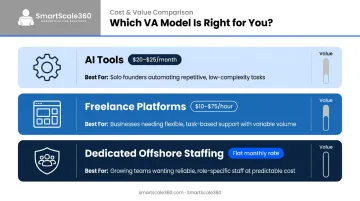
For businesses with ongoing, high-volume needs, dedicated offshore arrangements typically deliver the strongest output per dollar — you're not re-onboarding someone new every month.
Factor 3: Match Skills and Industry Experience to Your Niche
A VA's general administrative skills matter far less than their familiarity with your specific industry. A VA who understands real estate transaction timelines, homecare scheduling platforms, or legal document handling requires significantly less training — and makes fewer costly errors.
Screen specifically for prior industry experience. Look for providers that match candidates based on domain fit, not just availability. SmartScale360, for example, places VAs across homecare, law firms, real estate, financial services, and insurance — candidates who already know the relevant workflows, software, and terminology.
Factor 4: Evaluate Communication Skills and Language Proficiency
For any customer-facing or client-communication role, this factor will make or break the engagement. Miscommunication causes client churn, missed deadlines, and brand damage — especially when a VA is representing your business externally.
Before committing:
- Request a video or phone interview
- Ask for a writing sample relevant to your business
- Assess clarity, tone, and responsiveness
The Philippines ranks #28 in the EF English Proficiency Index 2025, placing it in the "High" proficiency band — and its IT-BPM industry employs 1.82 million professionals in client-facing remote roles. Look for staffing providers that screen for English proficiency as part of their vetting process rather than leaving that assessment to you.
Factor 5: Align Pricing Models with Your Budget and ROI Expectations
The cost difference between models is significant — and worth calculating before you commit:
- BLS administrative staff: $36.42/hour × 2,080 hours = ~$75,750/year in compensation alone (excludes office space, equipment, and overhead)
- Managed offshore VA (full-time): Published rates start around $1,988/month, or ~$23,856/year — an all-in managed service including recruiting, HR, and ongoing support
That gap — roughly 68% — widens further when you account for what you're not paying: office space, equipment, benefits, and employer taxes. SmartScale360 prices its managed VA service at approximately 60% below the fully-loaded cost of a comparable US-based hire, with no setup fees and no long-term contracts.
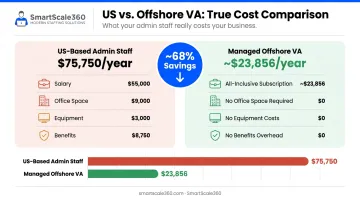
The right model depends on how much management bandwidth you have — and how consistent your support needs are.
Factor 6: Prioritize Flexibility and Scalability
Small businesses experience uneven demand — seasonal spikes, growth phases, slow periods. A VA arrangement that locks you into rigid contracts creates unnecessary risk.
When evaluating any provider, get clear answers on:
- Is there a minimum contract term or long-term commitment?
- What's the process for replacing or adjusting my VA if the match isn't right?
- Can I add additional staff as my business grows?
- Can I scale hours up or down without penalty?
SmartScale360 operates on a no-contract, no-setup-fee model with free VA replacement if the match isn't right — and packages that can be modified or upgraded at any time.
How SmartScale360 Can Help You Find the Right Virtual Assistant
SmartScale360 was built specifically to give small and medium-sized businesses access to the same caliber of offshore talent that large corporations have leveraged for years. With 20+ years of outsourcing and business experience, the company serves industries including homecare, real estate, law firms, financial services, insurance, and marketing agencies.
Their approach is straightforward:
- Free consultation — A SmartScale360 consultant learns your specific business needs, required hours, and role requirements
- Candidate matching and screening — The team recruits, screens, and presents college-educated, English-speaking professionals from the Philippines matched to your role
- Ongoing support — Once placed, your VA is supported with 24/7 availability and packages that scale as your needs change
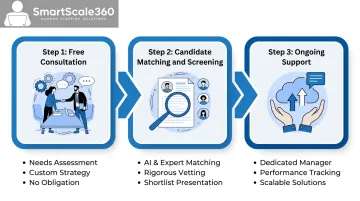
Here's what sets this model apart for SMBs:
- Dedicated staff matched to specific roles and industries — not generic generalists
- No contract, no setup fee, and free VA replacement if the match doesn't work
- Labor cost reductions of up to 60–70% compared to US in-house hiring
- Transparent monthly pricing for predictable budgeting
- US-hours coverage by default — VAs work your schedule, not theirs
Those advantages translate into real operational change. Lynette Stroud manages a Home Instead franchise serving 100+ clients and 250+ caregivers. Through SmartScale360, she built a dedicated remote scheduling team: three coordinators handling full scheduling, billing support, documentation, and weekend coverage.
Labor costs dropped by up to 60%, and in-house staff satisfaction improved significantly. Her summary: "Scheduling is fun now. That's when you know it's working."
Conclusion
The right virtual assistant match depends on your specific tasks, your industry, how you communicate, and where your business is headed — not just price or feature lists.
As your business evolves, revisit the arrangement. What works at five employees may need to change at fifteen. Tasks shift, volume grows, and the VA who was a perfect fit at launch may need to expand their scope — or you may need to add a second seat.
The best starting point is a simple task audit: identify the three biggest time-drains in your week that don't require your direct expertise. Then use the factors in this guide to evaluate your options. Or, if you'd rather skip the search, SmartScale360 matches businesses with pre-screened, college-educated VAs based on your specific role and industry — backed by 20+ years of outsourcing experience.
Frequently Asked Questions
What is the average cost for a virtual assistant?
Costs vary widely by model and geography. Freelance VAs on platforms like Upwork typically run $10–$75/hour depending on skill level and location. Managed offshore VAs from providers like SmartScale360 are priced at a flat monthly rate, generally running 60–70% below the cost of a comparable US-based hire — making them significantly more affordable for ongoing support needs.
Is it worth hiring a virtual assistant for a small business?
For most small business owners, yes — when the right tasks are delegated. Time recovered from admin, scheduling, and customer service can be redirected toward revenue-generating work. The cost savings compared to a full-time in-house hire are substantial, and a dedicated VA typically pays for itself within the first few months.
What tasks can a virtual assistant handle for a small business?
The core categories include administrative support, customer service, social media management, bookkeeping and invoicing, data entry, research, and scheduling. A well-matched dedicated VA can handle multiple task types consistently — and over time, requires less oversight as they build familiarity with your business.
What's the difference between an AI virtual assistant and a human virtual assistant?
AI tools automate narrow, rule-based tasks at low cost but lack judgment and can't handle ambiguity. Human VAs manage more varied work, adapt to context, and can represent your business directly with clients. Most growing SMBs benefit from both: AI for repeatable automation, humans for anything requiring communication and discretion.
How do I know if my small business is ready to hire a virtual assistant?
The clearest signal: if you're regularly spending hours per week on repetitive tasks that don't require your expertise — and those hours are coming at the expense of strategic work or your own capacity — it's time. If that describes your week, a scoped VA role is likely the fastest way to reclaim it.
Should I hire a local or offshore virtual assistant?
Local VAs offer time-zone familiarity but come at significantly higher cost. Offshore VAs — particularly from the Philippines, which scores in the "High" band of the EF English Proficiency Index — deliver comparable quality at a fraction of the price. For budget-conscious SMBs with well-defined roles, offshore is typically the stronger choice.