The problem isn't effort. It's capacity. And hiring the wrong virtual assistant makes it worse: a bad match costs time to recruit, time to train, and money you don't get back. SHRM reports the average cost per hire runs nearly $4,700 — before factoring in lost productivity during ramp-up.
This guide cuts through the noise. You'll get a clear picture of what a property management VA actually does, what to look for when hiring one, and a step-by-step process that reduces the risk of a bad match.
Key Takeaways
- A property management VA handles remote, repeatable tasks — tenant communication, lease admin, maintenance coordination, listings, and bookkeeping.
- Hiring criteria should prioritize industry experience, English fluency, and software proficiency over lowest cost.
- Offshore VAs from vetted staffing partners cost up to 60–70% less than comparable US hires without sacrificing quality.
- Structured onboarding with SOPs, software access, and clear check-ins determines how fast a VA reaches full productivity.
- With the right hire and clear systems in place, a property management VA can take on 60–80% of your admin workload within the first 30–60 days.
What Is a Virtual Assistant for Property Management?
A property management virtual assistant is a remote professional who handles the day-to-day operational and administrative tasks of a property management business. They work inside your systems, communicate with your tenants and vendors, and operate on your schedule — without sitting in your office.
The distinction between a general VA and a property management-specialized VA matters more than most managers realize. A general VA can handle emails and scheduling. A property management VA understands lease cycles, tenant escalation protocols, maintenance workflows, and the software platforms the industry actually runs on — AppFolio, Buildium, Yardi, RentManager.
Benefits of Hiring a Property Management VA
The operational case adds up quickly:
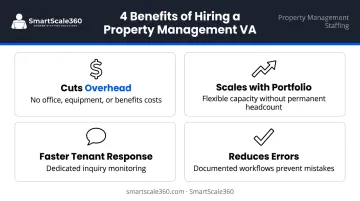
- Cuts overhead — no office space, equipment, benefits, or payroll taxes
- Scales with your portfolio — add hours or capacity without a permanent headcount commitment
- Keeps tenants responsive — dedicated monitoring means inquiries get answered faster
- Reduces errors — documented workflows prevent the mistakes that come from jumping between tasks
Those savings are substantial. US private-industry office and administrative support compensation averaged $36.42/hour in March 2026, including wages and benefits. A vetted offshore VA through a provider like SmartScale360 typically runs 60% below that rate — without sacrificing professional quality.
Tasks a Property Management Virtual Assistant Can Handle
Most managers underestimate how many of their daily tasks a VA can own completely. The ROI comes from matching the VA to high-volume, repeatable work — not one-off projects.
Administrative and Communication Tasks
This is the highest-volume category for most portfolios:
- Managing inboxes and routing tenant inquiries
- Scheduling property showings, inspections, and vendor appointments
- Handling vendor correspondence and follow-ups
- Preparing routine reports and maintaining records
Offloading this work lets managers stay focused on decisions that actually require their judgment.
Tenant and Lease Management
Buildium reports 75% of property management companies planned portfolio growth, while 93% experienced expense increases — a squeeze that makes administrative efficiency essential. VAs help by:
- Screening tenant applications using manager-set criteria
- Drafting leases and sending renewal reminders
- Coordinating move-in and move-out logistics
- Tracking lease compliance and flagging exceptions
Marketing and Listing Management
55% of surveyed property managers cited elevated vacancy as their top threat to net operating income. A VA keeps listings current without requiring daily manager attention:
- Writing and posting rental listings on Zillow, Apartments.com, Airbnb, and Vrbo
- Optimizing descriptions and updating photos
- Managing social media accounts and engagement
- Responding to inquiry messages before leads go cold
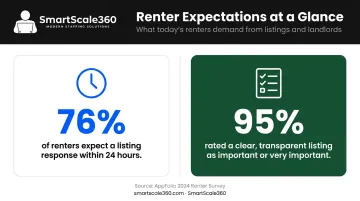
AppFolio's 2024 renter survey found 76% of renters expected a listing response within 24 hours, and 95% rated a clear, transparent listing as important or very important. A VA monitoring inquiries and keeping listings updated directly addresses both expectations.
Maintenance Coordination
The NAA reports 109.5 work orders per maintenance technician per month — a coordination load that creates real administrative drag. The physical repairs require boots on the ground, but everything around them can be handled remotely:
- Logging maintenance requests from tenants
- Contacting and scheduling licensed vendors
- Following up on job completion status
- Updating tenants on repair timelines
Financial Tracking and Bookkeeping Support
VAs working inside QuickBooks, AppFolio, or Buildium can handle:
- Tracking rent payment status and flagging late payments
- Logging expenses and managing vendor invoices
- Preparing monthly financial summaries
- Organizing records for accountants or CPAs
What to Look for When Hiring a Property Management VA
This is not a cost decision alone. The right hire reduces operational friction. The wrong one creates new management problems on top of the ones you already have. These criteria separate candidates who can contribute immediately from those who need months of hand-holding.
Property Management Knowledge and Experience
Skip the ramp-up period by hiring someone who already knows how lease cycles, tenant escalation protocols, and maintenance workflows operate. During interviews, ask directly about their experience with residential or commercial rentals and what property types they've supported. Specific answers signal real exposure — vague ones don't.
English Communication Skills
The VA will often be the first point of contact for tenants, vendors, and prospects. Strong written and verbal English isn't a bonus — it's a baseline requirement. Evaluate it during the interview itself, not just on a resume.
Technical Proficiency with Property Management Software
Look for working familiarity with platforms like AppFolio, Buildium, Yardi, or RentManager. AppFolio alone serves 22,096 property management customers — familiarity with it signals real industry exposure. Also confirm comfort with collaboration tools like Google Workspace, Asana, or ClickUp.
Organizational and Problem-Solving Ability
Property management generates simultaneous priorities constantly. A VA who can independently triage tasks, flag issues before they escalate, and juggle a multi-property workload without daily direction will save you more time than the hourly rate ever costs. Ask for a concrete example of how they've handled competing priorities — it's the fastest way to separate self-starters from those who wait to be told what's next.
Availability and Time Zone Compatibility
Time zone alignment determines whether a VA can respond to tenants and vendors in real time or only catch up hours later. Be clear about what level of overlap your role requires — full business-hours coverage is different from asynchronous task work — and factor this into every candidate evaluation.
How to Hire a Property Management VA: Step-by-Step
Most failed VA hires trace back to skipped steps: vague job scopes, no trial period, or sourcing from the wrong channel. This process reduces those failure points.
Step 1: Define the Role Before You Post
Before writing a job description, list every recurring task you want to delegate. Categorize them by:
- Frequency — daily, weekly, monthly
- Urgency level — real-time responsive vs. batch-processed
- Skill requirement — judgment-based vs. process-following
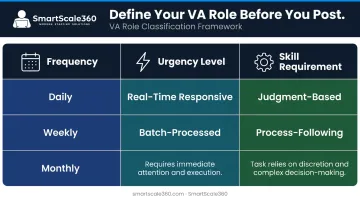
A precise scope makes screening faster and sets performance expectations before the first interview.
Step 2: Source Candidates Through the Right Channels
Generalist freelancing platforms like Upwork or Fiverr are built for project work, not dedicated operational support. VAs on those platforms often juggle multiple clients simultaneously, which directly affects responsiveness and accountability.
Dedicated offshore staffing firms pre-screen candidates for English fluency, real estate experience, and professional reliability. That pre-screening eliminates most of the hiring risk before you spend a minute interviewing.
Step 3: Interview and Evaluate with Role-Specific Criteria
Generic interview questions produce generic answers. Ask questions that reveal actual judgment:
- "Walk me through how you'd handle an angry tenant inquiry at 9am on a Monday."
- "You have three competing deadlines and a vendor who hasn't responded — what do you do first?"
- "What property management software have you used, and what tasks did you perform in it?"
Request a paid skills test or short practical exercise before committing. Anyone can make claims on a resume; task performance reveals the truth.
Step 4: Onboard with SOPs and Clear Expectations
A survey of more than 1,000 employees found one-third reported poor onboarding experiences, with 42% of remote new hires describing it as "truly terrible." A structured start prevents that outcome.
Strong onboarding includes:
- Written SOPs covering every task the VA will own, so nothing depends on verbal memory
- Software access provisioned before their first day — not during it
- A check-in cadence (daily or weekly) agreed on upfront, not improvised later
- A 30-day performance review tied to specific, measurable metrics
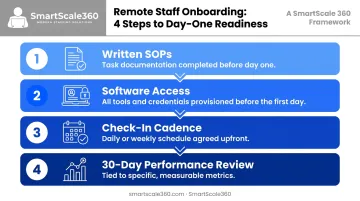
If the 30-day review reveals gaps, address them immediately — early course correction is far cheaper than restarting the hiring process.
How SmartScale360 Can Help
SmartScale360 was built specifically to give entrepreneurs and small-to-mid-size businesses access to the same offshore talent pool that large corporations have used for years — without building a global HR infrastructure from scratch.
For property management businesses specifically, SmartScale360 matches clients with college-educated, English-speaking remote staff from the Philippines — people screened for the role, not pulled from a generic pool. Their VAs are experienced with AppFolio, Buildium, Yardi, and RentManager. Staff can be scheduled for US business hours, so your tenants and vendors get real-time responses.
SmartScale360's key differentiators for property managers:
- Cuts labor costs by 60–70% compared to a comparable US in-house hire
- Dedicated staff matched to your specific role and workflow — not shared across multiple clients
- No contract, no setup fee, with flexible monthly pricing that scales with your portfolio
- US-hours coverage plus 24/7 availability for after-hours needs
- 20+ years of outsourcing experience across real estate and adjacent industries
SmartScale360 serves residential and small-commercial property managers, HOA administrators, and short-term rental operators. If your portfolio is growing faster than your admin capacity, reach out to discuss a staffing match — most clients have a VA placed and onboarded within two weeks.
Conclusion
Hiring a virtual assistant for property management isn't a shortcut — it's a deliberate operational decision. When it's executed well, a VA multiplies your capacity without proportionally increasing your cost or complexity. When it's executed poorly, it creates more work than it eliminates.
The managers who get the most out of their VAs treat the role as a long-term position, not a temporary fix. As your portfolio evolves, so should the VA's task scope. Start with the highest-volume, most repeatable work. Build trust through documented SOPs and consistent check-ins, then expand the role as the working relationship matures.
Use this guide as your starting checklist. When your portfolio grows or your operations shift, revisit your VA's task scope — the right setup at 20 units rarely looks the same at 100.
Frequently Asked Questions
What does a virtual assistant do in property management?
A property management VA handles remote, computer-based tasks including tenant communication, lease coordination, maintenance scheduling, listing management, and financial tracking. They function as an off-site extension of the management team, handling the operational work that doesn't require physical presence.
What's the average cost of a virtual assistant?
US-based VAs typically run $30–$75/hour, or roughly $1,200–$3,000/month for part-time support. Philippines-based VAs through dedicated staffing firms generally range from $500–$1,500/month. SmartScale360's offshore model runs 60–70% below the cost of a comparable US hire.
What skills should a property management virtual assistant have?
Core skills include strong English communication, proficiency with property management software (AppFolio, Buildium, Yardi, or RentManager), organizational ability, basic bookkeeping knowledge, and experience in tenant or customer-facing communication roles.
Can a virtual assistant handle tenant communication?
Tenant communication is one of the most common and high-impact VA tasks. This includes email responses, maintenance request acknowledgment, lease renewal outreach, and payment reminders. Sensitive legal matters or escalated disputes should remain with in-house staff.
What's the difference between a property management VA and property management software?
Software like Buildium or AppFolio automates and organizes data. A VA is a human professional who uses that software to execute judgment-based tasks — routing inquiries, following up with vendors, flagging exceptions. The two are complementary tools, not alternatives.
How long does it take to onboard a property management virtual assistant?
With prepared SOPs and software access ready before day one, a well-matched VA typically reaches full productivity within two to four weeks. The more complete your onboarding documentation, the faster that timeline.