For small and mid-sized property management businesses, the stakes are higher than for most SMBs. You're handling other people's money, operating under state licensing requirements, and managing financial activity across multiple properties simultaneously.
This guide covers everything you need to get the structure right: foundational setup steps, daily practices that keep your books accurate, financial reporting essentials, tax readiness, and the warning signs that it's time to stop doing this yourself.
Key Takeaways
- Dedicated bank accounts for operating, trust, and reserve functions are non-negotiable — mixing them creates compliance risk
- Your accounting method (cash vs. accrual) shapes how every transaction is recorded from day one
- Monthly reconciliation of both operating and trust accounts prevents errors from compounding into licensing problems
- Outsourcing bookkeeping to dedicated remote staff can reduce labor costs by up to 60% compared to hiring in-house
Setting Up Your Property Management Bookkeeping System
Getting the structural foundation right from the start prevents compounding errors down the road. Three setup decisions matter most: your bank accounts, your chart of accounts, and your accounting method.
Separate Bank Accounts for Every Function
At minimum, property managers should maintain three distinct accounts:
- Business operating account — for day-to-day income and expenses
- Trust/escrow account — for tenant security deposits (legally required in most states)
- Reserve account — for maintenance contingencies and unexpected capital needs
Mixing these isn't just sloppy — it's a compliance risk. States including California, Oregon, Nebraska, and Arkansas all have specific requirements around trust account separation, and violations can result in license suspension or revocation.
If you manage multiple properties, open sub-accounts or maintain separate tracking ledgers per property. This keeps income and expenses clearly attributed to each asset and makes owner reporting far cleaner.
Build a Tailored Chart of Accounts
Your chart of accounts is the master categorization list for every financial transaction. For property management, it needs to reflect the specific nature of the business. Here's a sample structure for a portfolio of 5–15 units:
| Account Name | Type | Example Transaction |
|---|---|---|
| Residential Rental Income | Income | Monthly rent received |
| Late Fee Income | Income | $75 late charge collected |
| Application Fee Income | Income | Tenant application fee |
| Management Fee Income | Income | Fee charged to property owner |
| Maintenance & Repairs | Expense | Plumber invoice |
| Property Insurance | Expense | Annual premium payment |
| Utilities | Expense | Common area electricity |
| Management Software | Expense | Buildium or AppFolio subscription |
| Security Deposit Liability | Liability | Deposit held for tenant |
| Security Deposit – Bank | Asset | Cash held in trust account |
| Operating Cash | Asset | Business checking balance |
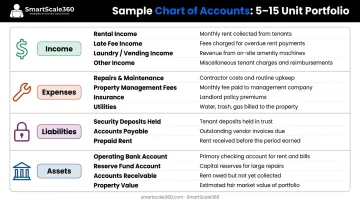
NARPM's standardized chart of accounts uses four-digit codes across eight top-level categories — a useful reference if you want to align with industry-standard structure from the start.
Choose Your Accounting Method and Bookkeeping Approach
The two primary methods compared:
| Cash-Basis | Accrual | |
|---|---|---|
| How it works | Records when money changes hands | Records when income is earned or expense is incurred |
| Best for | Smaller portfolios, simpler cash flow | Growing portfolios needing precise financials |
| Complexity | Lower — easier to maintain | Higher — requires more discipline |
| Audit readiness | Adequate for basic reporting | Stronger paper trail for investors and lenders |
For C corporations and certain partnerships, IRS Section 448 restricts the cash method above a gross receipts threshold of $32 million (the 2026 inflation-adjusted figure per IRS Revenue Procedure 2025-32). Most SMB property managers won't approach that threshold — but note that switching methods mid-year requires IRS approval, so picking the right one upfront avoids a costly adjustment later.
Double-entry bookkeeping — where every transaction is recorded as both a debit and a credit — is the stronger choice for anyone managing multiple properties or owner accounts. It produces the audit trail and cross-check accuracy that single-entry simply can't match.
Essential Day-to-Day Bookkeeping Practices
The system you build only works if the daily habits support it. These are the practices that keep your records accurate and your books audit-ready throughout the year.
Keep Records Current and Detailed
Every transaction — rent received, maintenance invoice paid, fee waived — should be recorded as it occurs. Batching entries weekly or monthly creates reconciliation headaches and increases the chance something gets missed or miscategorized.
Buildium recommends that property managers spend 15 to 20 minutes daily verifying new transactions, with same-day payment posting and weekly bank transaction reviews.
Each entry should include:
- Property address
- Tenant or vendor name
- Transaction category
- Amount and date
That level of detail makes records audit-proof and makes owner reporting significantly easier.
Reconcile Accounts Monthly
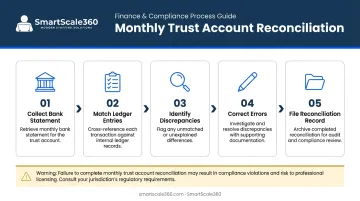
Bank reconciliation means comparing your internal ledger against your bank statements at the end of each month. The goal is to catch duplicate entries, missing transactions, bank errors, or unauthorized charges before they compound.
Property managers must reconcile both their operating account and their trust/escrow account separately. This isn't optional — trust account reconciliation is a licensing requirement in most states.
The data on what happens when managers skip this is stark: North Carolina Real Estate Commission records show that trust account mishandling accounted for nearly 20% of all disciplinary actions during the 2020–2021 license year. The broker-in-charge remains responsible even when a bookkeeper performs the work.
Manage Invoices, Receipts, and Vendor Payments
Retain all receipts — digital and physical — for every business expense. The IRS standard retention period is three years from filing, though property records should be kept through the limitations period for the year of disposition to support depreciation calculations.
For vendor management specifically:
- Log every invoice when received, not when paid
- Track accounts payable aging to catch overdue or duplicate payments
- Use a consistent system (Bill.com, QuickBooks, or your property management platform) rather than a patchwork of spreadsheets
Property managers dealing with multiple maintenance contractors are especially vulnerable to double payments and missed invoices without a structured AP process.
Maintain a Reserve Fund and Consistent Collections
Analyze prior-year unexpected expenses — emergency repairs, sudden vacancies, owner turnover — and budget an equivalent amount forward into a dedicated reserve account. This prevents cash flow disruption and eliminates any temptation to pull from tenant security deposit escrow, which is legally prohibited.
Collections tracking requires equal discipline. Every late or waived payment must still be formally recorded, including:
- The original due date and actual payment date
- Whether a late fee was charged or waived
- The correct income category for the transaction
Unlogged waivers and late payments quietly distort your income reports — and those gaps surface at the worst time: during owner reporting or an audit.
Financial Reporting and Tax Readiness
Good bookkeeping means little if it doesn't produce financial statements you can act on — and a tax position you can defend.
Generate and Review Key Financial Statements
Three reports form the core of property management financial oversight:
- Income Statement (P&L): shows revenue vs. expenses per period, ideally broken out per property for owner reporting
- Balance Sheet: snapshot of assets, liabilities, and equity at a point in time
- Cash Flow Statement: tracks actual cash movement and operating liquidity
Schedule monthly — or at minimum quarterly — reviews to spot underperforming properties, plan capital expenditures, and catch expense categories trending the wrong way before they compound.
Track and Maximize Tax Deductions
According to IRS Publication 527, rental property owners can deduct a broad range of ordinary and necessary expenses. Common deductible items include:
- Maintenance and repairs
- Property insurance premiums
- Mortgage interest
- Property taxes
- Management fees
- Professional accounting fees
- Mileage for property-related travel
- Advertising and tenant-screening costs
- Legal fees
- Wages for on-site staff or contractors
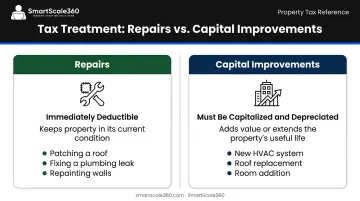
One critical distinction: repairs vs. capital improvements. A repair keeps property in normal operating condition and is immediately deductible. A capital improvement (replacing a roof, adding a room, installing a new HVAC system) must be capitalized and depreciated over time. Misclassifying these is one of the most common errors in property management tax returns, and it directly affects taxable income.
Understand Tax Filing Requirements
Rental income and expenses are typically reported on Schedule E (Form 1040) for passive rental activities with basic services. Property managers providing substantial services — regular cleaning, linen changes, maid service — may need to use Schedule C instead.
One compliance requirement that's frequently missed: Form 1099-NEC. For payments made after December 31, 2025, the filing threshold rises to $2,000 (up from the prior $600), per IRS guidance on 1099 reporting.
Any contractor or vendor paid $2,000 or more in a calendar year requires a 1099-NEC — that includes maintenance contractors, landscapers, and cleaning crews.
Common Bookkeeping Mistakes and When to Outsource
The Five Most Frequent Errors
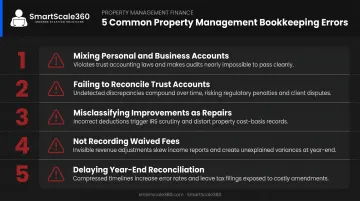
- Mixing personal and business expenses in a single account — this creates audit exposure and distorts every financial report
- Failing to reconcile trust accounts separately from operating accounts — a licensing violation in most states
- Misclassifying capital improvements as repairs (or vice versa) — affects taxable income and depreciation schedules
- Not recording waived fees or credits — distorts income reports and makes owner statements unreliable
- Delaying reconciliation until year-end — allows errors to compound and makes correction far more time-consuming
When to Stop Handling It In-House
These are the signals that bookkeeping has outgrown your current approach:
- Portfolio growth beyond 10–15 units with multiple owner relationships
- Spending more than a few hours per week on financial admin
- Recurring errors appearing in owner reports
- Approaching tax season without organized records
- Trust account reconciliation falling behind schedule
Once these signals appear, the next decision is what kind of help makes sense.
Hiring a full-time in-house bookkeeper carries significant overhead. Robert Half's 2026 salary data puts the national median starting salary for a bookkeeper at $55,000–$62,750, before benefits, payroll taxes, and equipment costs are factored in.
Outsourcing to a dedicated remote bookkeeper runs well below that cost. SmartScale360 provides college-educated, English-speaking remote bookkeepers on a flexible monthly per-seat model — no contracts, no setup fees. Their bookkeeping VAs handle:
- Transaction categorization and AP/AR workflows
- Bank reconciliation and month-end close packages
- 1099 preparation support and financial reporting
- Work inside QuickBooks Online, Xero, AppFolio, Buildium, and Yardi
For property managers who need to scale support up during tax season and back down afterward, that flexibility matters. Book a free consultation at smartscale360.com/pages/consultation to scope the right setup for your portfolio.
Frequently Asked Questions
What is property management bookkeeping?
Property management bookkeeping is the systematic recording of all financial transactions related to rental properties — rent collection, expense tracking, vendor payments, and owner disbursements. The goal is accurate financial records that support compliance, owner reporting, and tax filing.
What accounting method should property managers use — cash or accrual?
Most SMB property managers use cash-basis accounting for its simplicity. Accrual accounting better suits larger or more complex portfolios. IRS Section 448 does restrict the cash method above the $32 million gross receipts threshold, but most SMBs won't approach that level.
How often should property management books be reconciled?
Monthly, for both operating and trust accounts. Delaying reconciliation allows errors and discrepancies to compound, making correction more time-consuming and potentially triggering compliance issues with your real estate license.
What expenses can property managers typically deduct?
Common deductible expenses include maintenance and repairs, management fees, insurance, mortgage interest, property taxes, professional accounting services, and mileage for property visits. Consult a CPA to confirm eligibility for your entity type and situation.
What is trust accounting and why does it matter?
Trust accounting requires property managers to hold tenant security deposits and owner funds in dedicated, separate accounts. State regulations mandate this separation, and failure to comply can result in fines or loss of your property management license.
When should a small property management company outsource its bookkeeping?
Consider outsourcing when bookkeeping is eating significant weekly time, your portfolio has outgrown one person's capacity, or in-house hiring costs exceed what the business can absorb. Remote bookkeepers — including offshore options — are often significantly more cost-effective than US-based in-house staff.