Introduction
Labor costs are squeezing small and mid-sized businesses harder than ever. According to the Federal Reserve's 2024 Small Business Credit Survey, 75% of employer firms cited rising costs of goods, services, and wages as a top financial challenge. For many SMBs, payroll — once you factor in benefits, taxes, equipment, and overhead — becomes the single largest expense on the books.
Offshore BPO addresses that problem directly — but the wrong provider can trade one headache for another. Common pitfalls include:
- Hidden fees that quietly erode projected savings
- Poorly matched talent that underdelivers on day one
- Shared staffing models where no one owns accountability
Choosing a provider deserves the same scrutiny as deciding to outsource in the first place.
This guide covers what offshore BPO actually is, why it works for SMBs, the six factors that separate good providers from bad ones, and the red flags that should end any conversation before it starts.
Key Takeaways
- Offshore BPO contracts business processes to a provider in another country — reducing costs and accessing skilled talent unavailable or cost-prohibitive domestically.
- 75% of small employer firms report rising labor costs as a primary financial challenge, making offshore staffing increasingly relevant.
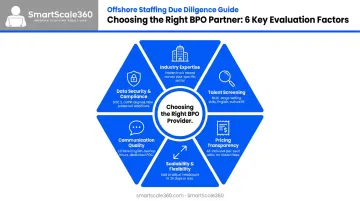
- The six factors that matter most: industry expertise, talent screening, pricing transparency, scalability, communication quality, and data security.
- Red flags include undisclosed fees, shared staffing models, and no formal screening process.
- SmartScale360 gives SMBs access to dedicated, college-educated, English-speaking offshore staff with no contracts or setup fees — the same talent model large corporations have used for years.
What Is Offshore BPO?
Offshore BPO (Business Process Outsourcing) means contracting specific business functions to a third-party provider located in another country — typically to reduce costs, access specialized skills, and free up internal capacity.
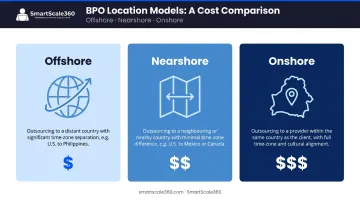
Three location models define how outsourcing is structured:
| Model | Definition |
|---|---|
| Offshore | Provider in a distant foreign country (e.g., U.S. company working with a team in the Philippines) |
| Nearshore | Provider in a neighboring or similar time zone country (e.g., U.S. working with Mexico or Canada) |
| Onshore | External provider in the same country |
Types of Offshore BPO Services
Offshore BPO covers two broad categories:
- Front-office BPO — customer support, sales development, marketing, lead generation
- Back-office BPO — HR, finance and accounting, data management, IT support, legal assistance
The global BPO market reflects this expansion. Grand View Research values it at $328.4 billion in 2025, projecting growth to $695.8 billion by 2033 at a 9.9% CAGR. Offshore BPO is no longer limited to call centers or manufacturing — it now spans virtually every business function.
Who Uses Offshore BPO?
Large corporations pioneered offshore BPO, but SMBs across a wide range of industries now access the same global talent pools:
- Homecare agencies and senior care franchises
- Real estate brokers and property management firms
- Financial services, accounting practices, and mortgage teams
- Law firms needing paralegal and legal assistant support
- Marketing agencies requiring overflow creative and digital support
- Franchises managing multi-location back-office operations
- IT services and web development companies
The Philippines alone generated $38 billion in IT-BPM revenue and employed 1.82 million workers in 2024. Its workforce ranked 28th out of 123 countries with a "High" proficiency rating in the EF English Proficiency Index 2025 — meaning SMBs can tap a deep, skilled, English-proficient talent pool without the overhead required to hire domestically.
Key Benefits of Offshore BPO for Small and Mid-Sized Businesses
Cost Reduction That Goes Beyond Salary
The savings from offshore BPO aren't just about paying less per hour. When you eliminate the full loaded cost of a domestic employee — salary, benefits, payroll taxes, office space, equipment, and recruitment expenses — the math changes substantially.
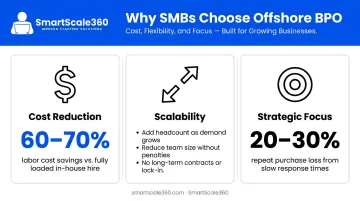
SmartScale360 documents labor cost reductions of 60–70% compared to fully loaded in-house hires. A U.S. paralegal, for example, costs $65–95K annually when fully loaded — offshore legal VAs deliver comparable output at up to 60% below that figure.
Scalability Without Payroll Lock-In
Hiring full-time domestic staff to meet seasonal demand or a new service line creates long-term payroll commitments that outlast the need. Offshore BPO sidesteps that problem entirely.
Good providers let you:
- Add headcount quickly during growth phases
- Reduce staff without severance or long notice periods
- Shift role types as your operations evolve
This flexibility is particularly valuable for SMBs that can't afford to over-hire in anticipation of demand.
Focus on What Actually Grows Your Business
Administrative work, scheduling, data entry, and support functions are necessary — but they're not what moves the revenue needle. Offshore BPO gives owners and in-house staff their time back.
That recovered time has a direct revenue impact. SmartScale360's customer service data shows SMBs lose 20–30% of repeat purchases to slow first-response time. Offloading that function to a dedicated offshore team doesn't just cut costs — it protects existing revenue and creates room for strategic work.
What to Look for When Choosing the Best Offshore BPO Provider
Selection criteria vary by industry and process type, but these six factors apply to any SMB evaluating providers — and each one connects directly to measurable business outcomes.
Factor 1: Industry Expertise and Specialization
A homecare agency and a marketing firm have nothing in common operationally. Your provider needs to understand your specific workflows, terminology, and compliance requirements — not just outsourcing in general.
KPIs affected: time-to-productivity for new staff, error rates, and how quickly the team can operate without heavy supervision.
Ask providers: Have you placed staff in my specific industry before? Can you describe the workflows they supported?
Factor 2: Talent Quality and Screening Process
The staff placed on your account determine your ROI. A provider with no formal vetting process is just guessing.
Evaluate screening on three dimensions:
- English communication — both written and spoken, especially for client-facing roles
- Education level — college-educated candidates tend to ramp faster and adapt better
- Role-specific competency — platform knowledge, software proficiency, and function-relevant experience
KPIs affected: candidate quality on arrival, attrition rate, and performance ramp time.
SmartScale360's process begins with a consultation to define exact role requirements before any recruitment starts — then screens candidates for English proficiency and role-specific skills before presenting the best matches to the client.
Factor 3: Pricing Transparency and Total Cost of Engagement
Low advertised rates often hide a more complicated reality. Training fees, equipment charges, management overhead, and headcount-change penalties can erode projected savings quickly.
Before signing anything, ask for:
- A complete, itemized cost structure
- Confirmation of what's included vs. billed separately
- The total monthly cost at your intended headcount
KPIs affected: predictable monthly labor cost vs. actual spend.
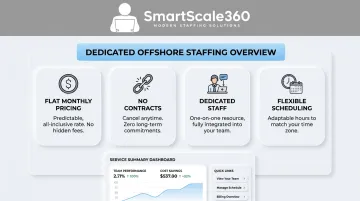
SmartScale360 operates on flat monthly per-seat pricing with no setup fees, no recruitment costs, and no long-term contracts. Clients know exactly what they're paying before any commitment.
Factor 4: Scalability and Contract Flexibility
SMB staffing needs change — new service lines, seasonal spikes, and growth phases all require headcount adjustments. A provider that locks you into a 12-month contract removes the flexibility that makes offshore staffing valuable in the first place.
Evaluate:
- Whether the provider offers month-to-month arrangements
- The process and timeline for adding or reducing staff
- Whether penalty fees apply to headcount changes
KPIs affected: cost of scaling, ramp time, and operational agility during transitions.
Factor 5: Communication Quality and Time Zone Compatibility
Offshore staffing only works if your team can communicate clearly and get answers fast. Assess the proposed team's English proficiency directly — not just the provider's general claims.
Key questions:
- What hours will the offshore team work relative to your operating timezone?
- What tools and protocols are used for daily collaboration?
- How quickly are instructions executed and questions answered?
KPIs affected: response time, instruction clarity, and client satisfaction scores for customer-facing roles.
SmartScale360 builds schedules around the client's operating hours, whether that's days, nights, weekends, or custom arrangements. Staff use whatever collaboration tools the client already has in place — no new systems required.
Factor 6: Data Security and Compliance Standards
Outsourced processes regularly involve sensitive data — patient records, financial accounts, legal files. The legal responsibilities don't transfer when you hand the work to a third party.
Depending on your industry:
- Healthcare — HIPAA requires a Business Associate Agreement (BAA) for any vendor handling PHI
- Financial services — FTC Safeguards Rule mandates capable service providers and contractual safeguards
- Law firms — ABA ethics guidelines require attorney supervision and confidentiality protections
Ask any provider: What security certifications do you hold? Do you execute NDAs and BAAs as standard? How do you handle confidentiality for sensitive industries?
Operational risk mitigated: data breaches, regulatory violations, and reputational damage — all of which can cost more than a year of offshore staffing fees.
Common Red Flags to Avoid When Evaluating Offshore BPO Providers
Polished sales decks and low quotes can mask serious operational problems. Before signing anything, watch for these warning signs:
Vague or incomplete pricing. If a provider can't give you a complete, itemized cost structure upfront, expect surprise fees mid-engagement. That pattern makes reliable budgeting impossible and shifts financial risk entirely to you.
Shared staffing models. Some providers assign one team member to handle multiple clients simultaneously. This produces inconsistent output and slower response times. Always confirm you're getting a dedicated staff member who works exclusively for your business.
No formal screening process. If a provider can't describe how they assess English proficiency, educational background, and role-specific competency, the placement is a guess. Ask exactly how candidates are evaluated — and if you get a vague answer, move on.
Rigid, long-term contracts. A provider who needs to lock you in for 12+ months to make their model work isn't confident in the quality of their output. Month-to-month arrangements shift accountability to the provider, where it belongs.
How SmartScale360 Can Help
SmartScale360 was built specifically to give SMBs and entrepreneurs access to the same offshore talent that large corporations have relied on for years — backed by 20+ years of outsourcing and business experience across multiple industries.
The model starts with a personalized consultation to understand your specific role requirements, scheduling needs, and business context. From there, SmartScale360 recruits and screens candidates from the Philippines, pre-vetted for English proficiency and role-specific competency, and presents only the best matches for your approval.
Key differentiators:
- Labor cost reductions of up to 60–70% vs. fully loaded in-house hiring
- No contracts and no setup fees — cancel or adjust at any time
- Dedicated staff assigned exclusively to each client (not shared across accounts)
- Flexible scheduling built around your hours, including nights and weekends
- 24/7 support — both from the offshore team and from the SmartScale360 account team
- Flat, predictable monthly pricing with no hidden fees
Industries currently served: homecare, real estate, financial services, law firms, marketing agencies, franchises, and IT services.
One Home Instead franchise owner illustrates what this looks like in practice. She built a remote scheduling team of three dedicated coordinators through SmartScale360, cutting labor costs by up to 60% and seeing measurable improvements in scheduling documentation. In her own words: "Scheduling is fun now. That's when you know it's working."
Conclusion
Choosing an offshore BPO provider comes down to fit — talent quality, communication standards, pricing model, and industry specialization that match your actual operational needs. Get that alignment right, and offshore staffing becomes a measurable edge. Get it wrong, and you'll spend more time managing the fallout than you saved by outsourcing in the first place.
That's why the best results come from treating the relationship as a true partnership. As your business evolves, review provider performance against your KPIs regularly — and hold the engagement to the same standard you'd apply to any key business partner.
Frequently Asked Questions
What does offshore BPO mean?
Offshore BPO is the practice of contracting business processes to a third-party provider in a foreign country, typically to reduce labor costs and access skilled talent that's too expensive to hire domestically. The provider handles specific functions while your business retains oversight and direction.
What are the four types of BPO services?
BPO is broadly divided into front-office (customer support, sales, marketing) and back-office (HR, finance/accounting, IT, data management) categories. It's also categorized by geography: offshore (distant country), nearshore (neighboring country), and onshore (same country).
How do businesses make money from BPO?
BPO primarily reduces costs rather than directly generating revenue. Businesses save by cutting domestic overhead, paying lower labor rates for skilled talent, and freeing up internal staff to focus on higher-value work that drives growth.
What are the risks of offshore BPO services?
The main risks include hidden fees, data security vulnerabilities, communication gaps, and inconsistent quality from poorly matched staff. Most of these risks are manageable when you choose a provider with transparent pricing, a rigorous screening process, and dedicated staff assigned specifically to your account.
What is the difference between offshore and nearshore BPO?
Offshore BPO uses a provider in a distant country, such as the Philippines for a U.S.-based business. Nearshore BPO uses a closer country like Mexico or Canada, which typically offers more time zone overlap but at a higher cost.
How much can offshore BPO reduce my labor costs?
SmartScale360's model delivers reductions of up to 60–70% compared to fully loaded in-house hiring — accounting for eliminated overhead including benefits, office space, equipment, and recruitment expenses, not just base salary differences.