Key Takeaways
- Open-to-close (OTC) transaction management covers every administrative step from contract execution through post-closing file archival
- Real estate VAs handle deadline tracking, document coordination, and party communication so agents stay focused on listings and leads
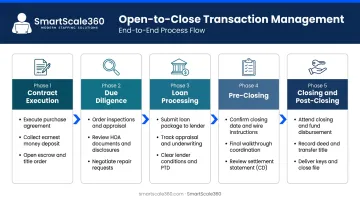
- The workflow moves through five sequential phases, each with defined tasks and handoff points
- Success requires platform access, communication standards, and state-specific training alongside the right hire
- A VA may not be the right fit in states with strict TC licensing requirements or for agents closing fewer deals than justify a dedicated seat
What Is Open-to-Close Transaction Management for Real Estate VAs?
Open-to-close transaction management is the full administrative lifecycle of a real estate deal — beginning the moment a purchase contract is ratified and ending with post-closing documentation and file archival. A real estate VA manages this workflow remotely on behalf of an agent, team, or brokerage.
According to NAR, the post-contract period covers escrow opening, earnest money handling, mortgage approval, inspection, appraisal, title search, final document signing, and key exchange. NAR notes the process typically takes "several weeks or more."
February 2026 data puts the current national closing benchmark at 30 days — with 14% of contracts experiencing delayed settlement and 6% terminating before close. Each of those failure points represents an administrative gap a VA is positioned to prevent.
Done well, this process keeps every deadline met, every document compliant, and every party — buyer, seller, lender, title company, inspectors — informed without the agent managing those details directly. That's the value a VA brings to the transaction.
How a VA Role Differs From a Licensed TC
The line between a VA and a licensed TC carries real compliance weight, and agents need to understand it before delegating:
- A real estate VA in a TC role provides administrative capacity and process discipline — tracking, communicating, coordinating, and filing
- A licensed transaction coordinator or in-house TC may carry additional legal accountability depending on state rules
- Final legal responsibility for the transaction remains with the agent or brokerage, regardless of who manages the administrative workflow
Most states permit supervised administrative coordination by unlicensed staff. New Mexico is a notable exception — it requires a broker's license for anyone acting as a TC in that state.
Why Real Estate Businesses Use VAs for Transaction Management
Real estate transactions involve a high volume of repetitive, time-sensitive administrative tasks. RealTrends' 2025 TC checklist documents the full scope:
- Contract review and contingency tracking
- Document collection and compliance review
- Inspection and appraisal coordination
- Title and lender status checks
- Closing preparation and file archiving
Every task on that list repeats with each transaction.
At volume, self-managing this workload creates real problems: missed deadlines, inconsistent client communication, and agents pulled away from the revenue-generating work only they can do.
The Financial Case
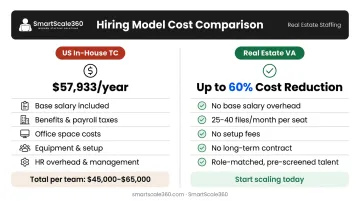
Those operational problems have a direct cost. Indeed's 2026 salary data puts the average US transaction coordinator base salary at $57,933/year — not counting benefits, payroll taxes, office space, equipment, and HR overhead. SmartScale360 documents a fully loaded cost of $45,000–$65,000 per producing agent team for a US in-house TC.
By contrast, SmartScale360 sources college-educated, English-speaking VAs from the Philippines who can handle 25–40 transaction files per month per seat at up to 60% below the cost of a US in-house hire — with no setup fees and no long-term contract. For independent agents and growing teams, that cost structure makes full transaction support genuinely accessible.
What the Agent Gains
Delegating open-to-close coordination returns agent time to three areas that actually grow a real estate business:
- Client-facing work: showings, consultations, offers, and negotiations
- Lead generation: prospecting, follow-up, and relationship development
- Business development: referral networks and team capacity
Transaction coordination is fundamentally an administrative and communication function. With the right systems in place, it's one of the highest-value tasks an agent can hand off.
How the Open-to-Close Process Works for a Real Estate VA
The process moves through five sequential phases. Each has defined inputs, tasks, and handoff points. The VA serves as the central coordinator across all parties throughout.
Phase 1: Contract Execution
This phase begins the moment the purchase agreement is signed. VA tasks include:
- Opening the transaction file and reviewing the contract for all key dates and contingency deadlines
- Distributing an introduction email to all parties — buyer, seller, agents, lender, title company
- Confirming the earnest money deposit timeline and tracking receipt
Phase 2: Due Diligence
This is where most deals are renegotiated or fall apart, making proactive communication critical. The VA:
- Schedules and tracks inspections and appraisals
- Collects and distributes inspection reports to the appropriate parties
- Monitors contingency deadlines for resolution or removal
- Coordinates repair amendment requests between agents
- Follows up with the title company to track the title search progress
Phase 3: Loan Processing
The VA's primary role here is delay prevention — keeping documents moving and parties informed so underwriting isn't held up by avoidable gaps:
- Monitors lender progress against the financing contingency deadline
- Follows up on outstanding conditions with the lender's processor
- Relays status updates to all parties on a pre-agreed cadence
- Flags financing-related delays before they threaten the closing date
Phase 4: Pre-Closing
Once "clear to close" is received, the VA shifts to closing preparation:
- Confirms the closing date, time, and location with the title company
- Schedules the final walkthrough with all parties
- Reminds buyers of wire transfer instructions and fraud prevention protocols
- Verifies all documents are in order using a closing disclosure tracking checklist
Per CFPB guidance, lenders must deliver the Closing Disclosure at least three business days before the scheduled closing — a deadline the VA monitors and confirms.
Phase 5: Closing and Post-Closing
Post-closing tasks are what convert a completed deal into a long-term client relationship:
- Confirms deed recording and distribution of final documents
- Archives the transaction file for broker compliance
- Coordinates closing gifts or utility transfer information if applicable
- Updates the CRM and requests a client review or referral
The referral ask and CRM update are what turn a closed transaction into a repeat relationship. SmartScale360's real estate VAs handle post-close updates across platforms including Follow Up Boss, kvCORE, Chime, and LionDesk.
Key Factors That Affect a Real Estate VA's Effectiveness
Hiring a VA doesn't automatically produce a well-run transaction. These five factors determine whether the model works:
- Works within a centralized platform (Dotloop, SkySlope, Brokermint, DocuSign Rooms) to track tasks, documents, and deadlines — without one, coordination defaults to email and memory, which fails under volume.
- Sets defined communication windows, escalation procedures, and approved email templates for each transaction phase; gaps at the wrong moment can damage client trust or kill a deal.
- Understands state-specific timelines, disclosure requirements, and contingency rules — or has access to state-specific checklists for each market they support.
- Gets properly screened and onboarded: pre-screening for English fluency and real estate knowledge reduces startup friction, but the agent's investment in SOPs and escalation paths determines how fast the VA operates independently.
- Stays within a sustainable file load. SmartScale360's TC seats are designed for 25–40 files per month — beyond that threshold, quality degrades. Teams at higher volume should plan for a second seat rather than overloading one.
Common Misconceptions About Real Estate VAs in Transaction Management
A few persistent myths keep real estate teams from delegating transaction work effectively. Here's what the evidence actually shows.
"A VA can't handle the complexity of transaction management." Open-to-close coordination is an administrative and communication function — not a licensed legal role. A trained VA handles all of it — tracking deadlines, distributing documents, following up with parties, and maintaining the compliance file — with the right tools and checklists. The complexity is real but manageable through process.
"You'll need to supervise constantly." A properly onboarded VA working inside a transaction management platform should operate independently against defined checklists and escalate exceptions — not require hand-holding on every file. If constant oversight is happening, the problem is almost always a missing or incomplete system, not a fundamental flaw in the VA model.
"Open to Close and open-to-close are the same thing." They're not — and the distinction matters when evaluating tools and workflows:
- Open to Close (OTC) is a specific SaaS platform priced between $99–$399/month. It's one tool a VA might use to manage transactions.
- The open-to-close process is a workflow concept describing the full administrative lifecycle of a real estate deal.
A VA can manage that process using Dotloop, SkySlope, Brokermint, or any comparable platform. OTC is one option, not the definition.
When a Real Estate VA Is Not the Right Fit
The VA model works well at meaningful transaction volume with the right infrastructure in place. It's not always the right answer.
Situations where a VA may be insufficient:
- New Mexico requires a broker's license for any TC role. Arizona, Oregon, Nevada, Texas, and Colorado permit supervised administrative work but draw clear boundaries around negotiation, advice, and contract interpretation — agents must verify their state's rules before delegating.
- Some brokerages require on-site document handling, in-person review, or a locally licensed coordinator. A remote VA cannot meet those requirements.
- Agents closing fewer than 3–5 transactions per month may not generate enough volume to justify onboarding a dedicated VA. A per-transaction TC service is often a better fit at that level.
Signs the model isn't working as designed:
- The VA is unclear on deadlines or consistently asks for information that should have been in the onboarding
- The agent is still managing most of the coordination themselves
- Transaction files are incomplete at key milestones
These are process failures, not VA failures. The fix is building a tighter system — clearer onboarding, documented workflows, defined deadlines — not switching to a different model.
Frequently Asked Questions
What is Open to Close software?
Open to Close (OTC) is a real estate transaction management SaaS platform used by agents, brokers, and TCs to manage tasks, documents, and deadlines for each transaction. A VA uses it to run the open-to-close workflow; the platform is the system, not the process.
How much does Open to Close cost?
Open to Close pricing starts at $99/month for the Grow plan, $199/month for Pro, and $399/month for Scale. Each plan includes one user and unlimited transactions, with additional users at $69/month. This is the software cost — separate from the cost of a VA who would use it.
What tasks does a real estate VA handle in open-to-close transaction management?
Core tasks include:
- Opening the transaction file and sending introductions to all parties
- Tracking contingency and compliance deadlines
- Coordinating inspections, appraisals, and lender follow-ups
- Managing pre- and post-closing documentation through file archival
Can a virtual assistant replace a licensed transaction coordinator?
In many states, yes. TC licensing requirements apply to negotiation and legal advice, not administrative management. However, agents must verify their state's rules. New Mexico, for example, requires a licensed broker to perform TC functions. The agent or brokerage retains legal accountability regardless.
How do I train a real estate VA for transaction management?
Provide state-specific transaction checklists, access to your transaction management platform, approved email templates for each phase, and a clear escalation protocol for exceptions. A few hours of upfront onboarding prevents compounding errors across every deal that follows.