
Outsourcing is no longer just cost-cutting. For many firms, it's how they stay competitive without growing headcount.
But here's where most firms go wrong: they treat all legal outsourcing as the same thing. A freelance attorney network, an e-discovery platform, a court appearance service, and an offshore administrative staffing partner are solving completely different problems. Choosing the wrong type of provider for the wrong task wastes time and money.
This guide breaks down five leading legal outsourcing options across the categories law firms actually need — so you can match the right provider to the right problem.
Key Takeaways
- Two-thirds of surveyed US law firms outsourced at least one role in 2022, saving ~$20,000 per FTE on average
- Legal outsourcing splits into two distinct categories: substantive legal work and operational/administrative support
- Most firms focus only on substantive outsourcing and overlook operational overhead — where the largest cost savings actually live
- Top providers are specialized, not interchangeable — each solves a different firm pain point
- ABA Formal Opinion 08-451 confirms outsourcing is ethically permissible with proper supervision and confidentiality safeguards
What Is Legal Process Outsourcing?
Legal process outsourcing (LPO) means delegating specific legal tasks or firm-support functions to external service providers — whether contract attorneys, specialist platforms, or offshore staffing partners.
Outsourcing and offshoring are not the same thing. Outsourcing describes who performs the work (an external provider). Offshoring describes where that provider is located (another country). You can outsource domestically or offshore, and conflating the two causes firms to evaluate providers on the wrong criteria entirely.
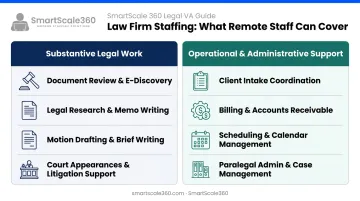
Two Categories Every Firm Should Understand
Before choosing any provider, identify which category of work you're outsourcing:
Substantive legal work:
- Document review and e-discovery
- Legal research and memo writing
- Motion drafting and brief writing
- Court appearances and litigation support
Operational and administrative support:
- Client intake coordination
- Billing, accounts receivable, and time entry
- Scheduling and calendar management
- Paralegal administrative tasks and case management system maintenance
Most firms focus on substantive outsourcing first — it's the more obvious category. The operational side, however, is where non-billable overhead steadily consumes attorney time and inflates labor costs. In practice, many firms see faster ROI by tackling operations first.
The global LPO market is projected to grow from $36.63 billion in 2026 to $102.77 billion by 2031, a 22.91% CAGR. External legal service delivery has gone mainstream across both corporate and law firm segments.
Top Legal Outsourcing Options for Law Firms
Each provider below was evaluated based on specialization fit, service reliability, pricing transparency, security standards, and scalability for solo, small, and mid-sized practices. These aren't competing options — they solve different problems.
LAWCLERK
LAWCLERK is an online marketplace connecting law firms with vetted freelance attorneys for project-based and hourly substantive legal work. It was built specifically for solo practitioners and small-to-mid-sized firms that need on-demand legal help without committing to a full-time hire.
What sets it apart from simply finding a freelancer on your own: LAWCLERK handles vetting (JD from an ABA-accredited school or active bar standing), NDA execution for every project, a two-tier conflicts check process, and secure encrypted document sharing. Hiring attorneys set flat fees for defined project scopes, which supports predictable client billing.
| Detail | Info |
|---|---|
| Best For | Solo and small firms needing on-demand research, drafting, discovery, or brief writing |
| Pricing Model | Flat fee per project set by the hiring attorney; no subscription required for one-off projects |
| Key Features | Vetted freelance attorney network, NDA management, secure document library, conflicts check process, billing tools |
Consilio
Consilio is a global legal services company specializing in e-discovery, document review, and managed document services. It's one of the most established options for firms handling litigation-heavy practices or large-scale document management.
The differentiator is infrastructure. Consilio has over 4,000 active review professionals, supports review in 31 languages, and holds ISO 27001, HITRUST, SOC 2 Type 2, and multiple other security certifications. For high-volume discovery matters, that depth of capacity is difficult to replicate elsewhere. It skews toward larger matters and enterprise-scale engagements.
| Detail | Info |
|---|---|
| Best For | Firms with high-volume litigation needing e-discovery, document review, or contract attorney overflow capacity |
| Pricing Model | Managed services, full-service, and self-service options; client rates are quote-based |
| Key Features | E-discovery technology platform, 4,000+ active review professionals, multi-language support, extensive security certifications |
Hire An Esquire
Hire An Esquire is a legal staffing and attorney-placement platform providing access to contract attorneys for both remote and in-office engagements. It serves firms that need flexible legal talent for variable or surge workloads across a broad range of practice areas.
The dual-mode model (remote or on-site) and broad practice area coverage — from M&A to family law to civil litigation — make it a versatile option. Firms get legal talent quickly without committing to a permanent hire. Engagements range from temporary projects to temp-to-perm arrangements. A four-step vetting process checks identity, bar standing, professional records, and a soft-skills assessment.
| Detail | Info |
|---|---|
| Best For | Firms needing flexible attorney coverage for specific cases, practice areas, or in-office surges |
| Pricing Model | Hourly rates for contract attorneys; $250 to post a job directly; broad rate guidance of $20–$200+/hour depending on experience |
| Key Features | Remote and in-office attorney placement, broad practice area coverage, temp through temp-to-perm engagement options |
AppearMe
AppearMe is a mobile-first marketplace that connects attorneys with qualified per diem attorneys for court appearances. The model is simple: a firm needs coverage for a routine hearing, books a local appearance attorney through the app, and pays a flat fee per appearance.
According to AppearMe, an attorney can be found within 60 seconds, including requests made 10 minutes before a hearing. For solo practitioners billing at flat fees, travel time and waiting time at routine hearings directly eat into profitability — AppearMe eliminates both.
| Detail | Info |
|---|---|
| Best For | Solo attorneys and small firms looking to eliminate travel and wait time for non-substantive hearing coverage |
| Pricing Model | Flat fee per appearance ($75–$350); no subscription or membership fees |
| Key Features | Mobile app scheduling, vetted local appearance attorneys, nationwide coverage, 60-second booking capability |
SmartScale360
SmartScale360 is an offshore staffing partner with 20+ years of outsourcing experience that places college-educated, English-speaking dedicated remote staff from the Philippines into law firm operational roles. Most firms underinvest here — and it's where the most immediate overhead savings tend to surface.
While other providers on this list handle substantive legal work, SmartScale360 addresses the operational layer: client intake coordination, billing and accounts receivable support, scheduling, case management system maintenance, and paralegal administrative tasks. These are the non-billable functions that still consume significant attorney and staff time every day.
The model is built around predictability and low commitment: a flat monthly rate, no setup fees, and no long-term contracts. Staff are matched to each firm's specific workflow. If a firm isn't satisfied with their assigned staff member, SmartScale360 replaces them at no charge.
| Detail | Info |
|---|---|
| Best For | Solo and small-to-mid-sized law firms looking to reduce operational labor costs and offload non-billable administrative functions |
| Pricing Model | Flat monthly rate per dedicated staff member; no setup fee, no long-term contract required |
| Key Features | College-educated, English-speaking remote staff; dedicated matching to firm-specific roles; intake, billing, scheduling, and paralegal admin support; 24/7 availability; cancel anytime |

How to Evaluate Legal Outsourcing Partners
The most common mistake law firms make when evaluating outsourcing partners is treating all providers as interchangeable. Searching for a single "LPO vendor" without first identifying whether you need substantive legal help, operational staffing, or both leads to poor fits.
Start with an internal audit: where is attorney and staff time going, and where does it generate the most value?
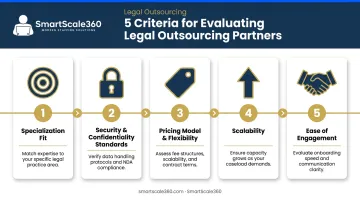
Five Evaluation Criteria That Matter
1. Specialization fit Does the provider specifically serve the type of task you want to outsource? A document review platform is not equipped to coordinate client intake. A paralegal admin VA is not equipped to handle e-discovery. Match the provider to the function.
2. Security and confidentiality standards For substantive legal work, this is non-negotiable. Look for NDAs executed at the project level, data encryption in transit and at rest, and certifications like SOC 2, ISO 27001, or HITRUST.
ABA Formal Opinion 08-451 permits outsourcing, domestic or offshore, provided the supervising attorney takes reasonable steps to verify competence, protect client information under Rule 1.6, and conduct conflict reviews.
3. Pricing model and flexibility Flat fees, hourly rates, and flat monthly retainers each serve different firm structures. Flat fees work well for defined projects. Hourly works for variable-demand staffing. Monthly retainers suit operational roles where consistency matters more than per-task pricing.
4. Scalability Can the provider add capacity quickly during a litigation surge or scale down during a slow quarter? This matters more for operational roles than for one-off project work.
5. Ease of engagement How much internal attorney time does onboarding and managing the provider actually require? For small firms without a dedicated operations staff member, a low-friction model, like AppearMe's on-demand booking or SmartScale360's matched dedicated staff approach, can save several billable hours a month on provider management alone.
For substantive legal work, weight security and specialization most heavily. For operational outsourcing, prioritize cost predictability and staff quality. Knowing which category your need falls into before you start vendor conversations will save significant time in evaluation.
Conclusion
Legal outsourcing has moved from a cost-cutting tactic to a standard operational strategy. The firms seeing the clearest returns tend to combine providers: a substantive legal overflow solution (like LAWCLERK or Hire An Esquire) alongside an operational support partner that handles the non-billable functions pulling attorneys away from billable work.
A practical starting point: do a one-week time audit. List every task handled in-house and sort them into two categories — "only a licensed attorney can do this" and "a trained remote professional could handle this." The second list is where outsourcing ROI is typically fastest and easiest to measure.
For firms ready to explore offshore operational staffing, SmartScale360 offers a no-contract, no-setup-fee starting point with dedicated staff matched to your firm's specific roles and workflow. A free consultation at smartscale360.com/pages/consultation is the simplest way to identify which operational functions make sense to hand off first.
Frequently Asked Questions
What are legal outsourcing services?
Legal outsourcing services involve delegating legal tasks or law firm operational functions to external providers. This covers substantive work like research, drafting, and e-discovery, as well as administrative functions like client intake, billing, and scheduling — all with the goal of reducing costs and improving operational efficiency.
What are the four types of outsourcing?
The four main models are:
- Direct contract: The firm engages a provider directly
- Managed outsourcing: A coordinating firm oversees delivery
- Required outsourcing: Mandated for compliance or cost purposes
- Multi-sourcing: Work is split across multiple specialized providers to reduce risk
Is outsourcing illegal in the US?
Outsourcing is legal in the US. Law firms must comply with ABA Model Rules 5.1–5.3 on supervision, Rule 1.6 on client confidentiality, and disclosure requirements on fee arrangements. ABA Formal Opinion 08-451 explicitly permits both domestic and offshore LPO when proper protocols — NDAs, conflicts checks, and supervision — are maintained.
What tasks should a law firm outsource first?
Start with high-volume, time-consuming, non-strategic tasks: document review, legal research and memo writing, client intake coordination, scheduling, and billing follow-up. These deliver quick time savings with low quality risk and minimal attorney oversight required.
How do law firms protect client confidentiality when outsourcing?
Key protections include:
- Require NDAs from all providers
- Verify security certifications (SOC 2, ISO 27001, or HITRUST)
- Use encrypted document sharing platforms
- Maintain supervisory oversight per ABA Model Rules 5.1–5.3
The supervising attorney remains responsible for all outsourced work.
How much can a law firm save through outsourcing?
According to Thomson Reuters, firms that outsourced support roles saved approximately $20,000 per outsourced FTE on average. Offshore staffing for operational roles can cut labor costs by 60–70% compared to in-house equivalents, since benefits, recruitment, and office overhead typically add 30%+ on top of base salary.