

Introduction
Running a lean financial services firm means every hour counts. According to a 2023 survey by Kitces Research, advisors spend only 41% of their time on client-facing work — the rest goes to administration, compliance tasks, and operations. For independent RIAs, insurance agencies, and boutique accounting practices, that imbalance is exactly what's pushing firms toward virtual assistants.
But deploying a VA in a financial services context isn't as simple as handing off a task list. Client data sensitivity, regulatory obligations under frameworks like Regulation S-P, and the need for industry-aware staff make this decision more nuanced than most "hire a VA" guides acknowledge.
This guide covers the operational reality of using a financial services VA: how to assess firm readiness, structure onboarding, delegate safely, and build the compliance discipline the industry requires.
Key Takeaways
- A VA delivers ROI only when your firm has documented, repeatable processes ready to hand off
- Compliance frameworks, system access controls, and signed confidentiality agreements must be in place before a VA's first day
- Start narrow — calendar management, CRM updates, intake processing — then expand scope based on output quality
- Licensed advisory judgment stays with you — the administrative infrastructure around it is what you delegate
- Start at 10–20 hours per week, track time recovered, and scale from there
When Is a Financial Services VA Right for Your Firm?
The clearest signal: your licensed professionals are consistently spending time on tasks that don't require their license.
Scheduling client reviews, updating CRM records, processing intake forms, tracking compliance document deadlines — none of these require a Series 65 or a CPA credential. When these tasks regularly displace relationship-building or revenue-generating activity, that's the operational gap a VA is designed to fill.
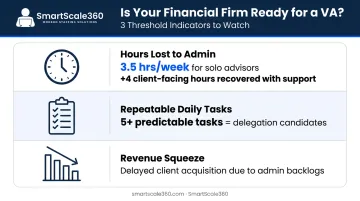
Threshold Indicators Worth Tracking
- Hours lost to admin: Kitces Research found that an unsupported solo Senior Advisor spends roughly 3.5 hours per week on administration — and advisors with back-office support gained approximately 4 additional client-facing hours per week compared to less productive peers
- Repeatable daily tasks: If you can list five or more tasks that happen on a predictable schedule and follow the same steps each time, you have delegation candidates
- Revenue squeeze: When client acquisition or portfolio review conversations get pushed back because of inbox management or scheduling backlogs, the cost of not having support becomes measurable
These indicators point toward readiness — but timing matters just as much as need.
When VA Adoption Gets Misused
The most common failure mode: firms hire a VA before standardizing their own workflows, then blame the model when results disappoint. A VA cannot replicate a process that exists only in the advisor's head.
Solo advisors managing 30 clients and five-person RIAs managing 150 have different VA needs, but both share the same prerequisite. The VA relationship starts working when the firm has already decided how things should be done; the VA executes that consistently.
What You Need Before Hiring a Financial Services VA
Document Your Repeatable Tasks First
Firms that get the fastest return from a VA typically spend one to two weeks writing out their recurring task list before the first conversation with a provider. For each task, document:
- What the task is and when it recurs
- The exact steps to complete it
- The expected output and format
- What "done correctly" looks like
Without this, even a strong VA will produce inconsistent results because the standard doesn't exist yet.
Prepare Your Technology Stack
Identify which platforms the VA will operate in — CRM, scheduling software, email, document management, billing systems — and confirm each supports individual user logins. Never share primary login credentials. A separate licensed seat per VA is not optional; it's your audit trail.
Platforms common in financial services VA roles include CRMs like Redtail or Wealthbox, document management tools, scheduling software, and accounting platforms such as QuickBooks Online or Xero. SmartScale360's financial services VAs are matched to client-specific software stacks, including platforms used in mortgage, insurance, and accounting workflows.
Establish a Compliance and Data Security Framework
Financial firms handle regulated client information. Before a VA begins work, you need:
- A signed confidentiality and data privacy agreement
- A defined list of what client data the VA can access — and what they cannot
- Audit trail capability within any shared software so access is logged and reviewable
The SEC's 2024 Regulation S-P amendments require covered firms to maintain service-provider oversight designed to protect customer information, with breach notification requirements as tight as 72 hours. Your VA relationship belongs inside that safeguards program — not outside it.
Also critical: FINRA Regulatory Notice 21-29 is explicit that a member firm cannot outsource its compliance obligations. Delegating tasks to a VA doesn't transfer your supervisory responsibility.
Define "Done" Before You Delegate
Vague instructions produce vague results. "Manage my inbox" is not a task definition. A proper task definition includes:
- The specific action and scope (e.g., "flag emails requiring advisor response within 24 hours, archive newsletters, move compliance-related correspondence to the [folder name] subfolder")
- The turnaround expectation
- The quality standard
This upfront discipline is the difference between a productive VA relationship and a frustrating one.
Evaluate Your VA Source Against Industry Requirements
Clear task definitions only produce results if the person executing them understands the environment they're working in. Generic freelancing platforms can fill one-off needs, but ongoing financial firm support requires a VA who knows industry-specific terminology, compliance document workflows, and client onboarding processes, and who functions as a dedicated resource rather than a shared one.
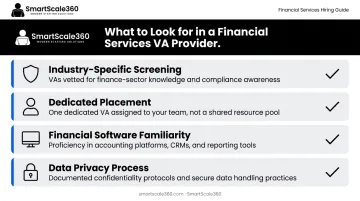
When evaluating providers, look for:
- Industry-specific screening (not just general admin skills)
- Dedicated placement — one VA assigned to your firm, not rotated among clients
- Familiarity with financial services software and regulatory document workflows
- A clear data privacy and confidentiality process before day one
Firms that treat VA selection with the same rigor they apply to any vendor hire — vetting for fit, not just availability — consistently see faster ramp-up times and fewer compliance headaches.
How to Deploy a Financial Services VA (Step-by-Step)
Firms that try to delegate everything at once consistently encounter quality issues that erode confidence in the model rather than the execution. A sequenced handoff works better.
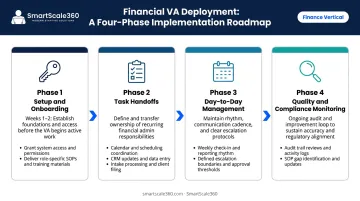
Setup and Onboarding (Weeks 1–2)
- Give the VA controlled access to each required system — individual logins only
- Walk through each process once using screen recordings or written SOPs
- Complete a test run of each task type before going live
The most common onboarding error: financial firm owners skip the walkthrough phase and assume a competent VA will figure it out. VAs need to learn your firm's specific way of doing things, not just the general task category.
Initiating Task Handoffs
Start with a narrow set of high-frequency, low-risk tasks:
- Calendar management and appointment reminders
- CRM data entry and contact updates
- New client intake form processing
- Document filing and deadline tracking
Errors in these areas are easy to catch and correct before expanding scope. After the first five CRM entries, review them against your quality standard. If they're accurate and formatted correctly, proceed. If not, correct the SOP — not just the output.
Day-to-Day Management
Establish a predictable communication rhythm — a short async daily update or a structured weekly check-in — that doesn't require the VA to interrupt the advisor constantly. Financial services VAs should know what to complete independently and when to escalate.
Operating boundaries matter here. Define explicitly:
- Tasks the VA completes and delivers directly
- Tasks that require advisor review and sign-off before going out
- Client-facing emails, compliance documents, and anything involving account data all require an approval step
Monitoring Quality and Compliance
In the early weeks, review task outputs using the same quality criteria you defined during setup. Look for patterns in errors rather than one-off mistakes — a recurring issue usually points to an SOP gap, not a VA competency problem.
On the compliance side, confirm the VA's system access is appropriate on a rolling basis. Review CRM audit trails quarterly, and update the privacy agreement any time the scope of work expands.
Offboarding and Access Control
When a VA relationship ends, disable their individual system logins right away and document what data they accessed during the engagement. This step is routinely skipped in informal VA arrangements, creating compliance exposure.
Firms using individually licensed software seats avoid this risk because access can be revoked instantly — no shared credentials to chase down.
What to Delegate — and What to Keep In-House
If a task is repeatable, documentable, and doesn't require a license or fiduciary judgment, it's a strong candidate for VA delegation. That single filter eliminates most of the guesswork.
Tasks That Delegate Well
- Calendar and appointment management — scheduling, reminders, rescheduling coordination
- CRM maintenance — updating client records, tracking follow-up dates, flagging stale contacts
- New client onboarding support — collecting documentation, setting up profiles, tracking missing forms
- Email inbox management — sorting, flagging priorities, drafting routine responses for advisor review
- Compliance document organization — filing, deadline tracking, maintaining audit-ready records
- Marketing support — social media scheduling, newsletter formatting, lead follow-up sequences
Tasks That Stay With Licensed Staff
- Any communication involving personalized financial advice, portfolio recommendations, or fiduciary guidance
- Signing or approving regulatory documents
- Direct client relationship management at the advisory level
The real risk in VA delegation isn't overreach — it's under-specification. Advisors who skip the step of writing clear task boundaries leave VAs guessing, which creates both operational gaps and regulatory exposure. Clear written SOPs for each delegated task are what make the arrangement work long-term.
Best Practices for Managing a Financial VA Long-Term
Treat quality management as an ongoing process, not a one-time onboarding event. Establish a monthly review covering:
- Task output quality against defined standards
- VA bandwidth relative to task volume
- New task categories that have emerged and could be delegated
Firms that revisit the delegation list regularly identify new time-saving opportunities and catch quality drift before it compounds.
Scale deliberately. Starting at 10–20 hours per week lets you measure the actual time recovered for advisor-level work before expanding scope. Tracking hours reclaimed, tasks handled, and response times improved gives you the ROI data to justify additional delegation. SmartScale360's month-to-month model lets financial firms scale up during high-volume periods — tax season, Q4 review cycles — and pull back during slower months without penalty.
Long-term success comes down to discipline over complexity. The firms that get the most from a financial services VA share three traits: clear task definitions, consistent communication rhythms, and a genuine investment in the onboarding phase. Get those right, and the systems will follow.
Frequently Asked Questions
What tasks should a financial firm never delegate to a virtual assistant?
Tasks requiring a license, fiduciary judgment, or direct client advisory relationship — including portfolio recommendations, regulatory filings, and personalized financial guidance — must stay with licensed staff. The VA handles the operational infrastructure around these activities, not the activities themselves.
How do I protect client data when working with a remote financial VA?
Require a signed confidentiality agreement, provide individual system logins (never shared credentials), and ensure your platforms have audit trail capability. These three steps let you track what was accessed, when, and by whom — which is exactly what Regulation S-P service-provider oversight requires.
How long does it take to onboard a financial services VA effectively?
Most firms need two to four weeks: one to two weeks for SOP documentation and system access setup, followed by one to two weeks of monitored test tasks before the VA operates independently. Skipping monitored test tasks is the most common reason early results disappoint.
What's the difference between a generic VA and a financial services VA?
A financial services VA has familiarity with industry terminology, CRM platforms common in advisory firms, compliance document workflows, and client onboarding processes. A generic VA will need considerably more training in each of these areas before operating without close supervision.
How many hours per week does a small financial firm typically need from a VA?
Most solo advisors or small firms start at 10–20 hours per week covering administrative and scheduling tasks, then scale as the relationship matures. The right starting point depends on how many repeatable tasks you can clearly define before hiring.
Can a virtual assistant handle client-facing communication for a financial advisor?
VAs can manage routine outbound communication — appointment reminders, document request follow-ups, onboarding coordination. Any communication involving financial guidance or advice requires the advisor to draft or approve it before it goes out. That approval step is non-negotiable.