Introduction
If you're spending hours each week chasing unpaid invoices, reconciling payments, or personally following up with clients who are 60 days overdue — you're not alone. According to QuickBooks' 2026 Small Business Late Payments Report, 59% of US small businesses had invoices at least 30 days overdue, with an average unpaid balance of $17,700.
That's not just a collections problem. It drains cash flow, consumes your team's time, and quietly stalls growth.
Corporations have relied on outsourced invoicing for years. That same model is now accessible and affordable for small businesses, through dedicated staffing solutions built specifically for SMBs rather than enterprise-scale BPO contracts.
This article covers what invoicing outsourcing actually includes, how to spot the signs you need it, and — practically — six tips to make it work without losing financial control.
Key Takeaways
- Invoicing outsourcing spans AR, AP, invoice creation, payment reminders, and collections as a full-cycle function
- Document your current process before handing anything off to an external partner
- Set measurable KPIs (invoice processing time, error rate, DSO) before the relationship starts
- A dedicated staffing model outperforms pooled BPO teams when client relationships and account consistency are priorities
- Start with one function, evaluate performance, then scale — don't hand over everything at once
What Does Outsourcing Invoicing Actually Cover?
Most small business owners assume invoicing outsourcing means hiring someone to generate and send invoices — but the actual scope covers your entire billing cycle, from first invoice to final collection.
Accounts Receivable vs. Accounts Payable
The two core categories are distinct, and knowing which you need matters:
- Accounts Receivable (AR): Getting paid by your customers — invoice creation, payment tracking, reminders, collections follow-up
- Accounts Payable (AP): Paying your vendors and suppliers — processing incoming bills, scheduling payments, reconciliation
Many small businesses start with AR outsourcing because that's where cash flow pressure shows up first. AP outsourcing typically follows once AR is running smoothly.
Core Tasks Typically Covered
| Task | AR or AP |
|---|---|
| Creating and sending invoices | AR |
| Tracking outstanding balances | AR |
| Sending payment reminders | AR |
| Following up on overdue accounts | AR |
| Collections escalation | AR |
| Processing vendor bills | AP |
| Scheduling payments | AP |
| Month-end reconciliation reporting | Both |
Full-Scope vs. Partial Outsourcing
You don't have to hand over everything on day one. Partial outsourcing — for example, delegating only payment reminders and 30/60/90-day follow-ups — is a legitimate starting point. SmartScale360's Billing & AR Specialist model supports this phased approach, handling tasks from invoice preparation to aging bucket follow-ups. It works within your existing accounting stack — QuickBooks Online, Xero, NetSuite, FreshBooks, or Bill.com — so there's no need to change your current setup.
Signs It's Time to Outsource Your Invoicing
The decision usually becomes obvious when invoicing shifts from a background task to an active drain on your time and cash flow.
Common Warning Signs
- Invoices are going out late because no one has bandwidth to generate them consistently
- You or your admin staff are personally chasing payments instead of working on higher-value tasks
- Cash flow gaps are forcing delayed payroll, unplanned debt, or late vendor payments
- Invoice errors are creating friction with clients or triggering payment delays
That last point matters more than people expect. Ardent Partners' 2024 ePayables research found that Best-in-Class AP teams had a 9% invoice exception rate — while the rest of the market ran at more than double that rate. Teams with high exception rates also spent 26.9% of their time on supplier inquiries, meaning errors compound into wasted hours.
The Hidden Cost of Manual Processing
Those error rates translate directly into dollars. The same Ardent Partners research found that organizations outside the Best-in-Class tier spent an average of $12.88 per invoice to process, compared to $2.78 for top performers — a 78% cost gap. Cycle time showed an even wider spread: 17.4 days versus 3.1 days.
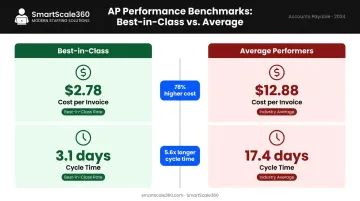
These aren't outsourcing price benchmarks — they're performance benchmarks. They show what inefficient in-house invoicing actually costs when you account for staff time, errors, and rework.
The Volume Threshold
When your admin or accounting staff spend more than a few hours a week on invoicing alone — generating statements, sending reminders, updating aging reports — the math starts favoring outsourcing. That time has a real cost, and it's rarely showing up as a line item on your budget.
Tips to Successfully Outsource Your Invoicing
Tip 1 — Document Your Current Process First
Before handing anything off, map your existing workflow:
- What triggers an invoice? (project completion, monthly cycle, milestone?)
- What payment terms do you use — Net 15, Net 30, Net 60?
- When do reminders go out, and through what channel?
- Who handles disputes or escalations?
An undocumented process creates miscommunication with any external partner. If you can't describe your workflow clearly, your outsourcing partner can't replicate it accurately.
Tip 2 — Define What to Delegate vs. What to Keep
Not everything should leave your desk. A practical split:
Delegate (repetitive, time-consuming):
- Invoice generation and delivery
- Payment reminder emails and calls
- AR aging report updates
- Status tracking and data entry
Keep in-house (strategic, judgment-based):
- Approving write-offs
- Final authority on payment disputes
- Reviewing aged receivables reports
- Client relationship decisions around collections
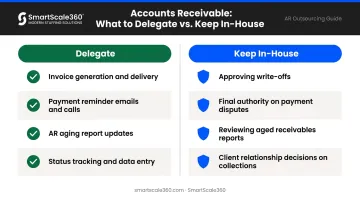
A home care franchise owner, for example, might outsource all billing statement generation and 30/60/90-day follow-up calls while retaining authority over any write-off above a certain dollar threshold. The outsourcing partner executes; the owner decides.
Tip 3 — Set Up Reporting and Communication Cadence
Lack of reporting structure is one of the most common reasons outsourcing arrangements fail. Before the relationship starts, establish:
- Weekly or bi-weekly check-ins with a standing agenda
- Standardized reporting: aged receivables report, weekly payment summary, exception log
- A clear escalation path for unusual situations
Your dedicated specialist should function like a remote team member, not a black box. SmartScale360's AR specialists work during your preferred hours and use your existing communication channels, so structured check-ins fit naturally into your workflow.
Tip 4 — Define Your KPIs Upfront
Performance reviews should be objective, not based on gut feel. Set these metrics before the engagement begins:
| KPI | What to Measure |
|---|---|
| Invoice processing time | Days from trigger to delivery |
| Error rate | Errors per 100 invoices |
| Days Sales Outstanding (DSO) | Aim for the APQC cross-industry median: 38 days |
| Invoice-to-cash cycle | APQC median is 22 days from invoice to payment receipt |
| On-time payment rate | % of invoices paid within terms |
| Follow-up frequency | Average reminders per invoice cycle |
Having these benchmarks defined before day one means performance conversations are grounded in data, not impressions.
Tip 5 — Protect Your Data with a Security Agreement
Any outsourcing partner handling customer financial data should sign a written agreement covering:
- What data they can access and for what purposes
- How data is stored and encrypted
- Who within the provider's organization has access
- Breach notification procedures
Regulatory requirements vary by industry and data type. Healthcare invoicing that touches protected health information requires HIPAA-compliant business associate agreements. If you handle California consumers' data, CCPA service provider contract requirements apply.
Offshore arrangements don't change these obligations. The FTC's guidance on protecting personal information is explicit: you remain responsible for what third-party partners do with your data.
Cloud-based accounting platforms have simplified some of this, but the written agreement is still non-negotiable.
Tip 6 — Start Small, Then Scale
Pick one invoicing function and outsource that first. Payment reminders and 30/60/90-day follow-up calls are ideal starting points — high volume, repeatable, and measurable.
Run that for 60 days. Evaluate accuracy, responsiveness, and reporting quality. If the partner performs well, expand scope to invoice generation, then reconciliation, then full month-end close support.
This phased approach reduces transition risk and gives you real performance data before expanding further. SmartScale360's model is built for exactly this kind of gradual rollout: packages can be modified or expanded at any time, with no long-term contracts required.
How to Choose the Right Invoicing Outsourcing Partner
Industry Experience Matters
A billing specialist who has worked with homecare agencies understands insurance billing and caregiver scheduling cycles. One with real estate experience recognizes retainer structures and project-based payment timelines. Ask prospective partners directly: what industries have you supported, and can you describe a billing nuance specific to that sector?
Technology Compatibility
Your partner's tools need to work inside your existing stack. Before signing anything, confirm:
- Which accounting platforms they support (QuickBooks, Xero, FreshBooks, NetSuite, Bill.com)
- How data is transferred between systems
- Whether your team needs to change any current workflows
Dedicated Staff vs. Pooled BPO Team
This distinction directly shapes quality for small businesses:
- Pooled BPO teams rotate agents across accounts, so no single person develops familiarity with your clients, payment terms, or billing quirks.
- A dedicated staffing model assigns one specialist to your business exclusively — they learn your client roster and billing patterns and stay consistent over time.
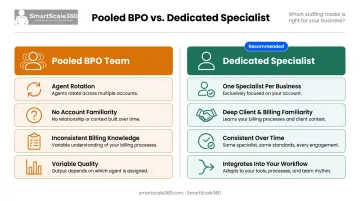
When client relationships and billing accuracy both matter, the dedicated model tends to win. SmartScale360, for example, assigns one offshore AR specialist per account who integrates into your workflow and operates on your schedule — rather than pulling from a shared pool.
Pricing and Contract Flexibility
Once you've settled on a staffing model, scrutinize the contract terms. Prioritize partners with:
- Transparent, predictable monthly pricing
- No long-term lock-in
- No setup fees
- A replacement guarantee if the initial specialist isn't the right fit
The BLS reports a median annual wage of $49,210 for bookkeeping and accounting clerks — and that's before benefits, payroll taxes, and office overhead. Offshore dedicated staffing through a provider like SmartScale360 typically runs approximately 60% below comparable US in-house cost, with no employment overhead attached.
Mistakes to Avoid When Outsourcing Invoicing
Watch out for these three patterns — each one is common, and each one is fixable before it becomes a real problem.
- No internal point of contact. Handing off invoicing without a designated internal reviewer creates accountability gaps. Someone on your team should check reports regularly, catch discrepancies early, and retain final authority on write-offs and disputes. Outsourcing execution is not the same as outsourcing financial decision-making.
- Choosing on price alone. A single incorrect invoice can delay a payment cycle, trigger a client dispute, or create a tax reporting discrepancy. Ardent Partners data shows a 2x+ exception rate gap between best-in-class and average performers — a direct measure of what low-cost, low-quality processing actually costs you.
- Skipping onboarding. The first 30–60 days are the most critical. Businesses that rush past proper setup — skipping invoice templates, payment terms, communication preferences, and escalation procedures — create problems that surface weeks later. A structured handoff in week one prevents most of them.
Frequently Asked Questions
Frequently Asked Questions
What are the four types of outsourcing?
Outsourcing is commonly grouped into professional services, IT, manufacturing, and business process outsourcing (BPO). Invoicing falls under BPO, where a third party executes financial processes on your behalf.
What is the difference between I2C and O2C?
Invoice-to-Cash (I2C) covers the process from issuing an invoice to collecting payment. Order-to-Cash (O2C) is broader — it starts when a customer places an order and runs through fulfillment, invoicing, and payment. Invoicing outsourcing typically targets the I2C portion of that cycle.
Is outsourcing illegal in the US?
US law permits outsourcing, both domestically and offshore. However, businesses must still meet applicable data privacy and security requirements — including HIPAA for healthcare data, CCPA for California consumer information, and GDPR for any EU-covered data — regardless of where their provider is located.
How much does it cost to outsource invoicing for a small business?
Costs vary by model and scope. Dedicated offshore AR specialists typically run around 60% below the cost of a comparable US in-house hire, with no setup fees or employment overhead — making it straightforward to compare against your current fully loaded staffing costs.
What invoicing tasks can be outsourced by a small business?
The most commonly outsourced tasks include invoice creation and delivery, payment reminders, accounts receivable follow-up, collections escalation, AP processing, and monthly reconciliation reporting.
How do I maintain control over my finances when outsourcing invoicing?
Retain oversight through regular reporting reviews, clearly defined KPIs, and a structured escalation process for disputes. Keep final approval authority over write-offs and adjustments.