Introduction
Real estate agents earn their keep in two places: in front of clients and at the negotiating table. Yet a significant chunk of every workday disappears into scheduling, inbox management, MLS updates, and paperwork — none of which require a license to complete.
According to the NAR 2023 Member Profile, only 17% of REALTORS® currently use a personal assistant, which means the majority of agents are still handling tasks that someone else could own entirely. Every hour spent on admin is an hour not spent closing deals.
This article covers:
- What a real estate agent assistant can handle
- Which tasks must stay with the licensed agent
- Skills to screen for when hiring
- A four-step delegation framework to make the transition straightforward
Key Takeaways
- Real estate assistants can handle administrative, marketing, listing, and transaction coordination tasks, so agents spend more time with clients.
- The licensed vs. unlicensed distinction determines what an assistant can legally do; violations can jeopardize an agent's license.
- Effective delegation requires SOPs and clear communication rhythms, not just a task list.
- Virtual and offshore assistants can handle remote tasks at 60–70% lower cost than in-house staff.
- Starting narrow — one task category first — builds trust before expanding scope.
What Does a Real Estate Agent Assistant Do?
A real estate agent assistant is a support professional who handles operational, administrative, and marketing work so the agent can stay focused on revenue-generating activity. Assistants may work in-office, remotely, or fully virtually. The role is defined by function, not physical setting.
Licensed vs. Unlicensed: Why It Matters
The most important distinction when hiring an assistant is licensure, because it determines legal scope.
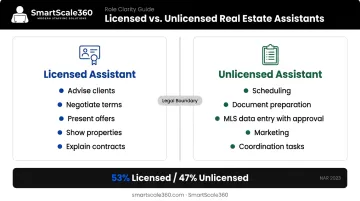
- Licensed assistants can advise clients, negotiate terms, present offers, and perform other activities that constitute the practice of real estate.
- Unlicensed assistants are limited to administrative and coordination functions — scheduling, document preparation, MLS data entry with agent approval, and similar tasks.
State rules vary considerably. Texas TREC explicitly prohibits unlicensed assistants from showing properties, answering substantive listing questions, or explaining contracts. California DRE and Florida FREC have comparable restrictions. Always confirm your state's specific rules before defining your assistant's role.
According to the NAR 2023 Member Profile, 53% of assistants reported by REALTORS® were licensed and 47% were unlicensed — and 46% worked full time, with 51% dedicated exclusively to one agent.
General VA vs. Real Estate-Specific Assistant
Licensure is only part of the picture — the assistant's industry background matters just as much. A general virtual assistant can handle calendar management and email. A real estate-specific assistant also understands MLS workflows, transaction timelines, compliance terminology, and platforms like Follow Up Boss, kvCORE, or dotloop. That industry context cuts onboarding time sharply and reduces the risk of errors on time-sensitive tasks.
Core Duties You Can Delegate to a Real Estate Assistant
If a task doesn't require your license, your judgment, or your relationships — it can be delegated. These five areas account for the bulk of what pulls agents away from revenue-generating work.
Administrative and Scheduling
These are high-volume, low-judgment tasks that consume hours without requiring the agent's expertise:
- Managing the agent's calendar and scheduling showings, inspections, and appointments
- Responding to routine emails and handling phone inquiries
- Organizing digital and physical files
- Maintaining CRM records and contact data
- Coordinating with vendors, service providers, and clients on logistics
Listing Management
The assistant handles execution; the agent approves content:
- Entering new listings into MLS and real estate platforms
- Writing property descriptions using agent-approved templates
- Uploading photos, documents, and floor plans
- Updating pricing, status, and availability
- Pulling comparable sales data for agent review
Marketing Support
Most agents lose momentum on marketing when deal flow picks up. An assistant keeps campaigns running consistently, regardless of how busy the pipeline gets:
- Creating and scheduling social media posts
- Building and sending email campaigns
- Designing digital flyers and open house materials
- Compiling monthly market reports
- Tracking campaign performance metrics
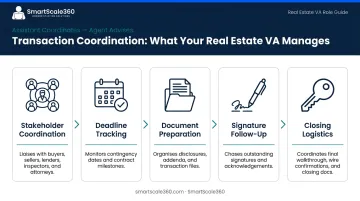
Transaction Coordination
This is where a skilled assistant delivers some of the highest leverage. The assistant coordinates; the agent advises — a boundary that keeps the workflow compliant:
- Coordinating between buyers, sellers, lenders, inspectors, and attorneys
- Tracking contingency deadlines and key dates
- Preparing and organizing documents for agent review
- Following up on outstanding signatures
- Scheduling and confirming closing logistics
Bookkeeping and Reporting
Independent agents rarely have a back-office finance team — which means bookkeeping either falls to them or doesn't get done. An assistant covers the basics so nothing slips:
- Logging expenses in QuickBooks or similar software
- Paying recurring bills and preparing invoices
- Reconciling accounts monthly
- Generating expense summaries for tax preparation
- Tracking commission income and outstanding receivables
What Tasks Should Stay With the Agent?
Unlicensed assistants cannot legally perform activities that constitute the practice of real estate. Keep these with the agent:
- Showing properties — even informally or at open houses
- Presenting or negotiating offers — any discussion of terms with a buyer or seller
- Providing pricing opinions to clients — sharing a CMA directly with a client requires the agent's involvement
- Executing contracts — signing or advising on contractual language
Beyond legal compliance, certain high-judgment tasks should stay with the agent regardless of the assistant's licensure status:
- Strategic pricing decisions
- Handling sensitive negotiations or client disputes
- Advising on legal or financial implications of a transaction
- Final calls on marketing positioning or offer strategy
The dividing line is straightforward: if the task requires your license, your professional judgment, or your duty to the client, it stays with you. Anything else is fair game for delegation.
What Skills Should You Look for in a Real Estate Assistant?
Not every candidate who can answer a phone belongs in a real estate transaction pipeline. The right assistant combines technical fluency with the discipline to manage high-stakes deadlines without being micromanaged.
Hard Skills
- Proficiency with CRM platforms (Follow Up Boss, kvCORE, Chime, Top Producer, Wise Agent)
- MLS data entry and listing management
- Document preparation and organization
- Basic bookkeeping (QuickBooks or equivalent)
- Digital marketing tools — Canva, Mailchimp, social scheduling platforms
Candidates with prior real estate exposure ramp up faster and make fewer compliance-adjacent errors.
Soft Skills
- Attention to detail: contracts and compliance documents leave zero room for sloppiness
- Written communication: every email and text sent on your behalf reflects your reputation
- Proactive follow-through — real estate deadlines don't wait, and neither should your assistant
- Comfort managing multiple timelines — juggling 10+ active transactions at once is standard territory
Additional Screening Criteria for Virtual or Offshore Assistants
- Strong English fluency, both written and spoken
- Reliable internet connection and communication tools
- Overlap with U.S. business hours
- Familiarity with U.S. real estate market practices, terminology, and transaction workflows
How to Effectively Delegate to a Real Estate Assistant
Step 1 — Audit Your Time
Track every task for one week. Categorize each as:
- "Only I can do this" (requires license, judgment, or client relationship)
- "Someone else can do this with clear guidance"
That second list becomes your initial delegation roadmap. Don't guess — measure.
Step 2 — Build Task-Specific SOPs
A Standard Operating Procedure documents exactly how a recurring task gets done. Without one, every delegated task generates questions, inconsistencies, and rework. With one, the task runs the same way every time — regardless of who's doing it.
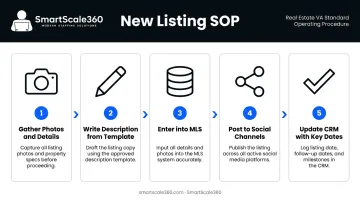
Example SOP — posting a new listing:
- Gather agent-approved photos and property details
- Write description using the agent's approved template
- Enter listing into MLS with correct fields and pricing
- Post to designated social channels per brand guidelines
- Update CRM with listing status and key dates
Build the SOP once, then stop re-explaining the task.
Step 3 — Set Communication Rhythms and Access
Define these before the assistant starts:
- Daily or weekly check-in cadence (a 15-minute async update works well for most setups)
- Tool access — calendar, CRM, email, transaction management platform
- Response time expectations for client-facing tasks
- Escalation path when the assistant encounters something outside their scope
Step 4 — Start Narrow, Then Expand
Delegate one category first — scheduling and inbox management is a common starting point. Run it for 30 days, evaluate performance, then layer in additional responsibilities in stages:
- Month 1: Scheduling and inbox management
- Month 2: Listing coordination or social media posting
- Month 3+: Transaction coordination and deadline-sensitive tasks
This staged approach builds the mutual trust and process clarity needed before handing off anything with a hard deadline.
Virtual vs. In-Person: Choosing the Right Assistant
The Cost Reality
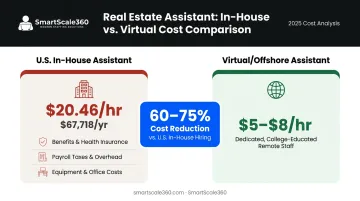
According to Indeed, the average U.S. real estate assistant earns $20.46 per hour, with Glassdoor reporting an annual average of $67,718. Add benefits, payroll taxes, office space, and equipment, and the fully loaded cost climbs substantially higher.
Virtual assistants (particularly those based in the Philippines) are frequently listed on platforms like OnlineJobs.ph in the $5–$8 per hour range for real estate-specific roles. That gap represents a 60–75% reduction in labor cost for the same administrative and transaction coordination work.
Services like SmartScale360 sit squarely in that range, matching agents with dedicated offshore staff at up to 60% below U.S. in-house costs — covering everything from transaction coordination and listing management to CRM and marketing support, with no contracts and no setup fees.
When Each Model Makes Sense
| Model | Best For | Key Tradeoff |
|---|---|---|
| In-person assistant | High-volume teams needing physical presence | Higher cost, less flexibility |
| Virtual/offshore assistant | Independent agents and small teams | No on-site presence |
Physical tasks — attending showings, managing signage, handling printed documents — require in-person support. Everything else, including the majority of what most agents actually need help with, can be handled remotely without sacrificing quality.
Frequently Asked Questions
What do real estate agent assistants do?
Real estate agent assistants handle administrative, marketing, listing, and transaction coordination tasks so agents can focus on clients and closings. The specific scope depends on whether the assistant is licensed or unlicensed, with unlicensed assistants limited to non-brokerage activities.
What skills does a real estate assistant need?
Hard skills to look for: CRM platforms, MLS data entry, document management, and basic bookkeeping. On the soft skills side, attention to detail, clear written communication, and the ability to juggle multiple active transaction timelines are non-negotiable.
Does a real estate assistant need to be licensed?
A license is not required for administrative work, but is necessary for activities that constitute the practice of real estate — negotiating offers, advising clients, or showing property. Rules vary by state, so confirm your jurisdiction's specific requirements before defining the role.
What is the difference between a virtual and in-person real estate assistant?
In-person assistants can perform physical tasks like attending showings or managing signage. Virtual assistants handle all remotely-executable work: administrative support, marketing, listing management, and transaction coordination — usually at a fraction of the cost.
How much does it cost to hire a real estate agent assistant?
U.S.-based in-house assistants average around $20–$34 per hour according to Indeed and Glassdoor. Virtual and offshore assistants are available at substantially lower rates, with the cost gap between the two models exceeding 60%.
How do I know which tasks to delegate first?
Start by auditing your week for repetitive tasks that don't require your license or direct judgment. Pick one category first — scheduling or inbox management works well — then expand once you've confirmed the assistant handles it reliably.