According to an MGMA poll of 570 medical group leaders, 56% named staffing shortages as their top productivity roadblock — and that was before factoring in the recruitment challenges that followed. Front-office staff turnover hit 40% across reporting practices in 2023, meaning many providers are constantly replacing the people who keep their operations running.
Healthcare BPO — business process outsourcing — offers a direct response to this problem. Instead of hiring, training, and retaining in-house staff for every administrative function, providers delegate those roles to specialized external teams. The result: lower costs, better coverage, and internal staff freed up for work that actually requires their presence.
This article covers what healthcare BPO is, which specific services apply to home care agencies and medical practices, the real business case behind outsourcing, and how to choose a partner that fits your operation.
Key Takeaways
- Healthcare BPO covers non-clinical tasks — scheduling, billing, intake, payroll, EHR management — handled by specialized external teams
- Outsourcing administrative roles can cut labor costs by 60–70% while improving coverage and accuracy
- Home care agencies have distinct outsourcing needs that differ from hospital or enterprise healthcare use cases
- A dedicated staffing model outperforms shared service centers for smaller providers
- The right partner brings HIPAA-compliant workflows, healthcare-trained staff, and flexible month-to-month terms
What Is Healthcare BPO and Why Are Providers Turning to It?
Healthcare BPO is the practice of hiring a third-party provider to manage non-clinical, administrative, or back-office functions that support healthcare operations. The BPO team does not deliver care, diagnose patients, or replace licensed professionals — they handle the operational layer that keeps those clinical teams running.
Why Home Care Agencies Are Particularly Well-Suited
Unlike large hospital systems with dedicated departments for every function, home care agencies typically run lean. The owner or a small internal team is often managing caregiver scheduling, client intake, billing, HR, and compliance simultaneously. That structural mismatch creates burnout, errors, and high staff turnover, which then compounds the original problem.
Caregiver turnover in the home care industry stood at 75% in 2024, according to the Activated Insights Benchmarking Report. Every departure triggers a wave of administrative work: recruiting, screening, onboarding, credentialing, and schedule adjustments. Without adequate back-office capacity, that wave overwhelms the team that's already stretched thin.
Choosing the right BPO model is what determines whether that relief actually materializes — or just adds another vendor to manage.
Two BPO Models — and Why Smaller Providers Need the Right One
Not all BPO arrangements work the same way, and the difference matters significantly for smaller providers:
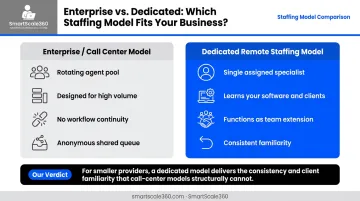
- Enterprise/call center model: Work is distributed among a large pool of agents. Calls and tasks rotate through whoever is available. Designed for volume at scale.
- Dedicated remote staffing model: A specific individual is matched to your agency, learns your software, your workflows, and your client base. Functions as an extension of your team.
For a home care agency managing 100+ clients and 250+ caregivers, a dedicated person who knows your operation is far more effective than an anonymous shared queue. A small medical practice with a tight-knit front-office team has the same need: continuity, familiarity, and someone who doesn't have to relearn your setup every week. That's the practical difference between a BPO partner and a generic overflow service.
Key Healthcare BPO Services for Home Care Agencies and Medical Providers
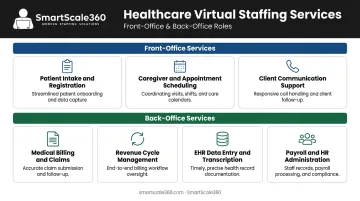
Healthcare BPO services split into two categories: front-office work that touches patients and clients, and back-office work that keeps the business running. Most home care agencies need both.
Front-Office and Patient-Facing Services
Patient intake and registration coordination Outsourced intake coordinators handle new client onboarding, gather demographic and insurance information, verify eligibility, and manage documentation. The practical effect is a shorter gap between inquiry and care start — without adding headcount to your internal team.
Caregiver and appointment scheduling This is one of the highest-volume, highest-stress tasks in home care. Dedicated scheduling coordinators manage shift assignments, fill last-minute call-outs, confirm visits, and follow up with clients. SmartScale360's scheduling coordinators work within platforms like WellSky/ClearCare, AxisCare, AlayaCare, and MatrixCare — the systems most home care agencies already use.
A Home Instead franchise owner named Lynette Stroud hired three dedicated remote scheduling coordinators through SmartScale360 to manage coverage for 100+ clients and 250+ caregivers. Her summary: "Scheduling is fun now. That's when you know it's working."
Patient and client communication support Outsourced staff can manage inbound calls, appointment reminders, status updates, and follow-up outreach — improving responsiveness without adding to your payroll.
Back-Office and Administrative Services
Medical billing, coding, and claims processing MGMA reported an aggregate 8% first-submission denial rate for single-specialty practices — and 60% of practice leaders said their denial rate increased in 2024 compared to the prior year. Outsourced billing specialists handle claim submission, insurance verification, denial management, and follow-up on unpaid claims. Accuracy here directly affects cash flow.
Revenue cycle management (RCM) RCM covers the full billing lifecycle: from eligibility verification through collections. In a November 2024 MGMA poll, 36% of practice leaders said their organizations planned to outsource or automate part of RCM in 2025 — making it one of the fastest-growing outsourcing priorities in the sector.
Data entry, EHR management, and medical transcription Outsourced staff can update electronic health records, transcribe physician or caregiver notes, and maintain documentation accuracy — freeing clinical staff from documentation tasks so they can focus on care.
Payroll support and HR administration With caregiver turnover at 75%, payroll processing is constant: new hires, terminations, pay rate changes, overtime tracking. Home care agencies typically run complex pay structures — hourly, per-visit, split-shift — which makes payroll a strong candidate for outsourcing.
The Real Business Case: Benefits of Healthcare BPO for Smaller Providers
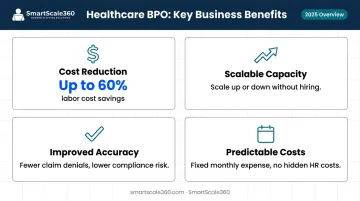
Cost Reduction
This is the primary driver, and the math is straightforward. BLS data shows mean annual wages for medical secretaries and administrative assistants at $43,380, and billing specialists at $47,120 — before benefits, payroll taxes, equipment, and office overhead. For home care agencies in the services-for-elderly sector, comparable administrative roles run $19–$22/hour on average.
SmartScale360's dedicated offshore staffing model — sourcing college-educated, English-speaking remote staff from the Philippines — reduces labor costs by up to 60% compared to equivalent U.S.-based in-house hires. That reduction applies across scheduling coordinators, intake specialists, billing support, and HR assistants.
Scale Without the Hiring Burden
BPO lets providers add administrative capacity during high-demand periods without the full cost of recruiting, onboarding, and training. Common scenarios include:
- Open enrollment and payer credentialing cycles
- Seasonal care surges requiring extra scheduling coverage
- Franchise expansion adding new location administrative load
When demand drops, you're not managing layoffs or severance. The model scales in both directions.
Improved Accuracy and Reduced Compliance Risk
Dedicated BPO staff trained in healthcare administration catch billing errors before claims go out, meet documentation deadlines consistently, and stay current on payer requirements. Claim denials typically cost providers $25–$118 per rework cycle — and HIPAA violations carry penalties starting at $100 per incident. Staff trained specifically on your workflows reduce both risks directly.
Returning Clinical and Leadership Hours to Patient Care
The AMA's 2025 survey found physicians spending an average of 13 hours per week on prior authorizations alone, with 94% saying it contributes to burnout. When administrative tasks shift off the plates of a practice owner or clinical director, those hours go back into care quality, business development, and staff retention — which compounds over time into lower turnover, stronger patient outcomes, and sustainable growth.
Predictable, Transparent Costs
Outsourcing converts unpredictable HR variable costs — turnover, equipment, benefits, sick leave — into a fixed monthly expense. For smaller providers managing tight margins, that predictability makes month-to-month financial planning significantly more reliable. SmartScale360 operates on a no-contract, no-setup-fee model with transparent monthly pricing, which reduces financial risk for agencies testing outsourcing for the first time.
Common Challenges in Healthcare BPO and How to Address Them
Data Privacy and HIPAA Compliance
Entrusting patient data to a third party is a legitimate concern — and one with real regulatory teeth. Any BPO partner handling protected health information (PHI) qualifies as a business associate under HIPAA.
HHS guidance is clear: a signed Business Associate Agreement (BAA) is required, covering permitted uses, data safeguards, breach notification, and subcontractor obligations.
Before signing with any BPO partner, verify:
- A signed BAA is available and covers all applicable functions
- Data encryption and access controls are in place
- Breach notification protocols are documented
- Subcontractor compliance obligations are passed through
OCR reached a $175,000 HIPAA settlement with a business associate in 2025 following a ransomware incident — a reminder that compliance lapses carry real financial consequences.
Integration With Existing Systems
The biggest integration hurdle is ensuring BPO staff can work within your existing scheduling software, EHR, or billing platform without disrupting operations. The best partners adapt to your tools rather than requiring a system overhaul.
Look for staff already trained on platforms common in home care — such as WellSky/ClearCare, AxisCare, AlayaCare, and MatrixCare. SmartScale360's remote staff come with this platform familiarity built in and adjust to new systems as needed.
Maintaining Quality and Oversight at a Distance
Outsourced staff can be managed effectively with the right structure in place:
- Set measurable KPIs upfront: clean claim rates, fill rates, and intake response times
- Document SOPs so expectations are clear from day one
- Schedule regular check-ins to surface issues before they compound
- Prioritize dedicated staff over rotating pools — familiarity with your workflows and clients matters
MGMA recommends vendor-specific KPIs, real-time reporting access, and regular strategic alignment reviews rather than limiting oversight to price alone.
How to Choose the Right Healthcare BPO Partner for Your Practice
Start With Healthcare-Specific Experience
Not every BPO provider understands caregiver scheduling, visit verification, Medicaid billing, or state-specific compliance. Ask for demonstrated experience with similar organizations — and request references from existing clients in comparable settings before signing anything.
Evaluate the Staffing Model: Dedicated vs. Shared
A dedicated staff member who knows your client base, your scheduling system, and your team's preferences will consistently outperform a rotating pool of agents. Shared-model staffing creates gaps: dropped context between shifts, slower response times, and scheduling errors that directly affect patient care.
Prioritize Flexibility Over Long-Term Lock-In
Smaller providers should be cautious of contracts with high setup fees, long minimum terms, or rigid pricing structures. SmartScale360 operates on a no-contract, no-setup-fee model with transparent monthly pricing, so if the arrangement isn't the right fit, you're not trapped.
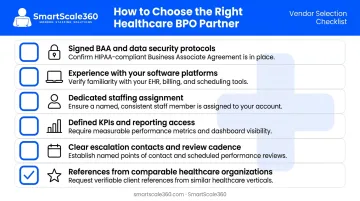
Once you've evaluated experience, staffing model, and contract terms, use a structured checklist to finalize your decision:
- Signed BAA and documented data security protocols
- Demonstrated experience with your specific software platforms
- Dedicated (not shared) staffing assignment
- Defined KPIs and reporting access
- Clear escalation contacts and performance review cadence
- References from comparable healthcare organizations
Frequently Asked Questions
What is a BPO in healthcare?
A healthcare BPO is an arrangement where a healthcare organization hires an external provider to manage non-clinical, administrative functions — such as billing, scheduling, data entry, and patient communication. Internal staff retain focus on care delivery while the BPO team handles the operational layer.
What are the main types of healthcare BPO services?
The two broad categories are front-office services (patient intake, scheduling, client communication) and back-office services (medical billing, coding, claims processing, payroll, EHR management). Home care agencies typically use both, given the dual demands of caregiver management and client-facing operations.
What tasks can home care agencies outsource to a BPO?
Home care agencies commonly outsource caregiver scheduling coordination, client intake, billing and payroll support, recruiting, HR and onboarding assistance, and documentation management.
Is healthcare BPO HIPAA compliant?
Reputable partners operate with documented HIPAA-aligned processes, signed Business Associate Agreements, data encryption, and documented breach notification protocols. Always verify these credentials and request a signed BAA before sharing any PHI with a third-party provider.
How much can healthcare providers save by outsourcing administrative tasks?
Savings vary by role and model. Outsourcing to dedicated offshore professionals — particularly from the Philippines — can reduce labor costs by up to 60% compared to equivalent U.S.-based hires, with additional savings from eliminated benefits, equipment, and office overhead.
What should I look for when choosing a healthcare BPO partner?
Look for these qualities before committing to a partner:
- Healthcare and home care-specific experience
- Dedicated (not shared) staffing model
- Signed BAA and documented HIPAA compliance processes
- Transparent, predictable pricing
- Flexible engagement terms with no long-term contracts or high setup fees